
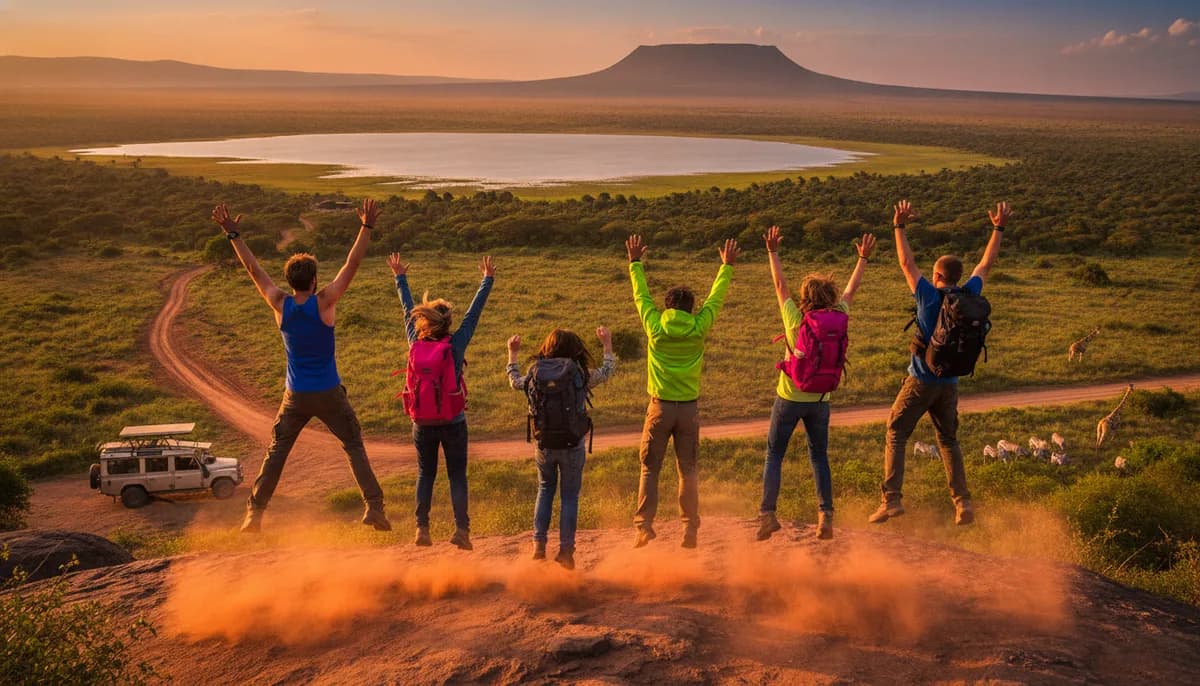
Self-Launched Upgraded Tanzania Safari: Arusha, Lake Manyara, Serengeti & Ngorongoro
7 days · Tanzania
G Adventures charges £2,450
No-markup version: ~£1,180 per person
Estimate only, not a guaranteed price. Always verify costs independently before booking.
A self-launched version of G Adventures' 7-day "Upgraded Tanzania Safari". You'll follow the same classic northern circuit — Arusha, Mto wa Mbu village, Lake Manyara, Olduvai Gorge, the Serengeti and the Ngorongoro Crater — but by joining a seat-in-vehicle (shared 4x4) camping/banda safari booked directly with an Arusha-based operator, adding the Maasai village and community project visits on the ground, and travelling on local shuttles and shared transfers instead of a private group tour. Costs below are rough backpacker-mid-range estimates in GBP per person and exclude international flights.
Day-by-day
Arrive in Arusha
Arusha
Land at Kilimanjaro International Airport (JRO) and take a pre-paid shared shuttle or the local 'Airport Express' style bus to Arusha town (≈£12–18; a private taxi is £30–40 — only worth it if you're arriving at night with no shared option). Check into a budget guesthouse in the Njiro or Kaloleni area and spend the afternoon acclimatising: walk to the Arusha Clock Tower and the Cultural Heritage Centre, sort out a local SIM with data (Vodafone or Tigo, ≈£4–6 for a good bundle), and confirm your safari paperwork with the operator. If you still need to book, Arusha has dozens of operators around Sokoine Road and the Clock Tower; seat-in-vehicle safaris are far cheaper than private ones. Sort cash for tips and park fees — Tanzanian shillings are best, and ATMs in town work.
🚌Shared airport shuttle JRO → Arusha ≈£12–18
🛏Budget guesthouse in Arusha town (private room, hot water, breakfast) — ≈£22/night
- →Airport shared transfer
- →Arusha town orientation walk
- →Cultural Heritage Centre
- →Local SIM and cash setup
Mto wa Mbu village walk & Lake Manyara safari
Mto wa Mbu / Karatu
Travel by local dalla-dala or shared minibus from Arusha to Mto wa Mbu (≈£3–4, about 2 hrs), the lively market town at the base of the Rift Valley escarpment. Join a self-bookable community-guided village walk (arrange on arrival at the Mto wa Mbu Cultural Tourism Programme office, ≈£15–20 for 2–3 hrs) — you'll tour the banana and rice farms, the market, the woodcarvers' and Tingatinga painters' workshops, and share a traditional local lunch with a family (≈£6). In the afternoon join a shared 4x4 game drive or self-arranged vehicle into Lake Manyara National Park for the day (park entry ≈£35 + vehicle fee, best booked as part of your safari package or via a local guide in Mto wa Mbu, ≈£60–75 combined). Look for tree-climbing lions, elephants, hippos at the lake shore, and huge flocks of flamingos if the water levels are right. Overnight in a budget safari camp or basic lodge on the escarpment above Karatu/Mto wa Mbu.
🚌Dalla-dala / shared minibus Arusha → Mto wa Mbu ≈£3–4; shared 4x4 for park drive
🛏Budget safari camp or country guesthouse near Mto wa Mbu/Karatu — ≈£28/night incl. breakfast
- →Mto wa Mbu community village walk
- →Local market and artisan workshop visits
- →Traditional lunch with a local family
- →Lake Manyara National Park game drive
Olduvai Gorge & into the Serengeti
Serengeti National Park
If you've joined a seat-in-vehicle safari, day 3 is the long transfer day from the Manyara/Karatu area up onto the Serengeti plains — expect 5–7 hours driving on rough roads, so bring snacks and water. Stop at the Olduvai Gorge Museum and Visitor's Centre (entry ≈£6–8, plus a short guided talk on the Leakey excavations — the palaeoanthropology here goes back nearly 2 million years). Continue into Serengeti National Park (entry ≈£60 per 24 hrs + vehicle fee) and take a late-afternoon game drive on the Serengeti Plain in golden light: giraffe, lion prides, big herds of antelope, and zebra. Overnight in a comfortable tented camp or public campsite inside or near the park (public campsites ≈£15–20 pp; a mid-range tented camp ≈£50–70 pp with dinner and breakfast).
🚌Seat-in-vehicle 4x4 shared with other travellers (covered in safari package); Olduvai entry ≈£7
🛏Tented camp or public campsite in/near Serengeti — ≈£45/night incl. dinner & breakfast
- →Olduvai Gorge Museum & Visitor Centre
- →Scenic drive across the Ngorongoro Conservation Area
- →Late-afternoon Serengeti game drive
Full day in the Serengeti
Serengeti National Park
Up early for a morning game drive — dawn is when predators are most active. Return to camp for brunch, then head out again in the afternoon. Buffalo, elephant, lion, leopard and rhino (the Big Five) are all possible; with luck you'll tick several off in a day. If you want the bucket-list extra, book a Serengeti hot-air balloon safari directly with a company such as Serengeti Balloon Safaris (≈£450–500 pp — expensive but includes a champagne breakfast, and far cheaper self-booked than as a tour add-on). Optionally visit the Serengeti Wildlife Research Centre near Seronera for a short talk or exhibition on the park's ecology and migrations. Back to camp for sunset and dinner.
🚌Shared 4x4 safari vehicle within the park
🛏Tented camp or public campsite in/near Serengeti — ≈£45/night incl. dinner & breakfast
- →Morning 4x4 game drive
- →Afternoon game drive
- →Optional Serengeti hot-air balloon safari (~£450–500)
- →Serengeti Wildlife Research Centre visit
Across the savanna to Ngorongoro
Ngorongoro Conservation Area
Depart the Serengeti early and drive across the plains to the Ngorongoro Conservation Area (entry ≈£50 per 24 hrs + vehicle fee, usually included in the safari package). Drop into the crater on a full-day game drive — Ngorongoro is the world's largest intact volcanic caldera, a 260 km² natural amphitheatre with around 25,000 large animals and one of the best places on earth to see black rhino, plus lion, elephant, hippo, flamingo and huge herds on the crater floor. Bring lunch and water; the descent road is steep and dusty. Stay overnight on the crater rim or just outside at Karatu. Public campsites on the rim ≈£15–25 pp; basic lodges in Karatu ≈£40–60 pp. Catch the sunset over the highlands from the rim before dinner.
🚌Shared 4x4 descent into the crater (covered in safari package)
🛏Basic lodge or campsite on the Ngorongoro rim / Karatu — ≈£45/night incl. dinner & breakfast
- →Full-day Ngorongoro Crater game drive
- →Crater rim sunset viewpoint
- →Scenic highlands drive
Maasai village & Monduli community project
Monduli District / Arusha
Drive out of the highlands toward Arusha, stopping in the Monduli District to visit a Maasai boma. Organise this through a community-run cultural tourism programme rather than an operator's markup — a local guide and village fee is typically £20–35 pp and goes directly to the community. You'll see how the village runs and can ask about ongoing fuel-efficient cookstove projects that reduce smoke and firewood use in Maasai households (the same kind of initiative G Adventures supports — genuinely interesting, and you can talk to the families doing the building). Bring small cash for crafts if you want to buy directly from the makers. Continue to Arusha and check back into a guesthouse (≈£22). Evening at leisure — try a local 'nyama choma' grill or an Indian-Tanzanian spot in town (≈£8–12).
🚌Shared vehicle back to Arusha (covered in safari package); local dalla-dala in town ≈£1–2
🛏Budget guesthouse in Arusha — ≈£22/night incl. breakfast
- →Maasai village visit with local guide
- →Clean cookstove project discussion
- →Local craft market browsing
- →Arusha town evening
Arusha & departure
Arusha
Slow morning — grab breakfast, do last-minute shopping at the Maasai Market or the Cultural Heritage Centre for crafts and coffee, and settle tips for your safari driver and cook (budget ≈£20–30 pp cash, which is a normal and expected part of safari life in Tanzania). Take the shared shuttle back to Kilimanjaro Airport (≈£12–18) or continue onward — Arusha is a good base for onward buses to Moshi and Kilimanjaro hikes, or a shuttle to Nairobi (≈£25–35, ~6 hrs).
🚌Shared shuttle Arusha → JRO ≈£12–18
🛏None (departure day)
- →Maasai Market / craft shopping
- →Safari tip settlement
- →Shared transfer to Kilimanjaro Airport
Self-launched vs. G Adventures
| This itinerary (self-launched) | G Adventures | |
|---|---|---|
| Price per person | ~£1,180 | £2,450 |
| Duration | 7 days | 7 days |
| Who books it | You and your group, direct | Tour operator, guided group |
| Savings | £1,270 per person (52%) | |
Estimate only, not a guaranteed price. Always verify costs independently before booking.
Want to see more G Adventures-style trips? Check them out here.~£1,180
estimated per person
You never pay Travel Crew for this — you pay hostels, transport, and activity providers directly, the same as if you'd booked it all yourself.
This publishes your dates so other travellers can find and join you — no tour operator needed.
Customise with Tour BusterCreated by
Travel Crew
0 trips
Frequently asked questions
How much does Self-Launched Upgraded Tanzania Safari: Arusha, Lake Manyara, Serengeti & Ngorongoro cost?+
Doing it yourself with this self-launched itinerary costs an estimated £1,180 per person for 7 days in Tanzania. This is an AI-generated estimate based on typical budget-traveller prices — actual costs will vary by season and how you book.
Is this cheaper than booking with G Adventures?+
Yes — G Adventures charges around £2,450 per person for a similar tour. Doing the same route independently, using the same standard of accommodation and activities, costs an estimated £1,180 — a saving of roughly £1,270 (52%) per person.
How long is the Tanzania trip?+
This itinerary runs 7 days, covering 7 day-by-day stops through Tanzania.
How do I join this trip?+
You can join an existing open departure using this itinerary if one is scheduled, or launch your own departure with your own dates and invite other travellers to join you — no tour operator required.
Isn't it easier to just use a tour operator?+
Well, yes, a tour operator will book all the individual parts of your travel for you and provide a guide. That's obvious, but doing this has the potential to save the group thousands, which can in turn improve your itinerary substantially or save you huge amounts of money. Also, when you launch a departure, Travel Crew has tools in place to help you book the individual sections of the trip or make it easier for you to do this as a group. Really, you do not need a middle man. If you are more comfortable paying more and using a middle man, then you should certainly do this.
Is it safer to book through a tour operator?+
Arguably, there isn't much difference. A self-launched trip runs on the same principle as a group travel crew: collective responsibility, everyone looking out for each other, the same way it would if a group of friends organised the trip themselves — because that's exactly what's happening. You should always take out travel insurance before you go, self-launched or not; that doesn't change either way. Every open departure is published publicly with real dates and a real trip organiser, so it's never an anonymous arrangement, and our support team is reachable any time you need help, including in an emergency while you're away. Longer-term, we're building direct relationships with ground DMCs in popular destinations, offered as an optional paid add-on for extra on-the-ground support. Ultimately, though, the group is responsible for its own conduct and safety on a self-launched trip, same as on any trip you plan yourself.
What kind of trip is this?+
This is a adventure, wildlife, culture trip through Tanzania, self-launched rather than run by a tour operator — you organise it with a group you find or bring yourself.
Would you like to name the operator, name the trip, or have any suggestions about how to improve this itinerary?
Drop your comment below — if you've done a similar route, tell us what worked, what you'd add, or what you'd skip.
No comments yet — be the first to share your take.
Sign in to leave a comment.