
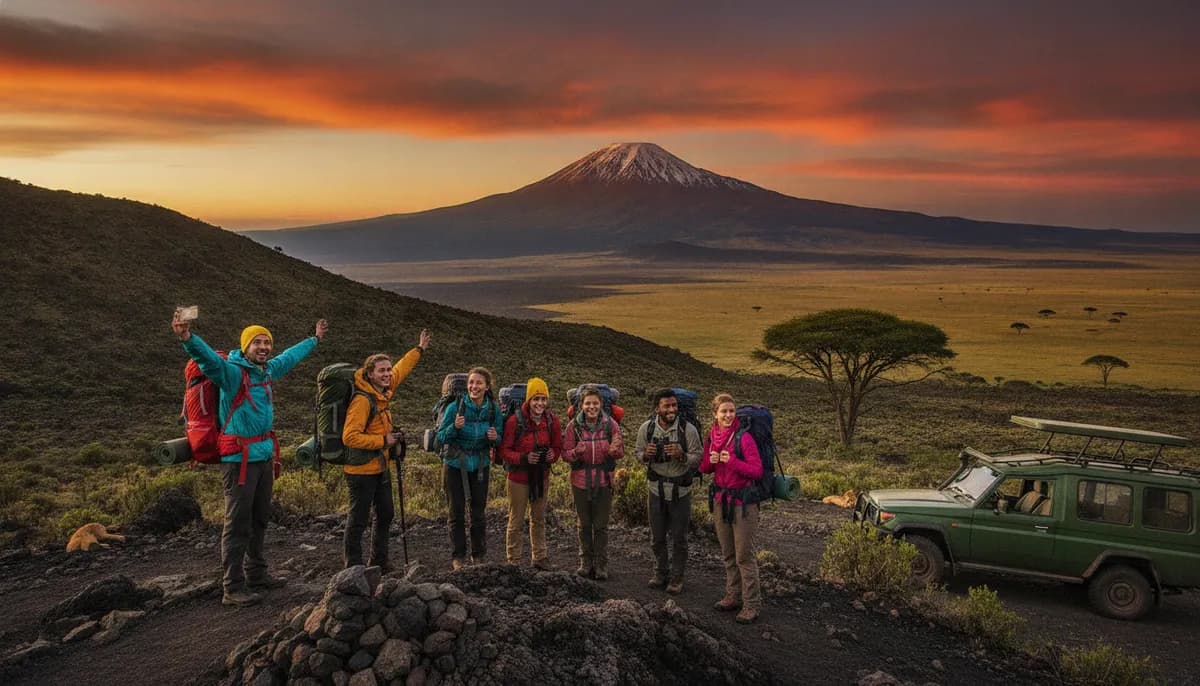
Self-Launched Mt Kilimanjaro Trek - Rongai Route
8 days · Tanzania
G Adventures charges £2,350
No-markup version: ~£1,425 per person
Estimate only, not a guaranteed price. Always verify costs independently before booking.
A self-launched, independently booked version of G Adventures' 8-day Rongai Route Kilimanjaro trek. You skip the group tour markup by booking directly with a licensed Moshi-based operator (or assembling permits, guide and crew yourself), staying in a budget guesthouse in Moshi either side of the climb, and using a shared shuttle from Kilimanjaro Airport. The route itself is identical: a quieter northern approach via Simba Camp, Kikelelwa, Mawenzi Tarn and Kibo, a midnight summit push to Uhuru Peak (5,895m) via Gilman's Point, and a descent through Horombo to Marangu. Costs are rough backpacker-level estimates in GBP and exclude international flights, gear hire, insurance and crew tips — but do include park fees, which are the single biggest expense. Book in the dry seasons (Jan–Feb, Jun–Oct) and allow 2–3 months' lead time in peak season.
Day-by-day
Arrive Kilimanjaro Airport (JRO) and settle into Moshi
Moshi
Fly into Kilimanjaro International Airport and take a pre-booked shared shuttle or local taxi the ~45 min to Moshi town (£15–20 shared, £30–35 private). Check into a budget guesthouse near the clock tower — plenty of clean doubles with hot water and wifi for £15–22/night. Spend the afternoon buying last-minute supplies: a 3L refillable water bottle (single-use plastic bottles are confiscated at the park gate), electrolyte tablets, sunscreen and snacks from a supermarket on Market Street. Meet your guide or operator contact in the evening to confirm gear hire (sleeping bag ~£30, down jacket ~£15, poles ~£10 for the trek) and hand over your 15kg duffel — anything over that gets weighed and refused at the gate.
🚌Shared shuttle or taxi from JRO to Moshi (~£15–20)
🛏Budget guesthouse in Moshi town (~£18/night, twin share)
- →Buy trek supplies and refillable water bottle
- →Gear hire fitting with your operator
- →Pre-trek briefing
Rongai Gate trailhead to Simba Camp (2,600m)
Simba Camp
An early transfer (~2.5 hrs) from Moshi to Rongai Gate on the Kenyan border side of the mountain, where park fees and permits are checked. Day one is a gentle 3–4 hour walk through pine forest and heath, quieter and drier than the southern routes, so you'll often have the trail almost to yourself. Camp is at Simba Camp with views over the Kenyan plains towards Amboseli. Your cook handles dinner; wash water is provided in basins by the crew. Sleep with your water bottle inside your bag so it doesn't freeze.
🚌Shared operator transfer Moshi–Rongai Gate (~2.5 hrs); 3–4 hrs trekking
🛏Alpine camping at Simba Camp (tent and mattress supplied by operator; bring sleeping bag)
- →Park gate registration and permit check
- →Rainforest and heath zone trek to Simba Camp
Simba Camp to Kikelelwa Camp (3,600m)
Kikelelwa Camp
A longer day, roughly 5–6 hours on the trail, climbing steadily out of the heath into moorland. On clear mornings you get superb views east onto the ice fields spilling off Kibo and across to Mawenzi. Go slowly — this is where the Rongai's gentle gradient pays off on acclimatisation. Lunch is a packed box from your cook, eaten at a rocky outcrop en route. Kikelelwa is a small, exposed camp tucked beneath the jagged Mawenzi ridgeline; expect frost overnight even in the dry season.
🚌5–6 hrs trekking on foot
🛏Alpine camping at Kikelelwa Camp
- →Moorland trek with views of Kibo's eastern ice fields
Kikelelwa to Mawenzi Tarn Camp (4,330m)
Mawenzi Tarn Camp
A short but steep 3–4 hour climb up grassy slopes into a high alpine bowl. Mawenzi Tarn is the only lake on the mountain and the most photogenic camp on the Rongai route, ringed by the volcanic spires of Mawenzi. Use the afternoon for an acclimatisation stroll up the ridge above camp before resting — this extra altitude exposure genuinely improves summit odds. Dinner is early and the tents are cold, so layer up.
🚌3–4 hrs trekking on foot
🛏Alpine camping at Mawenzi Tarn Camp
- →Steep ascent to Mawenzi Tarn
- →Optional 1-hr acclimatisation walk above camp
Mawenzi Tarn to Kibo Camp (4,750m) via the Saddle
Kibo Camp
A 4–5 hour walk across the lunar 'Saddle' — the barren alpine desert between the Mawenzi and Kibo peaks. High UV, dust and wind, so cover up and keep drinking (aim for 3L). Kibo Camp sits directly beneath the summit wall, and you'll aim for an early dinner and a few hours' sleep before the midnight alarm. Pack your summit bag tonight: headtorch, warm hat, gloves, goggles, insulated layer, 2L water and snacks.
🚌4–5 hrs trekking on foot
🛏Alpine camping at Kibo Camp (no water point — crew carry water up)
- →Traverse of the Saddle between Mawenzi and Kibo
- →Summit bag prep
Summit night: Uhuru Peak (5,895m), descend to Horombo Camp
Horombo Camp
The big one. Start at roughly midnight for a 6–8 hour zig-zag up frozen scree to Gilman's Point (5,681m) on the crater rim, timed for sunrise. From Gilman's it's another 1.5 hours around the crater edge to Uhuru Peak, Africa's highest point. Move polepole ('slowly'), watch for signs of altitude sickness, and be ready to turn around — your guide's call is final. Then it's a long 5–6 hour descent by the Marangu route to Horombo Camp (3,720m), where huts and a hot meal await. Expect to fall asleep before dark.
🚌6–8 hrs ascent, 5–6 hrs descent on foot
🛏Horombo Camp (tented or basic A-frame huts depending on operator)
- →Midnight summit push
- →Gilman's Point sunrise
- →Uhuru Peak (5,895m)
- →Descent via Marangu route
Horombo to Marangu Gate, back to Moshi
Moshi
A 5–6 hour descent through the heather and rainforest zones — warmer, birdlife everywhere, and a good chance of colobus monkeys. Collect your summit certificate at Marangu Gate, then take your operator's transport back to Moshi (~45 min). Hand over the crew tip envelope (budget £100–140 per person for a 6-day trek, split between guide, assistant guide, cook and porters — this is a huge portion of their income, so don't skip it). If you want the equivalent of the G-supported women's cooperative visit, a short tuk-tuk ride to the Moshi Women's Cooperative or a local café makes a lovely, direct-impact final afternoon. Treat yourself to a hot shower and a proper meal.
🚌5–6 hrs trekking down; operator transfer Marangu Gate to Moshi (~45 min)
🛏Budget guesthouse in Moshi town (~£18/night, twin share)
- →Summit certificate collection at Marangu Gate
- →Crew tip ceremony
- →Optional Moshi Women's Cooperative visit and spa massage
Depart Moshi
Moshi
Leisurely breakfast, laundry collection and any final souvenirs before heading back to Kilimanjaro Airport by shared shuttle or taxi. If you have time, the Materuni waterfall and coffee tour (bookable direct or via GetYourGuide, ~£35–45) makes a great half-day add-on before a late flight.
🚌Shared shuttle or taxi Moshi to JRO (~£15–20)
🛏None (checkout)
- →Optional Materuni waterfall and coffee tour
Self-launched vs. G Adventures
| This itinerary (self-launched) | G Adventures | |
|---|---|---|
| Price per person | ~£1,425 | £2,350 |
| Duration | 8 days | 8 days |
| Who books it | You and your group, direct | Tour operator, guided group |
| Savings | £925 per person (39%) | |
Estimate only, not a guaranteed price. Always verify costs independently before booking.
Want to see more G Adventures-style trips? Check them out here.~£1,425
estimated per person
You never pay Travel Crew for this — you pay hostels, transport, and activity providers directly, the same as if you'd booked it all yourself.
This publishes your dates so other travellers can find and join you — no tour operator needed.
Customise with Tour BusterCreated by

Travel Crew
0 trips
Frequently asked questions
How much does Self-Launched Mt Kilimanjaro Trek - Rongai Route cost?+
Doing it yourself with this self-launched itinerary costs an estimated £1,425 per person for 8 days in Tanzania. This is an AI-generated estimate based on typical budget-traveller prices — actual costs will vary by season and how you book.
Is this cheaper than booking with G Adventures?+
Yes — G Adventures charges around £2,350 per person for a similar tour. Doing the same route independently, using the same standard of accommodation and activities, costs an estimated £1,425 — a saving of roughly £925 (39%) per person.
How long is the Tanzania trip?+
This itinerary runs 8 days, covering 8 day-by-day stops through Tanzania.
How do I join this trip?+
You can join an existing open departure using this itinerary if one is scheduled, or launch your own departure with your own dates and invite other travellers to join you — no tour operator required.
Isn't it easier to just use a tour operator?+
Well, yes, a tour operator will book all the individual parts of your travel for you and provide a guide. That's obvious, but doing this has the potential to save the group thousands, which can in turn improve your itinerary substantially or save you huge amounts of money. Also, when you launch a departure, Travel Crew has tools in place to help you book the individual sections of the trip or make it easier for you to do this as a group. Really, you do not need a middle man. If you are more comfortable paying more and using a middle man, then you should certainly do this.
Is it safer to book through a tour operator?+
Arguably, there isn't much difference. A self-launched trip runs on the same principle as a group travel crew: collective responsibility, everyone looking out for each other, the same way it would if a group of friends organised the trip themselves — because that's exactly what's happening. You should always take out travel insurance before you go, self-launched or not; that doesn't change either way. Every open departure is published publicly with real dates and a real trip organiser, so it's never an anonymous arrangement, and our support team is reachable any time you need help, including in an emergency while you're away. Longer-term, we're building direct relationships with ground DMCs in popular destinations, offered as an optional paid add-on for extra on-the-ground support. Ultimately, though, the group is responsible for its own conduct and safety on a self-launched trip, same as on any trip you plan yourself.
What kind of trip is this?+
This is a adventure, hiking, backpacker trip through Tanzania, self-launched rather than run by a tour operator — you organise it with a group you find or bring yourself.
Would you like to name the operator, name the trip, or have any suggestions about how to improve this itinerary?
Drop your comment below — if you've done a similar route, tell us what worked, what you'd add, or what you'd skip.
No comments yet — be the first to share your take.
Sign in to leave a comment.