
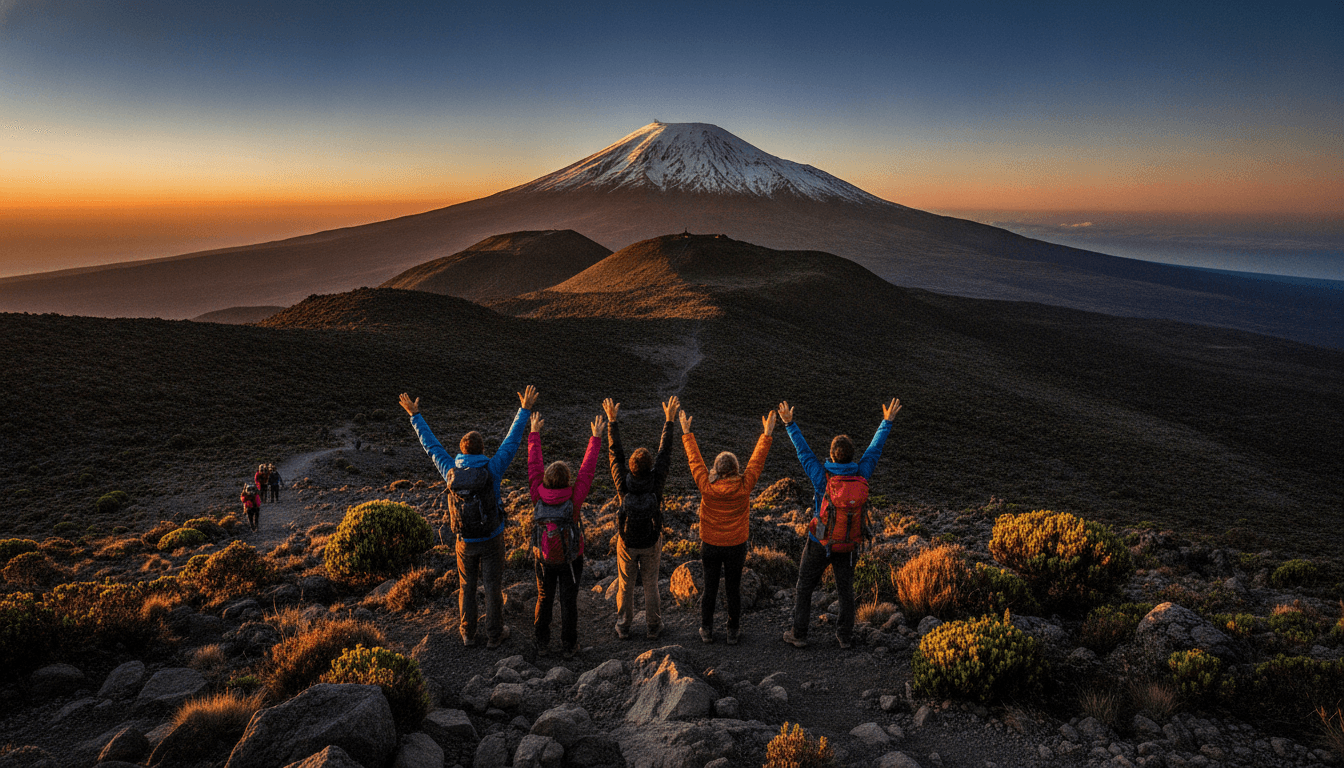
Kilimanjaro Lemosho Route & Zanzibar Beaches — Self-Launched
13 days · Tanzania
G Adventures charges £3,890
No-markup version: ~£1,900 per person
Estimate only, not a guaranteed price. Always verify costs independently before booking.
A self-launched version of G Adventures' 13-day Lemosho Route climb plus Zanzibar. You book a budget/operator Lemosho 8-day trek in Moshi directly (small-group or private, with guide, cook, porters, park fees and camping included — Kilimanjaro is one of the few treks where you genuinely cannot go entirely solo, as guides and licensed porters are mandatory), then fly or ferry yourself to Zanzibar for a Stone Town cafe crawl, a spice farm tour and a few slow days in Jambiani. Costs assume a mid-range budget trek operator, dorm/guesthouse stays off the mountain, local buses and dala-dalas, and self-booked activities. Prices are approximate GBP estimates for hostel/budget-traveller standards.
Day-by-day
Arrive Moshi — gear check & trek briefing
Moshi
Fly into Kilimanjaro International Airport (JRO) and take a shared shuttle or boda-taxi into Moshi town (~£6-8). Check into a budget guesthouse or hostel dorm. Spend the afternoon hiring any missing kit (down jacket ~£18, sleeping bag ~£30, poles ~£10 — renting is far cheaper than buying) and do a final kit weigh-in with your trek operator. Eat an early, carb-heavy dinner on the main strip. Get to bed early: the climb starts tomorrow.
🚌Shared airport shuttle or taxi from JRO to Moshi (~£7, 45 min)
🛏Budget guesthouse or hostel dorm in Moshi centre (~£12-16/night)
- →Gear hire and weigh-in
- →Trek briefing with guide
- →Moshi town wander
Lemosho Trailhead to Mti Mkubwa Camp (2,650m)
Moshi / Mti Mkubwa
The trek begins. A transfer vehicle takes you to Londorossi Gate (~2 hrs from Moshi) for permit formalities, then on to the Lemosho trailhead. Day one is a 3-4 hour walk through dense, humid rainforest with colobus monkeys around you — pace yourself and drink steadily. Your operator's cook handles all meals and the porters pitch camp. Expect afternoon rain; have your waterproofs accessible, not buried in the duffel.
🚌Operator transfer to Londorossi Gate and trailhead (~2 hrs); 3-4 hr trek
🛏Two-person alpine tent (operator-supplied), Mti Mkubwa Camp
- →Londorossi Gate permit formalities
- →Rainforest trek through the Lemosho trailhead
Mti Mkubwa to Shira 1 Camp (3,610m)
Shira 1 Camp
Today the forest opens into giant heather and moorland as you climb the Shira Ridge and drop onto the wide Shira Plateau. ~5-6 hours of walking. Walk 'pole pole' (slowly) and let the pace build. Shira 1 is a broad, airy camp with a clean view of Kibo ahead — a good spot to watch sunset on the summit you'll be standing on in five days.
🚌5-6 hr trek, ~8 km
🛏Two-person alpine tent, Shira 1 Camp
- →Shira Ridge ascent
- →Shira Plateau moorland walk
Shira 1 to Shira 2 Camp (3,850m) — acclimatisation
Shira 2 Camp
A short, gentle day across the Shira Plateau (~3-4 hours), deliberately easy to build acclimatisation. Use the extra hours for a side walk to the Shira Cathedral rock formation or simply rest, hydrate and sort your summit layers. Mornings here are cold; afternoons are sunny — an ideal day to dry kit after yesterday's damp rainforest day.
🚌3-4 hr trek, ~7 km
🛏Two-person alpine tent, Shira 2 Camp
- →Shira Plateau crossing
- →Acclimatisation side walk to Shira Cathedral
Shira 2 to Barranco Camp (3,950m) via Lava Tower (4,600m)
Lava Tower / Barranco Camp
The hardest and most important day before the summit: climb to Lava Tower at 4,600m, then descend 650m into the Great Barranco Valley to sleep — 'climb high, sleep low'. This is where headaches and breathlessness often first appear, so go slowly and tell your guide immediately if anything feels wrong. The descent into Barranco gives you a dramatic view of the Barranco Wall you'll scale tomorrow and the Western Breach behind it.
🚌6-7 hr trek, ~10 km
🛏Two-person alpine tent, Barranco Camp
- →Lava Tower acclimatisation climb
- →Descent into the Great Barranco Valley
Barranco Wall scramble to Karanga Camp (3,995m)
Karanga Camp
A fun, hands-on start: the Great Barranco Wall is a steep scramble rather than a technical climb, and porters trot past you with loads balanced on their heads. ~4-5 hours, ending in the alpine desert of the Karanga Valley. Short day, big altitude gain — rest properly in the afternoon.
🚌4-5 hr trek, ~5 km
🛏Two-person alpine tent, Karanga Camp
- →Great Barranco Wall scramble
- →Karanga Valley trek
Karanga to Barafu Camp (4,673m) — summit prep
Barafu Camp
A short but exposed trek through alpine desert to Barafu ('ice') Camp — a narrow ridge with wind, no shelter and a fantastic view of Kibo and Mawenzi. Arrive early, eat a big early dinner, lay out your summit layers in exact order and try to sleep by 7pm. You're climbing at midnight.
🚌3-4 hr trek, ~4 km
🛏Two-person alpine tent, Barafu Camp
- →Barafu Camp arrival and route briefing
- →Summit kit preparation
Summit day — Uhuru Peak (5,895m) and descent to Mweka Camp
Uhuru Peak / Mweka Camp
Midnight start. You climb northwest scree in the dark for 6-7 hours, 'pole pole', past the Rebmann and Ratzel glaciers to Stella Point on the crater rim — then a further hour along the rim to Uhuru Peak, Africa's highest point, usually for sunrise. Photos, then a long, dusty 5-6 hour descent to Mweka Camp (3,100m). This is the day that earns the beach at the end.
🚌10-14 hr trekking, ~15 km up and down
🛏Two-person alpine tent, Mweka Camp
- →Midnight summit ascent to Stella Point
- →Uhuru Peak summit
- →Descent to Mweka Camp
Mweka Gate, certificates and back to Moshi
Moshi
A short 3-4 hour descent through forest to Mweka Gate, where you sign out and collect your summit certificate at the park office. Tipping is expected on Kilimanjaro and is a major part of local crew income — budget roughly £60-90 per climber split across guide, assistant guide, cook and porters (many operators publish a suggested breakdown; check your operator's guidance and budget it from day one). Back in Moshi by afternoon: shower, then eat. Many budget trek operators will drop you at your guesthouse for the night. If you'd like the culture stop the group tour includes, ask any Moshi trek operator or guesthouse to arrange a visit to a women's cooperative sewing/coffee project — these are small, free or donation-based visits.
🚌3-4 hr descent to Mweka Gate plus operator transfer to Moshi
🛏Budget guesthouse or hostel dorm in Moshi (~£12-16/night)
- →Mweka Gate sign-out and summit certificate
- →Crew tipping ceremony
- →Moshi guesthouse evening
Moshi to Arusha — market day
Arusha
Take a local bus or shared shuttle from Moshi to Arusha (~2 hrs, roughly £2-3 on the bus, £6-8 on a shuttle). Check into a budget hotel near the centre and spend the afternoon at the Arusha Central Market for fresh produce, spices and fabric, or the Maasai Market for crafts. Sort your onward Zanzibar flight or ferry booking tonight.
🚌Local bus Moshi-Arusha (~£3, 2 hrs)
🛏Budget hotel or hostel in Arusha (~£14-20/night)
- →Arusha Central Market
- →Maasai Market browsing
- →Trip admin and laundry
Fly to Zanzibar — Stone Town to Jambiani
Stone Town / Jambiani
Morning domestic flight from Arusha (ARK) or Kilimanjaro (JRO) to Zanzibar (ZNZ), roughly 1-1.5 hrs; budget operators run these for around £70-110 one way booked in advance. Alternatively the slower, much cheaper route is a bus to Dar es Salaam plus the ferry from Kigamboni to Stone Town (~£22 total, a full day). Arrive Zanzibar: drop bags, do a self-guided walk of Stone Town's alleys (Forodhani Gardens, the Old Fort, the Anglican Cathedral built on the former slave market) and eat at a Forodhani night market stall. Then take a dala-dala south to Jambiani (~1 hr, ~£1).
🚌Domestic flight Arusha/Kilimanjaro to Zanzibar (~£85) plus dala-dala to Jambiani (~£1)
🛏Beach guesthouse or hostel in Jambiani (~£16-25/night)
- →Self-guided Stone Town walk
- →Forodhani Gardens night market
- →Dala-dala ride to the east coast
Spice farm tour, Jozani Forest & the beach
Jambiani
Book a spice farm tour locally or via GetYourGuide (~£20-30 including transport) — a couple of hours sniffing and tasting vanilla, cinnamon, cardamom and cloves, with the slave-trade history of the clove plantations covered honestly by most guides. In the afternoon, either join a shared snorkelling trip out of Jambiani (~£30-40, self-book on the beach or via your guesthouse) or take a local bus/taxi to Jozani Forest for the endemic Zanzibar red colobus monkeys (~£25-35 including entry and guide). Sunset back on the sand.
🚌Shared minibus or boda-boda to spice farm and Jozani (~£6)
🛏Beach guesthouse or hostel in Jambiani (~£16-25/night)
- →Spice farm tour
- →Jozani Forest red colobus walk OR Jambiani reef snorkelling
- →Beach swimming
Beach morning and Stone Town departure
Jambiani / Stone Town
A slow last morning: swim, breakfast on the sand, pack. Take a dala-dala or shared taxi back to Stone Town (~£1-8 depending on comfort level), pick up last-minute coffee and spices at Darajani Market, then continue to Zanzibar airport (10 mins from Stone Town). If you're not flying straight out, Stone Town has good-value guesthouses for a final night. Book onward flights for after 14:30 to be safe — the group tour uses the same rule.
🚌Dala-dala or shared taxi Jambiani to Stone Town (~£2-8), then taxi to ZNZ airport (~£4)
🛏None (departure day)
- →Final beach morning
- →Darajani Market spice and coffee shopping
Self-launched vs. G Adventures
| This itinerary (self-launched) | G Adventures | |
|---|---|---|
| Price per person | ~£1,900 | £3,890 |
| Duration | 13 days | 13 days |
| Who books it | You and your group, direct | Tour operator, guided group |
| Savings | £1,990 per person (51%) | |
Estimate only, not a guaranteed price. Always verify costs independently before booking.
Want to see more G Adventures-style trips? Check them out here.~£1,900
estimated per person
You never pay Travel Crew for this — you pay hostels, transport, and activity providers directly, the same as if you'd booked it all yourself.
This publishes your dates so other travellers can find and join you — no tour operator needed.
Customise with Tour BusterCreated by

Travel Crew
0 trips
Frequently asked questions
How much does Kilimanjaro Lemosho Route & Zanzibar Beaches — Self-Launched cost?+
Doing it yourself with this self-launched itinerary costs an estimated £1,900 per person for 13 days in Tanzania. This is an AI-generated estimate based on typical budget-traveller prices — actual costs will vary by season and how you book.
Is this cheaper than booking with G Adventures?+
Yes — G Adventures charges around £3,890 per person for a similar tour. Doing the same route independently, using the same standard of accommodation and activities, costs an estimated £1,900 — a saving of roughly £1,990 (51%) per person.
How long is the Tanzania trip?+
This itinerary runs 13 days, covering 13 day-by-day stops through Tanzania.
How do I join this trip?+
You can join an existing open departure using this itinerary if one is scheduled, or launch your own departure with your own dates and invite other travellers to join you — no tour operator required.
Isn't it easier to just use a tour operator?+
Well, yes, a tour operator will book all the individual parts of your travel for you and provide a guide. That's obvious, but doing this has the potential to save the group thousands, which can in turn improve your itinerary substantially or save you huge amounts of money. Also, when you launch a departure, Travel Crew has tools in place to help you book the individual sections of the trip or make it easier for you to do this as a group. Really, you do not need a middle man. If you are more comfortable paying more and using a middle man, then you should certainly do this.
Is it safer to book through a tour operator?+
Arguably, there isn't much difference. A self-launched trip runs on the same principle as a group travel crew: collective responsibility, everyone looking out for each other, the same way it would if a group of friends organised the trip themselves — because that's exactly what's happening. You should always take out travel insurance before you go, self-launched or not; that doesn't change either way. Every open departure is published publicly with real dates and a real trip organiser, so it's never an anonymous arrangement, and our support team is reachable any time you need help, including in an emergency while you're away. Longer-term, we're building direct relationships with ground DMCs in popular destinations, offered as an optional paid add-on for extra on-the-ground support. Ultimately, though, the group is responsible for its own conduct and safety on a self-launched trip, same as on any trip you plan yourself.
What kind of trip is this?+
This is a adventure, hiking, budget trip through Tanzania, self-launched rather than run by a tour operator — you organise it with a group you find or bring yourself.
Would you like to name the operator, name the trip, or have any suggestions about how to improve this itinerary?
Drop your comment below — if you've done a similar route, tell us what worked, what you'd add, or what you'd skip.
No comments yet — be the first to share your take.
Sign in to leave a comment.