
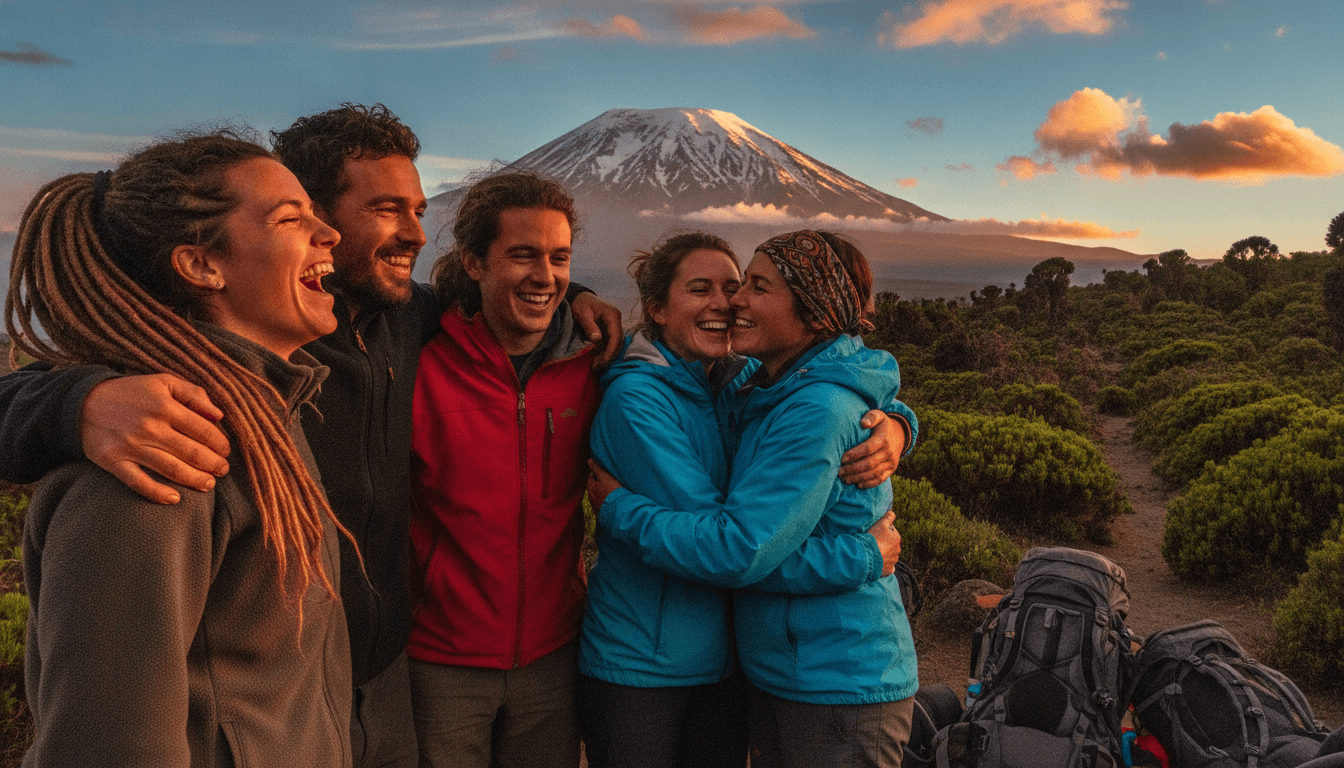
Climb Mount Kilimanjaro via the Lemosho Route in 10 Days (Self-Launched)
10 days · Tanzania
Much Better Adventures charges £2,950
No-markup version: ~£1,435 per person
Estimate only, not a guaranteed price. Always verify costs independently before booking.
A self-launched version of the classic 10-day Lemosho Route Kilimanjaro climb. You book directly with a licensed local Tanzanian operator (or arrange your own porters/guide) and organise your own transfers, lodging in Moshi and pre-trek night. The route itself — 8 days on the mountain, camping the whole way, ending with a midnight summit push to Uhuru Peak (5895m) — is identical, because Kilimanjaro National Park rules require a registered guide and porters for all trekkers. The savings come from booking direct with a local operator, choosing a budget guesthouse in Moshi instead of a lodge, and handling your own arrival logistics. All costs are approximate.
Day-by-day
Arrive Kilimanjaro (JRO) — transfer to Moshi
Moshi
Land at Kilimanjaro International Airport (JRO). Pre-book a shared shuttle or private transfer to Moshi (about 45 min, £15-25 one way, or £8-12 pp shared). Check into a budget guesthouse in Moshi town — there are dozens of clean, friendly places around £15-25 per night (e.g. the Kilimanjaro backpacker hostels clustered off Market Street). In the late afternoon meet your local trekking operator for a briefing and equipment check. You can rent missing gear (sleeping bag, down jacket, trekking poles, gaiters) locally for roughly £40-70 for the whole trip. Have an early dinner in town.
🚌Shared shuttle or private transfer from JRO to Moshi (~£10-25)
🛏Budget guesthouse/hostel in Moshi, twin or dorm (~£15-25 per night)
- →Airport transfer to Moshi
- →Trek briefing and gear check
- →Gear rental in town
- →Dinner in Moshi
Drive to Lemosho Gate, trek to Big Tree Camp (2780m)
Lemosho Gate / Big Tree Camp
Morning drive through mountainside villages to the Lemosho Gate (2-3 hrs). Your operator handles park formalities and permits. Begin hiking through pine and lush rainforest — the trail can be muddy and slick, so have gaiters and poles ready. Watch for buffalo, elephants and colobus monkeys. Reach Big Tree Camp (2780m) for your first night on the mountain: ~3-4 hrs, 4.8km, 400m ascent. Porters set up camp and cook dinner.
🚌Operator 4x4 transfer to trailhead (included in trek package)
🛏Mountain campsite, twin tent
- →Scenic drive to Lemosho Gate
- →Rainforest trekking
- →Wildlife spotting
- →First night camping on the mountain
Onto the Shira Plateau to Shira Camp (3500m)
Shira Camp
Leave the rainforest and climb onto the Shira Plateau, a rugged moorland environment above 3000m. Good chances of spotting birds of prey and other wildlife. About 4-6 hrs hiking, 7.9km, 720m ascent. Reach camp mid-afternoon, rest, and hope for an epic sunset over the plateau.
🚌On foot
🛏Mountain campsite, twin tent
- →Moorland trekking
- →Shira Plateau crossing
- →Wildlife and raptor spotting
Cross the plateau to Shira II camp (3900m)
Shira II Camp
A gentler day continuing east across the Shira Plateau to Camp II — 5-7 hrs, 6.9km, 675m ascent. The slow pace is deliberate acclimatisation. After settling in, take a short afternoon acclimatisation walk toward Moir Hut, then return to camp for dinner.
🚌On foot
🛏Mountain campsite, twin tent
- →Shira Plateau traverse
- →Afternoon acclimatisation walk to Moir Hut
Lava Tower (4640m) then descend to Barranco Camp (3950m)
Lava Tower / Barranco Camp
The big acclimatisation day. Traverse the western slopes of Kibo to where the Lemosho Route merges with the busier Machame Route, then climb to the Lava Tower (4640m), a volcanic outcrop formed ~150,000 years ago. Lunch at its base, then descend through moorland dotted with Giant Senecio trees to Barranco Camp — 4-6 hrs, 10.1km, 470m up and 690m down. Climb high, sleep low.
🚌On foot
🛏Mountain campsite, twin tent
- →Trek to Lava Tower
- →High-altitude acclimatisation
- →Giant Senecio moorland descent
Barranco Wall to Karanga Camp (4035m)
Barranco Wall / Karanga Camp
After breakfast, follow a steep ridge to the base of the Barranco Wall — a 257m scramble that looks harder than it is. Slow, deliberate steps get you up. From the top, views over the Heim Glacier if clouds allow, then wind up and down the Karanga Valley to Karanga Camp — 4-5 hrs, 5.2km, 385m up, 300m down. Critical altitude adjustment for the summit push.
🚌On foot
🛏Mountain campsite, twin tent
- →Scramble the Barranco Wall
- →Heim Glacier viewpoint
- →Karanga Valley trek
Karanga Camp to Barafu Camp (4673m)
Barafu Camp
A short but steep climb through thinning air to Barafu Camp — your final stop before the summit. 2-3 hrs, 3.3km, 640m ascent. 'Barafu' means 'ice' in Swahili; the camp sits on a rocky, exposed ridge. Early dinner, prep your summit kit, and grab some sleep before the midnight wake-up.
🚌On foot
🛏Mountain campsite, twin tent
- →High-altitude trekking
- →Summit-prep and rest at Barafu
Summit day — Uhuru Peak (5895m) and descent to Millennium Camp (3800m)
Uhuru Peak / Millennium Camp
The toughest stretch, starting in the middle of the night. Head torches on, climb through rocky scree to Stella Point (5756m) on the crater rim, then push on to Uhuru Peak (5895m) — the highest point in Africa. Take your photos, then begin the long descent over dusty volcanic terrain back to moorland and Millennium Camp (3800m). 11-13 hrs, 13.4km, 1255m up, 2105m down. Pace it 'pole pole'.
🚌On foot
🛏Mountain campsite, twin tent
- →Midnight summit push
- →Stella Point (5756m)
- →Uhuru Peak summit (5895m)
- →Long descent to Millennium Camp
Descend to Mweka Gate and return to Moshi
Mweka Gate / Moshi
Carry on down through the forest to Mweka Gate — 6-7 hrs, 12.1km, 2160m descent. Watch for black-and-white colobus monkeys among the trees. It gets warmer and muddier lower down, so keep gaiters and poles handy. Collect your summit certificate at the gate, then drive back to Moshi for a hot shower and celebration. Tip your porters and crew (customary and significant in Tanzania — budget ~£100-180/$130-220 depending on crew size and service).
🚌On foot to Mweka Gate, then operator transfer to Moshi
🛏Budget guesthouse/hostel in Moshi, twin or dorm (~£15-25 per night)
- →Descent to Mweka Gate
- →Colobus monkey spotting
- →Collect summit certificate
- →Crew tipping ceremony
Breakfast and onward travel
Moshi
Relaxed breakfast, then head to Kilimanjaro Airport (about 1 hr) or continue your Tanzania adventure — safaris in the Serengeti/Ngorongoro or a few days in Zanzibar are the classic add-ons. Pre-book your airport transfer.
🚌Shared shuttle or private transfer from Moshi to JRO (~£8-25)
🛏None (checkout)
- →Breakfast in Moshi
- →Airport transfer or onward travel planning
Self-launched vs. Much Better Adventures
| This itinerary (self-launched) | Much Better Adventures | |
|---|---|---|
| Price per person | ~£1,435 | £2,950 |
| Duration | 10 days | 10 days |
| Who books it | You and your group, direct | Tour operator, guided group |
| Savings | £1,515 per person (51%) | |
Estimate only, not a guaranteed price. Always verify costs independently before booking.
Want to see more Much Better Adventures-style trips? Check them out here.~£1,435
estimated per person
You never pay Travel Crew for this — you pay hostels, transport, and activity providers directly, the same as if you'd booked it all yourself.
This publishes your dates so other travellers can find and join you — no tour operator needed.
Customise with Tour BusterCreated by

Travel Crew
0 trips
Frequently asked questions
How much does Climb Mount Kilimanjaro via the Lemosho Route in 10 Days (Self-Launched) cost?+
Doing it yourself with this self-launched itinerary costs an estimated £1,435 per person for 10 days in Tanzania. This is an AI-generated estimate based on typical budget-traveller prices — actual costs will vary by season and how you book.
Is this cheaper than booking with Much Better Adventures?+
Yes — Much Better Adventures charges around £2,950 per person for a similar tour. Doing the same route independently, using the same standard of accommodation and activities, costs an estimated £1,435 — a saving of roughly £1,515 (51%) per person.
How long is the Tanzania trip?+
This itinerary runs 10 days, covering 10 day-by-day stops through Tanzania.
How do I join this trip?+
You can join an existing open departure using this itinerary if one is scheduled, or launch your own departure with your own dates and invite other travellers to join you — no tour operator required.
Isn't it easier to just use a tour operator?+
Well, yes, a tour operator will book all the individual parts of your travel for you and provide a guide. That's obvious, but doing this has the potential to save the group thousands, which can in turn improve your itinerary substantially or save you huge amounts of money. Also, when you launch a departure, Travel Crew has tools in place to help you book the individual sections of the trip or make it easier for you to do this as a group. Really, you do not need a middle man. If you are more comfortable paying more and using a middle man, then you should certainly do this.
Is it safer to book through a tour operator?+
Arguably, there isn't much difference. A self-launched trip runs on the same principle as a group travel crew: collective responsibility, everyone looking out for each other, the same way it would if a group of friends organised the trip themselves — because that's exactly what's happening. You should always take out travel insurance before you go, self-launched or not; that doesn't change either way. Every open departure is published publicly with real dates and a real trip organiser, so it's never an anonymous arrangement, and our support team is reachable any time you need help, including in an emergency while you're away. Longer-term, we're building direct relationships with ground DMCs in popular destinations, offered as an optional paid add-on for extra on-the-ground support. Ultimately, though, the group is responsible for its own conduct and safety on a self-launched trip, same as on any trip you plan yourself.
What kind of trip is this?+
This is a adventure, hiking, gap-year trip through Tanzania, self-launched rather than run by a tour operator — you organise it with a group you find or bring yourself.
Would you like to name the operator, name the trip, or have any suggestions about how to improve this itinerary?
Drop your comment below — if you've done a similar route, tell us what worked, what you'd add, or what you'd skip.
No comments yet — be the first to share your take.
Sign in to leave a comment.