
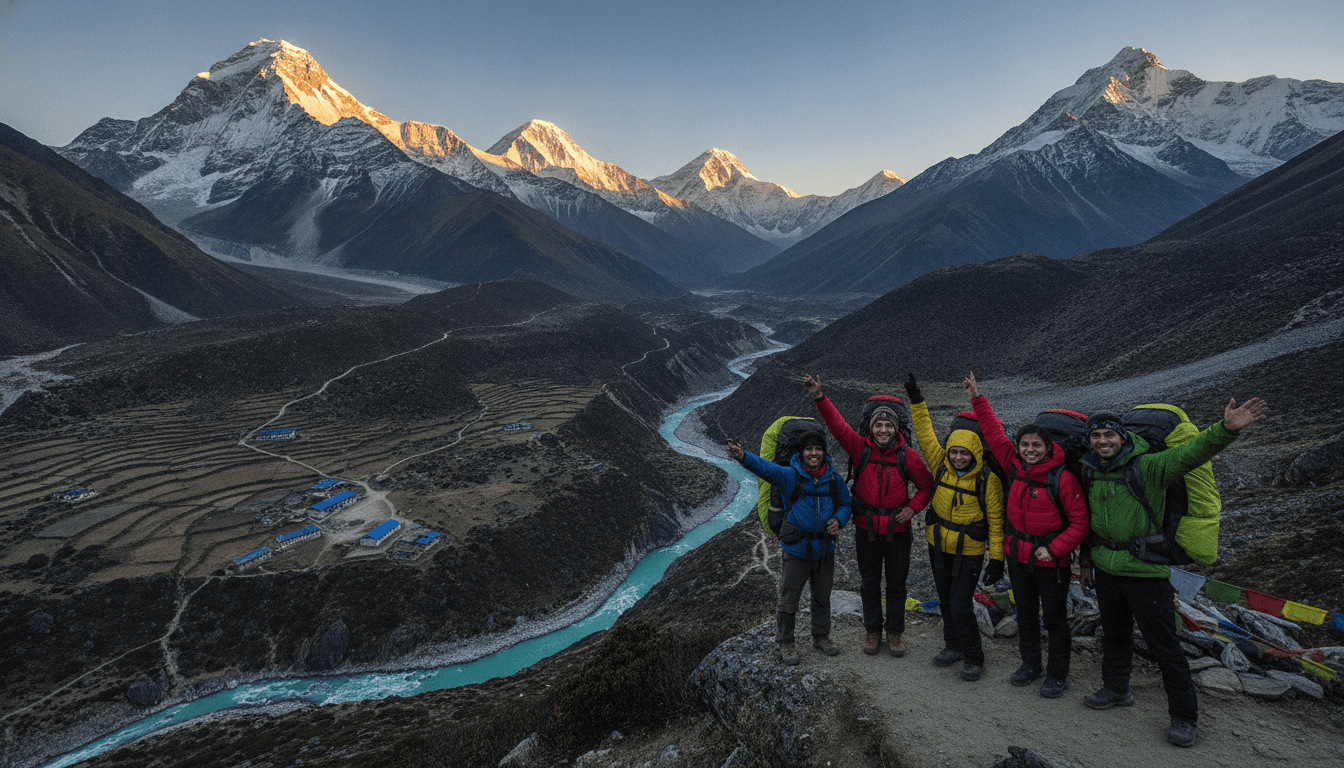
Treasures of Nepal — Self-Launched Edition
10 days · Nepal
G Adventures charges £2,100
No-markup version: ~£695 per person
Estimate only, not a guaranteed price. Always verify costs independently before booking.
A do-it-yourself version of the classic Kathmandu–Pharping–Kurintar–Chitwan–Pokhara loop: same temples, monastery night, jungle safari and Himalayan sunrise, booked independently with local guides, tourist buses and budget guesthouses. No trekking required — this is culture, wildlife and mountain views at backpacker prices. All costs are approximate per person and assume shared/dorm or simple private rooms and eating local.
Day-by-day
Arrive Kathmandu — Thamel base camp
Kathmandu
Land at Tribhuvan International Airport and take a prepaid airport taxi to Thamel (roughly NPR 800–1,000 / £5–6; ignore the aggressive touts in arrivals and use the official prepaid counter). Check into a guesthouse or hostel in Thamel or the quieter Patan-side of town. Spend the afternoon easing in: wander Durbar Marg, sort a Nepali SIM (Ncell or NTC, ~£3–5 with data), draw cash from an ATM (Visa/Mastercard work in Thamel), and buy your TIMS/entry tickets later — no permits needed for this route. Evening: momo dinner and a rooftop beer.
🚌Prepaid airport taxi ~£5–6 (20–30 min)
🛏Thamel guesthouse or hostel (private twin or dorm)
- →Thamel orientation walk
- →Nepali SIM card and cash run
- →Momo dinner
Boudhanath, Bhaktapur and the Sisterhood of Survivors
Kathmandu
Book a shared or small-group day tour through GetYourGuide/Klook (roughly £25–35) or haggle a private driver for the day (~£35–45, split between two). Start at Boudhanath Stupa for the morning kora (clockwise circuit) with the monks and pigeons, then push on to Bhaktapur Durbar Square — the best-preserved old royal city, entry NPR 1,800 (~£11). Lunch at the Sisterhood of Survivors' restaurant in Kathmandu, run by survivors of trafficking and trained as guides and cooks — book directly by phone or drop in; a thali lunch is ~£4–6 and directly supports the project. Optional: Pashupatinath ghats and Swayambhunath (Monkey Temple) if you have energy left.
🚌Shared day tour or hired car with driver
🛏Thamel guesthouse or hostel
- →Boudhanath Stupa kora
- →Bhaktapur Durbar Square (entry ~£11)
- →Lunch at Sisterhood of Survivors
- →Optional Pashupatinath / Swayambhunath
Patan, Pharping and a night in a monastery
Pharping
Optional early Everest experience flight from Kathmandu's domestic airport (~£150–180 for a one-hour mountain flight — book via Yeti or Buddha Air; skip if the budget is tight). Mid-morning, explore Patan Durbar Square (entry NPR 1,000 / ~£6) and the excellent Patan Museum. Then take a local bus or taxi 45 minutes south to Pharping (~£3 bus, £8 taxi) and check into the Neydo Monastery guesthouse or a nearby Buddhist monastery guesthouse — simple rooms, dinner with the monks and the option to join the morning puja. Nearby: Dakshinkali Temple and the Padmasambhava cave, walkable or reachable by local bus. Book the monastery stay directly by email or phone in advance.
🚌Local bus or taxi Kathmandu–Pharping ~£3–8
🛏Monastery guesthouse, Pharping (simple twin, shared bathrooms)
- →Patan Durbar Square and Patan Museum
- →Neydo Monastery overnight and evening chanting
- →Optional Everest mountain flight
- →Optional Dakshinkali Temple and Padmasambhava cave
Pharping to Kurintar — riverside lodge
Kurintar
Morning monastery puja if you're up for it, then head down to the Prithvi Highway. Take a local bus or shared jeep from Pharping back through Kathmandu's ring road and west to Kurintar (~3–4 hours total, ~£5–7), where river lodges sit on the banks of the Trishuli. Check into a simple riverside lodge (many are ~£12–18/night for a twin). Afternoon option: whitewater rafting on the Trishuli — half-day trips can be arranged at the lodge or via Klook for roughly £20–25, or just do the free nature walk and a Tharu/Tamang village visit.
🚌Local bus Pharping–Kurintar ~£5–7
🛏Riverside lodge, Kurintar
- →Monastery morning puja
- →Trishuli River rafting (optional, ~£22)
- →Riverside nature walk and village visit
Kurintar to Chitwan National Park
Sauraha, Chitwan
Bus or shared jeep from Kurintar to Sauraha (Chitwan's main backpacker village) — about 3 hours on the Prithvi and Narayanghat–Mugling road, ~£5–8. Check into a guesthouse in Sauraha (a good private twin is £10–16; dorms cheaper). Chitwan National Park entry is NPR 2,000 (~£12) for foreigners, valid for the length of your stay, plus a small buffer-zone fee. Afternoon: Tharu village walk with a local guide (~£8) and the sunset over the Rapti River. Evening Tharu cultural stick-dance show at the community hall (~£2–3) — skip the resort version and go local.
🚌Local bus/jeep Kurintar–Sauraha ~£5–8
🛏Sauraha guesthouse
- →Chitwan park entry (~£12)
- →Tharu village walking tour
- →Tharu cultural dance show
- →Rapti River sunset
Chitwan: canoe, jungle walk and jeep safari
Sauraha, Chitwan
Full wildlife day. Start with a dugout canoe trip down the Rapti at dawn (book at your guesthouse, ~£6–8) — watch for gharial and mugger crocodiles and river birds. Then a guided jungle walk (~£12–15 with a licensed guide; never walk solo, it's genuinely dangerous). Afternoon: shared jeep safari into the park (~£25–30 per person), the best shot at one-horned rhino, sloth bear, monkeys and — if you're very lucky — a Bengal tiger or leopard. Combine the canoe plus walk plus jeep as a package at your guesthouse for a discount (~£40 all-in). Eat dal bhat at a local Sauraha kitchen for £3–4.
🚌On foot, canoe and park jeep
🛏Sauraha guesthouse
- →Dawn dugout canoe on the Rapti
- →Guided jungle walk with licensed guide
- →Jeep safari in Chitwan National Park
- →Birdwatching
Chitwan to Pokhara
Pokhara
Tourist bus from Sauraha to Pokhara — 5–6 hours via Mugling, around £7–10 (book a seat the night before at any Sauraha travel agent). Arrive into Pokhara's Lakeside and check into a guesthouse or hostel (£10–16 private twin). Afternoon: stroll the Lakeside promenade, watch the fishtail of Machhapuchhre appear over the lake, and sort your Sarangkot sunrise transport for tomorrow. Optional: hire a scooter (~£6–8/day) or cycle Pokhara's old bazaar.
🚌Tourist bus Sauraha–Pokhara ~£7–10
🛏Lakeside guesthouse or hostel, Pokhara
- →Lakeside promenade walk
- →Machhapuchhre viewpoint
- →Scooter or bicycle hire
Sarangkot sunrise, Phewa Lake and the World Peace Pagoda
Pokhara
Pre-dawn taxi up to Sarangkot (share one, ~£6–8 return, or ~£3 on a shared jeep) for sunrise over the Annapurna range — free, no ticket, just bring a jacket. Walk or ride back down. Mid-morning: rent a rowing boat on Phewa Lake (~£4–6/hour) and cross to the trailhead for the World Peace Pagoda hike (1–1.5 hours up, free). Afternoon options: paragliding from Sarangkot — book direct or via GetYourGuide for ~£55–70 — or the International Mountain Museum (~£4). Sunset at Phewa with the Annapurnas reflected in the water.
🚌Shared taxi/jeep to Sarangkot, hired boat
🛏Lakeside guesthouse or hostel, Pokhara
- →Sarangkot sunrise
- →Phewa Lake boating
- →World Peace Pagoda hike
- →Optional paragliding (~£60)
- →International Mountain Museum
Fly Pokhara to Kathmandu
Kathmandu
Morning flight Pokhara–Kathmandu, roughly 25 minutes and £60–85 one-way (Yeti, Buddha Air or Shree Airlines — book early for the cheapest fare; the alternative is a 7–8 hour tourist bus for ~£10 if you want to save money and watch the hills roll by). Back in Kathmandu: last-minute souvenir run in Thamel or Asan Tole, a Boudhanath revisit at dusk, and a final farewell dinner. Optional: the Garden of Dreams for a quiet coffee.
🚌Domestic flight Pokhara–Kathmandu ~£60–85 (or tourist bus ~£10)
🛏Thamel guesthouse or hostel
- →Domestic mountain flight
- →Asan Tole market wander
- →Boudhanath at dusk
- →Farewell dinner
Depart Kathmandu
Kathmandu
Check out and take a metered/prepaid taxi back to Tribhuvan International Airport (~£5–6, allow 45–60 minutes in traffic). If you have a late flight, haggle for a day room at a Thamel guesthouse (~£8) and get one last dal bhat before you fly.
🚌Taxi to airport ~£5–6
🛏None (departure day)
- →Airport transfer
Self-launched vs. G Adventures
| This itinerary (self-launched) | G Adventures | |
|---|---|---|
| Price per person | ~£695 | £2,100 |
| Duration | 10 days | 10 days |
| Who books it | You and your group, direct | Tour operator, guided group |
| Savings | £1,405 per person (67%) | |
Estimate only, not a guaranteed price. Always verify costs independently before booking.
Want to see more G Adventures-style trips? Check them out here.~£695
estimated per person
You never pay Travel Crew for this — you pay hostels, transport, and activity providers directly, the same as if you'd booked it all yourself.
This publishes your dates so other travellers can find and join you — no tour operator needed.
Customise with Tour BusterCreated by

Travel Crew
0 trips
Frequently asked questions
How much does Treasures of Nepal — Self-Launched Edition cost?+
Doing it yourself with this self-launched itinerary costs an estimated £695 per person for 10 days in Nepal. This is an AI-generated estimate based on typical budget-traveller prices — actual costs will vary by season and how you book.
Is this cheaper than booking with G Adventures?+
Yes — G Adventures charges around £2,100 per person for a similar tour. Doing the same route independently, using the same standard of accommodation and activities, costs an estimated £695 — a saving of roughly £1,405 (67%) per person.
How long is the Nepal trip?+
This itinerary runs 10 days, covering 10 day-by-day stops through Nepal.
How do I join this trip?+
You can join an existing open departure using this itinerary if one is scheduled, or launch your own departure with your own dates and invite other travellers to join you — no tour operator required.
Isn't it easier to just use a tour operator?+
Well, yes, a tour operator will book all the individual parts of your travel for you and provide a guide. That's obvious, but doing this has the potential to save the group thousands, which can in turn improve your itinerary substantially or save you huge amounts of money. Also, when you launch a departure, Travel Crew has tools in place to help you book the individual sections of the trip or make it easier for you to do this as a group. Really, you do not need a middle man. If you are more comfortable paying more and using a middle man, then you should certainly do this.
Is it safer to book through a tour operator?+
Arguably, there isn't much difference. A self-launched trip runs on the same principle as a group travel crew: collective responsibility, everyone looking out for each other, the same way it would if a group of friends organised the trip themselves — because that's exactly what's happening. You should always take out travel insurance before you go, self-launched or not; that doesn't change either way. Every open departure is published publicly with real dates and a real trip organiser, so it's never an anonymous arrangement, and our support team is reachable any time you need help, including in an emergency while you're away. Longer-term, we're building direct relationships with ground DMCs in popular destinations, offered as an optional paid add-on for extra on-the-ground support. Ultimately, though, the group is responsible for its own conduct and safety on a self-launched trip, same as on any trip you plan yourself.
What kind of trip is this?+
This is a culture, wildlife, adventure trip through Nepal, self-launched rather than run by a tour operator — you organise it with a group you find or bring yourself.
Would you like to name the operator, name the trip, or have any suggestions about how to improve this itinerary?
Drop your comment below — if you've done a similar route, tell us what worked, what you'd add, or what you'd skip.
No comments yet — be the first to share your take.
Sign in to leave a comment.