
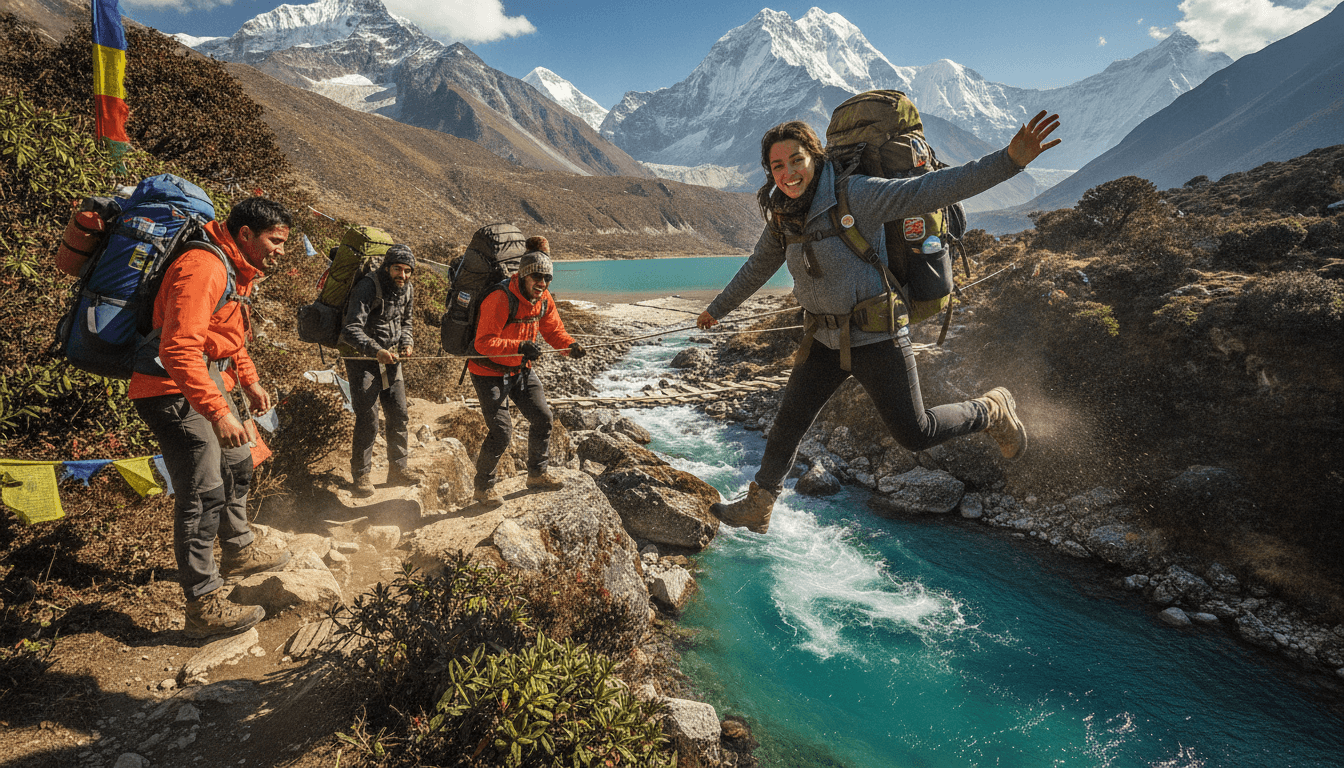
Self-Launched Everest & Gokyo Lakes Circuit, Nepal
19 days · Nepal
Much Better Adventures charges £2,195
No-markup version: ~£870 per person
Estimate only, not a guaranteed price. Always verify costs independently before booking.
This self-launched version of the classic Everest and Gokyo Lakes Circuit lets you tackle one of the world's most iconic high-altitude treks independently — saving a significant chunk over guided operator prices. You'll follow the same circular route through the Gokyo Valley, cross the legendary Cho La Pass (17,782 ft), reach Everest Base Camp, and summit Kala Patthar — all under your own steam. You'll book your own teahouses, hire a local licensed guide and porter directly in Kathmandu or Namche, and sort your own permits via the TIMS and Sagarmatha National Park entry points. Teahouses along the trail are plentiful, sociable, and part of the authentic Himalayan experience. Costs below are per-person estimates assuming solo travel; sharing costs where possible (e.g. porters) will reduce them further.
Day-by-day
Arrive in Kathmandu
Kathmandu
Fly into Tribhuvan International Airport (KTM) and make your own way to Thamel — the backpacker hub of Kathmandu. A taxi from the airport costs around £5–8 (negotiate before getting in, or use a prepaid taxi desk). Check into a guesthouse in Thamel and spend the evening wandering the buzzing streets, grabbing a dal bhat, and soaking up the chaos. This is the night to sort any last-minute gear you've forgotten — Thamel is lined with trekking shops selling everything from down jackets to hiking poles at very reasonable prices.
🚌Prepaid taxi from KTM airport to Thamel (~£5–8)
🛏Guesthouse in Thamel, Kathmandu — e.g. Hotel Encounter Nepal or similar budget hotel (~£15–20/night twin share)
- →Explore Thamel's markets and gear shops
- →Pick up any last-minute trekking supplies
- →Optional: visit Pashupatinath Temple or Boudhanath Stupa (entry ~£3 each)
Kathmandu Admin & Acclimatisation Day
Kathmandu
Use today to sort your trekking permits — you'll need two: the TIMS card (Trekkers' Information Management System, ~£15) and the Sagarmatha National Park entry permit (~£25). Both can be obtained in person at the Nepal Tourism Board office in Pradarshani Marg, or at the Trekking Agencies' Association of Nepal (TAAN) office. You can also hire a licensed independent trekking guide directly here or through Thamel guesthouses — expect to pay £20–30/day for a good English-speaking guide. Arrange your porter at the same time (£12–18/day). In the afternoon, take a bus to Ramechhap/Manthali (departs from the New Bus Park, ~£5–6, ~6 hrs) ready for an early morning Lukla flight.
🚌Tourist bus from Kathmandu New Bus Park to Ramechhap (~£5–6, ~6 hrs)
🛏Budget guesthouse near Ramechhap/Manthali airport (~£8–12/night)
- →Obtain TIMS card at Nepal Tourism Board (~£15)
- →Obtain Sagarmatha National Park permit (~£25)
- →Hire a licensed guide and porter directly (negotiate rates in Thamel or via guesthouse)
Fly to Lukla, Trek to Phakding
Lukla → Phakding
Take an early morning flight from Manthali/Ramechhap to Lukla (Tenzing-Hillary Airport). Tara Air and Summit Air operate these routes — book direct on their websites or through a local agent in Kathmandu (~£120–140 return per person). The 20-minute flight over the Himalayan foothills is breathtaking. From Lukla (2,840m), follow the trail down through pine forests alongside the Dudh Kosi River to Phakding village (~2,610m). The walk takes around 3–4 hours and is a gentle warm-up for the days ahead. Teahouses in Phakding are plentiful — expect to pay £3–6/night for a basic twin room (meals are extra but cheap).
🚌Manthali to Lukla flight via Tara Air or Summit Air (~£120–140 return, book in advance)
🛏Teahouse in Phakding (~£3–6/night, twin share)
- →Scenic 20-minute mountain flight to Lukla
- →4hr hike along Dudh Kosi River to Phakding (~5 miles, ~190m ascent)
- →Explore Phakding village and nearby monasteries
Phakding to Namche Bazaar
Namche Bazaar
Today's hike (~5–6 hrs, ~6 miles) is the toughest of the lower section, climbing ~1,200m to Namche Bazaar (3,440m) — the gateway to the Khumbu. Highlights include crossing the famous Hillary Suspension Bridge with views of Mt. Thamserku (6,623m), passing through Jorsale, and the steep final push up to Namche. Your first glimpse of Everest's summit from the ridge above town makes it all worthwhile. Namche is a proper mountain town with ATMs (last reliable ones on the trek), a bakery, gear shops, and lively teahouses.
🚌Self-guided hiking (your licensed guide leads the way)
🛏Teahouse in Namche Bazaar (~£4–8/night, twin share)
- →Cross the Hillary Suspension Bridge
- →Steep climb to Namche Bazaar (3,440m)
- →First views of Mt. Everest from the ridge above town
- →Withdraw cash from ATM in Namche (last reliable ATMs on the trek)
Acclimatisation Day in Namche Bazaar
Namche Bazaar
A rest day at 3,440m is essential before pushing higher. The golden rule of altitude acclimatisation: 'climb high, sleep low'. Take an easy hike up to the Everest View Hotel (3,880m) for a jaw-dropping panorama of Everest, Lhotse, Ama Dablam, and Thamserku — this is free to access as a walking trail. Visit the Sagarmatha National Park Visitor Centre and the weekly Saturday market (if you're here on the right day). The Hillary School and Khunde Hospital are a short detour away. Eat well, hydrate, and rest.
🚌On foot
🛏Teahouse in Namche Bazaar (~£4–8/night, twin share)
- →Acclimatisation hike to Everest View Hotel (3,880m) — free trail
- →Visit Sagarmatha National Park Visitor Centre
- →Explore Namche's bakeries, cafes and gear shops
- →Optional: hike to Khunde and Hillary School
Namche to Phortse Thanga
Phortse Thanga
Leave Namche and climb to Mong La (3,973m) for panoramic views of the Dudh Koshi valley before descending steeply to Phortse Thanga (~3,680m), a peaceful riverside settlement. The route passes through rhododendron and pine forest and offers great views of Ama Dablam. The hike takes around 5 hours. A local monastery near Phortse Thanga is worth a quick visit if it's open. This quieter trail sees far fewer trekkers than the main EBC route — enjoy the relative solitude.
🚌On foot (~5 hrs, ~5 miles)
🛏Teahouse in Phortse Thanga (~£3–6/night, twin share)
- →Climb to Mong La Pass (3,973m) with valley views
- →Descend to Phortse Thanga along forested trail
- →Visit local Gompa (monastery) near the village
Phortse Thanga to Dole
Dole
A longer, steeper day (~6 hrs) climbing through rhododendron forests via the Sherpa villages of Tonga and Gyele to reach Dole (~4,200m). The landscape changes dramatically as you push above the treeline into open alpine terrain. Views of Khumbila (5,765m) and Tawache (6,501m) are stunning. Take it slowly — you're now well above 4,000m. Dole is a small, quiet village with a handful of teahouses; a great place to catch your breath.
🚌On foot (~6 hrs, ~3 miles with significant ascent)
🛏Teahouse in Dole (~£3–5/night, twin share)
- →Trek through rhododendron forest above treeline
- →Pass through authentic Sherpa villages of Tonga and Gyele
- →Photography of Khumbila and Tawache peaks
Dole to Machhermo
Machhermo
A relatively short day (~4 hrs) ascending through juniper scrub and yak pastures to Machhermo (~4,470m). Arrive around lunchtime — use the afternoon to rest and acclimatise. The views of Cho Oyu (8,188m), the sixth-highest mountain in the world, are extraordinary from here. The Altitude Mountain Sickness (AMS) information centre in Machhermo (run by the Himalayan Rescue Association) is free to visit and well worth a stop to review altitude symptoms with your guide.
🚌On foot (~4 hrs, ~3 miles)
🛏Teahouse in Machhermo (~£3–5/night, twin share)
- →Short acclimatisation hike above Machhermo for Cho Oyu views
- →Visit HRA Altitude Sickness Information Centre (free)
- →Rest and rehydrate in preparation for Gokyo Valley
Machhermo to Gokyo
Gokyo
Trek along the edge of the Ngozumpa Glacier — the longest glacier in the Himalayas — to reach Gokyo village (~4,790m) beside the stunning turquoise Third Gokyo Lake. The trail follows the Dudh Kosi River upstream, passing the First and Second Gokyo Lakes before arriving at the main village (~5 hrs, ~6 miles). Gokyo is one of the most photogenic spots in the entire Himalayas — the sacred turquoise lakes set against towering white peaks will stop you in your tracks. Several good teahouses here with rooftop views.
🚌On foot (~5 hrs, ~6 miles)
🛏Teahouse in Gokyo (~£4–8/night, twin share)
- →Trek alongside the vast Ngozumpa Glacier
- →Pass the First and Second Gokyo Lakes
- →Arrive at Third Gokyo Lake — one of the most beautiful views in the Himalayas
Acclimatisation & Gokyo Ri Summit
Gokyo
Another crucial acclimatisation day at ~4,790m. The main event: hike up Gokyo Ri (5,357m / 17,575 ft) — a steep 2–3 hr climb from the village but absolutely non-negotiable for the views. From the summit, four 8,000m peaks are visible simultaneously — Everest, Cho Oyu, Lhotse, and Makalu — alongside the turquoise Gokyo Lakes and the immense Ngozumpa Glacier stretching to the horizon. No guide required for Gokyo Ri — it's a clear, well-marked trail. Start early to beat cloud build-up. Spend the afternoon resting and exploring the Fourth and Fifth Gokyo Lakes if energy allows.
🚌On foot
🛏Teahouse in Gokyo (~£4–8/night, twin share)
- →Summit Gokyo Ri (5,357m) — 2–3 hr climb, no technical skill required
- →360° views of Everest, Cho Oyu, Lhotse, Makalu and the Gokyo Lakes
- →Optional: explore Fourth and Fifth Gokyo Lakes in the afternoon
Gokyo to Thagnak (Dragnag)
Thagnak (Dragnag)
A short but memorable day (~4 hrs, ~3 miles) trekking from Gokyo onto and across the Ngozumpa Glacier itself to reach Thagnak (~4,700m), the staging post for tomorrow's big Cho La Pass crossing. The glacier crossing is straightforward but requires care — your guide will lead you safely between cairns, ice formations, and moraine deposits. Arrive early, eat well, and get an early night: tomorrow is the hardest day of the trek.
🚌On foot across Ngozumpa Glacier (~4 hrs)
🛏Teahouse in Thagnak (~£3–5/night, twin share)
- →Cross the Ngozumpa Glacier — the longest glacier in the Himalayas
- →Navigate between ice formations and moraine with your guide
- →Rest and prepare for Cho La Pass crossing tomorrow
Cross the Cho La Pass (5,420m)
Dzongla
The hardest and most spectacular day of the entire circuit (~8 hrs, ~8 miles). Start before dawn. The ascent to Cho La Pass (5,420m / 17,782 ft) is steep and rocky with significant scrambling on icy terrain — trekking poles and microspikes/crampons (hire in Namche ~£3–5/day) are strongly recommended. The glaciated top of the pass demands concentration, but the panoramic Himalayan views are extraordinary. Descend via a rocky gully into the Khumbu Valley to reach Dzongla (~4,830m). A challenging but deeply rewarding day that relatively few trekkers do — you've earned tonight's rest.
🚌On foot (~8 hrs, ~8 miles, significant scrambling)
🛏Teahouse in Dzongla (~£3–5/night, twin share)
- →Cross Cho La Pass (5,420m) — the highlight of the entire circuit
- →Technical scramble on rocky, often icy terrain (crampons recommended)
- →Panoramic Himalayan summit views before descending into Khumbu Valley
Dzongla to Lobuche
Lobuche
A short recovery day (~3 hrs, ~4 miles) with a gentle descent to Lobuche (~4,940m). The trail passes the Khumbu Glacier lateral moraine and several memorial chortens dedicated to climbers who have died on Everest — a moving and thought-provoking sight. Rest up in Lobuche and prepare mentally and physically for tomorrow's milestone: Everest Base Camp.
🚌On foot (~3 hrs, ~4 miles)
🛏Teahouse in Lobuche (~£4–6/night, twin share)
- →Visit memorial chortens dedicated to fallen Everest climbers
- →Short acclimatisation walk above Lobuche
- →Rest and prepare for EBC day
Everest Base Camp (5,364m)
Gorak Shep / Everest Base Camp
The big one. Trek from Lobuche to Gorak Shep (~5,170m) — the last teahouse stop — then continue along the edge of the Khumbu Glacier to Everest Base Camp at 5,364m / 17,598 ft (~5 hrs total, ~7 miles). The base camp itself is rocky and glaciated, often dotted with expedition tents during climbing season (April–May). Spend time taking it all in, then return to Gorak Shep for the night. Note: the best Everest views are actually from Kala Patthar tomorrow — EBC is more about the achievement than the vista.
🚌On foot (~5 hrs to EBC and back to Gorak Shep)
🛏Teahouse in Gorak Shep (~£5–8/night, twin share — most expensive teahouses on the route due to altitude)
- →Trek to Everest Base Camp (5,364m) — the highest point most people will ever stand
- →Walk along the edge of the Khumbu Glacier
- →Photography at EBC with Khumbu Icefall backdrop
Sunrise from Kala Patthar, Descend to Pangboche
Pangboche
Rise before dawn (around 3–4am) for the optional but unmissable climb to Kala Patthar (5,545m / 18,209 ft) — the highest point of the trek and the finest viewpoint in the entire Everest region. Watch the sun rise behind the summit of Everest and the surrounding 8,000m peaks. The climb from Gorak Shep takes 1.5–2 hrs. Return to Gorak Shep for breakfast, then begin the long descent: past Lobuche, Dingboche, and down to Pangboche (~3,930m), crossing suspension bridges and re-entering the lush valley (~8 hrs total, ~12 miles).
🚌On foot (~8 hrs including Kala Patthar ascent)
🛏Teahouse in Pangboche (~£3–6/night, twin share)
- →Summit Kala Patthar (5,545m) for sunrise views of Everest — the best viewpoint on the entire trek
- →Long descent from Gorak Shep to Pangboche via Dingboche
- →Visit Pangboche Monastery — one of the oldest in the Khumbu (small entry fee ~£1)
Pangboche to Namche Bazaar
Namche Bazaar
A long but increasingly green descent (~6 hrs, ~8 miles) back down toward Namche Bazaar, re-crossing suspension bridges and passing through the forest above Phungi Thanga. The air gets noticeably thicker and richer as you drop below 4,000m — many trekkers experience a renewed surge of energy. Celebrate your achievement with a slice of cake at one of Namche's excellent bakeries tonight.
🚌On foot (~6 hrs, ~8 miles)
🛏Teahouse in Namche Bazaar (~£4–8/night, twin share)
- →Long descent back through Khumbu forests and suspension bridges
- →Celebrate at Namche Bazaar bakery or café
- →Pick up any trekking souvenirs or yak wool goods in Namche
Namche to Lukla
Lukla
The final day of trekking (~6 hrs, ~11 miles), retracing your steps through pine and rhododendron forests, across the Hillary Bridge and back to Lukla. Say goodbye to your guide and porter here — tipping is customary and expected: budget ~£30–40 total for a guide (£20–25) and porter (£10–15) as a thank-you for the full trek. Have a final celebratory meal in Lukla — the pizza at several guesthouses is surprisingly good after two weeks of dal bhat.
🚌On foot (~6 hrs, ~11 miles)
🛏Teahouse/guesthouse in Lukla (~£4–8/night, twin share)
- →Final day's trekking through rhododendron and pine forests
- →Cross the Hillary Suspension Bridge one last time
- →Tip your guide and porter — budget ~£30–40 total
- →Celebratory meal in Lukla
Fly Back to Manthali, Drive to Kathmandu
Kathmandu
Early morning flight from Lukla back to Manthali/Ramechhap (~£120–140 return already accounted for on Day 3). The return bus to Kathmandu takes around 6 hours (£5–6 from Ramechhap bus stand). Arrive in Kathmandu in the early evening — check back into Thamel and celebrate in style. The rooftop bars and restaurants of Thamel are well-suited to a post-trek blowout; try OR2K, The Third Eye, or Rosemary Kitchen for something special. Budget slightly more for tonight.
🚌Lukla to Manthali flight (included in return ticket booked on Day 3); bus Ramechhap to Kathmandu (~£5–6, ~6 hrs)
🛏Guesthouse in Thamel, Kathmandu (~£15–20/night, twin share)
- →Morning flight back from Lukla to Manthali
- →Bus journey back to Kathmandu through the hills
- →Celebratory dinner in Thamel — treat yourself after 15 days of dal bhat
Final Morning in Kathmandu
Kathmandu
Enjoy a well-earned lie-in and leisurely breakfast in Thamel. Spend your final few hours in Kathmandu exploring — Boudhanath Stupa (UNESCO World Heritage Site, ~£3 entry) is a short taxi ride away and a serene way to finish a spiritual Himalayan journey. Head to the airport for your international departure. Allow extra time for traffic — Kathmandu's roads can be chaotic. A taxi to KTM airport costs ~£5.
🚌Taxi to Tribhuvan International Airport (~£5)
🛏Check-out (or arrange late check-out with guesthouse)
- →Leisurely breakfast in Thamel
- →Optional visit to Boudhanath Stupa (~£3 entry)
- →Pick up last-minute souvenirs in Thamel markets
- →Transfer to KTM airport for international departure
Self-launched vs. Much Better Adventures
| This itinerary (self-launched) | Much Better Adventures | |
|---|---|---|
| Price per person | ~£870 | £2,195 |
| Duration | 19 days | 19 days |
| Who books it | You and your group, direct | Tour operator, guided group |
| Savings | £1,325 per person (60%) | |
Estimate only, not a guaranteed price. Always verify costs independently before booking.
Want to see more Much Better Adventures-style trips? Check them out here.~£870
estimated per person
You never pay Travel Crew for this — you pay hostels, transport, and activity providers directly, the same as if you'd booked it all yourself.
This publishes your dates so other travellers can find and join you — no tour operator needed.
Customise with Tour BusterCreated by

Travel Crew
0 trips
Frequently asked questions
How much does Self-Launched Everest & Gokyo Lakes Circuit, Nepal cost?+
Doing it yourself with this self-launched itinerary costs an estimated £870 per person for 19 days in Nepal. This is an AI-generated estimate based on typical budget-traveller prices — actual costs will vary by season and how you book.
Is this cheaper than booking with Much Better Adventures?+
Yes — Much Better Adventures charges around £2,195 per person for a similar tour. Doing the same route independently, using the same standard of accommodation and activities, costs an estimated £870 — a saving of roughly £1,325 (60%) per person.
How long is the Nepal trip?+
This itinerary runs 19 days, covering 19 day-by-day stops through Nepal.
How do I join this trip?+
You can join an existing open departure using this itinerary if one is scheduled, or launch your own departure with your own dates and invite other travellers to join you — no tour operator required.
Isn't it easier to just use a tour operator?+
Well, yes, a tour operator will book all the individual parts of your travel for you and provide a guide. That's obvious, but doing this has the potential to save the group thousands, which can in turn improve your itinerary substantially or save you huge amounts of money. Also, when you launch a departure, Travel Crew has tools in place to help you book the individual sections of the trip or make it easier for you to do this as a group. Really, you do not need a middle man. If you are more comfortable paying more and using a middle man, then you should certainly do this.
Is it safer to book through a tour operator?+
Arguably, there isn't much difference. A self-launched trip runs on the same principle as a group travel crew: collective responsibility, everyone looking out for each other, the same way it would if a group of friends organised the trip themselves — because that's exactly what's happening. You should always take out travel insurance before you go, self-launched or not; that doesn't change either way. Every open departure is published publicly with real dates and a real trip organiser, so it's never an anonymous arrangement, and our support team is reachable any time you need help, including in an emergency while you're away. Longer-term, we're building direct relationships with ground DMCs in popular destinations, offered as an optional paid add-on for extra on-the-ground support. Ultimately, though, the group is responsible for its own conduct and safety on a self-launched trip, same as on any trip you plan yourself.
What kind of trip is this?+
This is a adventure, hiking, culture trip through Nepal, self-launched rather than run by a tour operator — you organise it with a group you find or bring yourself.
Would you like to name the operator, name the trip, or have any suggestions about how to improve this itinerary?
Drop your comment below — if you've done a similar route, tell us what worked, what you'd add, or what you'd skip.
No comments yet — be the first to share your take.
Sign in to leave a comment.