
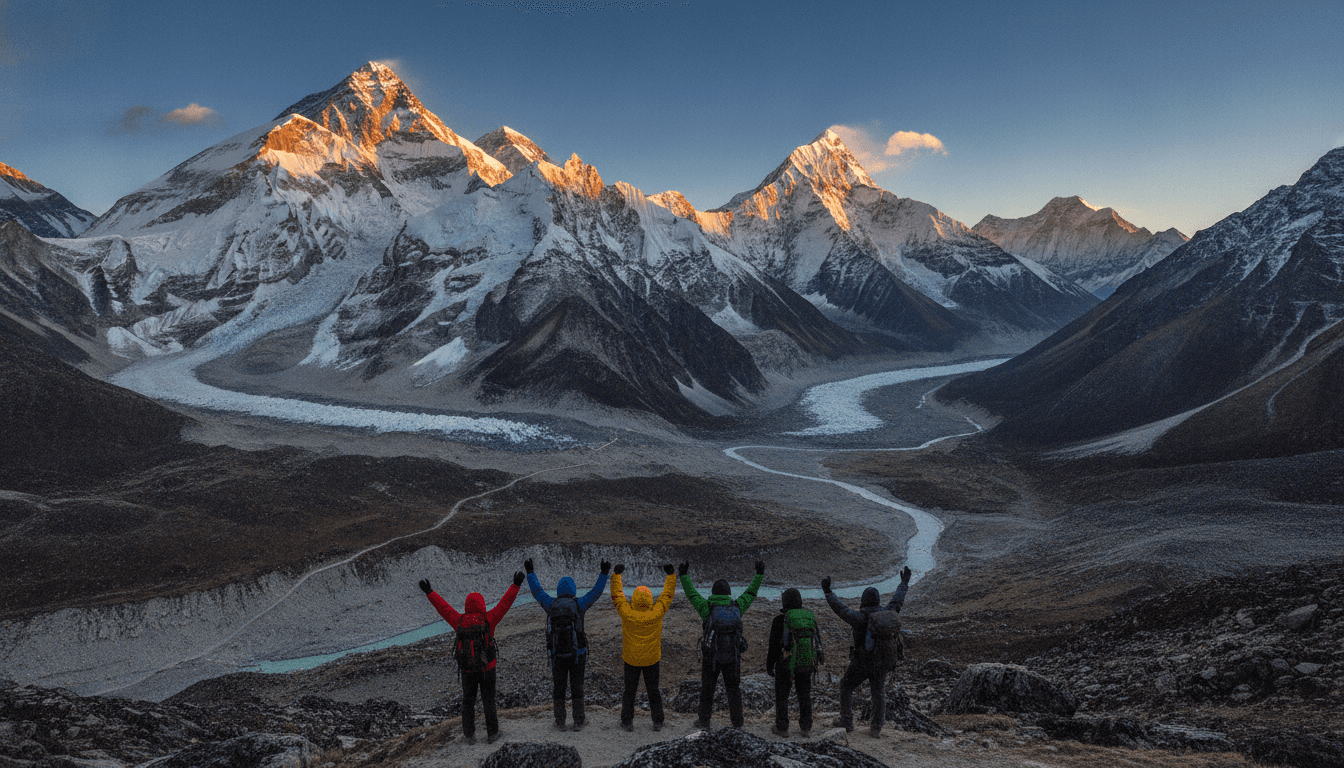
Everest Base Camp Self-Launched Trek – 15 Days
15 days · Nepal
Alpine Club of Himalaya charges £2,755
No-markup version: ~£1,050 per person
Estimate only, not a guaranteed price. Always verify costs independently before booking.
Experience one of the world's most iconic treks — Everest Base Camp — without the luxury lodge price tag. This self-launched version follows the exact same route from Kathmandu to EBC and back, swapping guided group logistics for independent teahouse trekking. You'll fly into Lukla, trek through Sagarmatha National Park past monasteries, glaciers and Sherpa villages, summit Kala Patthar for sunrise views of Everest, and reach Base Camp at 5,364m — all at a fraction of the cost. Hiring a local licensed guide and/or porter independently is still strongly recommended for safety and navigation, and can be arranged easily in Kathmandu or Namche. All costs are approximate estimates per person.
Day-by-day
Arrive in Kathmandu
Kathmandu
Arrive at Tribhuvan International Airport (KTM) and transfer to your guesthouse in Thamel, Kathmandu's backpacker hub. Spend the afternoon sorting your Sagarmatha National Park permit (~£25) and TIMS card (~£10) — both available at the Nepal Tourism Board office on Bhrikuti Mandap, a 10-minute walk or cheap taxi from Thamel. Grab dinner at one of Thamel's excellent local restaurants — try a dal bhat set for under £3. Book your Lukla flight if not already done (Tara Air or Summit Air operate daily flights, book direct online).
🚌Taxi from KTM airport to Thamel (~£5)
🛏Budget guesthouse in Thamel, Kathmandu — e.g. Hotel Encounter Nepal or similar (~£10–15/night)
- →Arrive at Tribhuvan International Airport and transfer to Thamel guesthouse
- →Obtain Sagarmatha National Park permit and TIMS card at Nepal Tourism Board office
- →Explore Thamel and grab a welcome dinner
- →Book/confirm Kathmandu–Lukla flight if not pre-booked (Tara Air or Summit Air, ~£130–£160 return)
Fly Kathmandu to Lukla – Trek to Phakding
Phakding (2,610m)
Take the early morning flight from Kathmandu to Lukla's Tenzing-Hillary Airport — one of the world's most dramatic runways. Flights depart from Ramechhap airport (~4hr drive from Kathmandu) during busy season — check with your airline. From Lukla (2,860m), begin your trek downhill along the Dudh Kosi river valley to Phakding (~3–4hrs). Pass through pine and rhododendron forests and visit Drangdrak Gompa and Pema Choling Gompa along the way. Check into a teahouse in Phakding.
🚌Flight Kathmandu–Lukla (~£65–80 one-way, already counted in transport total)
🛏Teahouse in Phakding — e.g. Phakding Guest House (~£5–8/night, meals extra)
- →Morning flight Kathmandu to Lukla (Tara Air / Summit Air, ~£130–£160 return, book direct)
- →Trek from Lukla to Phakding (~3–4hrs, ~8km)
- →Visit Drangdrak Gompa and Pema Choling Gompa
- →Spot views of Kumbila and Kusum Kanguru peaks
Phakding to Namche Bazaar
Namche Bazaar (3,440m)
A longer and more demanding day as you trek from Phakding to Namche Bazaar (~5–6hrs, ~11km). Cross multiple suspension bridges over the roaring Dudhkoshi River, enter the Sagarmatha National Park checkpoint (show your permit), and make the steep final climb up to Namche. On a clear day, you'll catch your first glimpse of Everest. Visit Utche Choling Gompa on the way. Namche Bazaar is a bustling Sherpa town with bakeries, gear shops, and Wi-Fi cafés — a good place to stock up.
🚌Trekking (no paid transport)
🛏Teahouse in Namche Bazaar — e.g. Khumbu Lodge or Panorama Lodge (~£6–10/night)
- →Trek Phakding to Namche Bazaar (~5–6hrs, ~11km)
- →Cross Hillary Suspension Bridge and multiple other bridges over Dudhkoshi River
- →Pass Sagarmatha National Park entry checkpoint (show permit)
- →Visit Utche Choling Gompa
- →First views of Mount Everest, Lhotse and Nuptse on the ascent
Acclimatisation Day in Namche Bazaar
Namche Bazaar (3,440m)
Do not skip this rest day — acclimatisation is critical above 3,000m. Follow the 'climb high, sleep low' principle: hike up to Khumjung village (~3,790m) and visit Khumjung Gompa (which allegedly houses a Yeti scalp), then descend back to Namche. On the way up, stop at the Everest View Hotel ridge for panoramic views of Everest, Ama Dablam, Lhotse and Kwangde. If it's Saturday, browse the famous Namche market. Spend the evening hydrating and resting.
🚌Trekking (no paid transport)
🛏Same teahouse in Namche Bazaar (second night)
- →Acclimatisation hike to Khumjung village (~3,790m) and back to Namche
- →Visit Khumjung Gompa
- →Panoramic views from Everest View Hotel ridge (no entry fee required for the viewpoint)
- →Explore Namche Bazaar village and Saturday market (if available)
- →Rest, rehydrate and prepare gear for higher altitude
Namche to Tengboche
Tengboche (3,860m)
Trek from Namche to Tengboche (~5–6hrs, ~10km), one of the most scenic sections of the entire route. Descend to Phunki Thenga and visit the famous water-powered prayer wheels before a steep climb up through rhododendron forest to Tengboche. The reward at the top is extraordinary: Tengboche Monastery, the largest in the Khumbu region, set against a jaw-dropping backdrop of Ama Dablam, Everest, Lhotse and Nuptse. Attend the evening puja ceremony at the monastery if timing allows (no fee, donations welcome).
🚌Trekking (no paid transport)
🛏Teahouse in Tengboche — e.g. Tengboche Monastery Guesthouse or Himalayan Hotel (~£5–8/night)
- →Trek Namche to Tengboche (~5–6hrs, ~10km)
- →Visit Phunki Thenga water-powered prayer wheels
- →Trek through rhododendron and juniper forest along the Chhorkung Ridge trail
- →Visit Tengboche Monastery — attend evening puja ceremony (donations welcome)
- →Views of Ama Dablam, Thamserku and the Khumbu peaks
Tengboche to Dingboche
Dingboche (4,410m)
Trek from Tengboche to Dingboche (~5–6hrs, ~10km), descending into the Imja Khola valley before climbing again. Pass through Debuche village and visit Debuche Gompa. Cross the Imja Khola on a long suspension bridge, then visit Pangboche Gompa — one of the oldest in the Khumbu. Continue along the valley floor with views of Ama Dablam dominating the skyline. Arrive at Dingboche, a high-altitude village of stone-walled fields used for growing potatoes and barley. Drink plenty of water and eat well tonight.
🚌Trekking (no paid transport)
🛏Teahouse in Dingboche — e.g. Moonlight Lodge or Eco Resort (~£5–8/night)
- →Trek Tengboche to Dingboche (~5–6hrs, ~10km)
- →Visit Debuche Gompa
- →Cross Imja Khola suspension bridge
- →Visit Pangboche Gompa (one of the oldest in Khumbu)
- →Views of Ama Dablam, Lhotse and Island Peak
Acclimatisation Hike – Nangkartsang Summit
Dingboche (4,410m)
Second essential acclimatisation day. Hike from Dingboche up to Nangkartsang Gompa and continue to Nangkartsang Summit (~5,050m) — a significant altitude gain that prepares your body for the days ahead. The 360-degree summit views encompass Lhotse, Makalu, Cho Oyu, Ama Dablam and Baruntse. Descend back to Dingboche for lunch and a restful afternoon. Altitude symptoms (headache, nausea) are common — descend immediately if symptoms worsen. Hydrate, eat garlic soup, and rest.
🚌Trekking (no paid transport)
🛏Same teahouse in Dingboche (second night)
- →Acclimatisation hike to Nangkartsang Gompa and Nangkartsang Summit (~5,050m)
- →Panoramic views of Lhotse, Makalu, Cho Oyu and Ama Dablam from summit
- →Descend to Dingboche for lunch and rest
- →Monitor for altitude sickness symptoms — consult teahouse first aid resources
Dingboche to Dughla (Thukla)
Dughla / Thukla (4,620m)
A shorter trekking day (~3–4hrs, ~7km) from Dingboche to Dughla (also called Thukla), allowing your body to continue adjusting. The trail follows the Khumbu Khola river, climbing gradually with views of Taboche, Cholatse, Ama Dablam and Kantega. Dughla is a small settlement with just a handful of teahouses. Arrive early, rest, and take time to acclimatise at this altitude before tomorrow's big push to Lobuche.
🚌Trekking (no paid transport)
🛏Teahouse in Dughla — e.g. Thukla Guest House (~£5–8/night)
- →Trek Dingboche to Dughla/Thukla (~3–4hrs, ~7km)
- →Views of Taboche, Cholatse, Ama Dablam and Kantega throughout
- →Follow the Khumbu Khola river trail
- →Arrive early and rest — shorter day intentional for acclimatisation
Dughla to Lobuche
Lobuche (4,940m)
Trek from Dughla to Lobuche (~3–4hrs, ~4km). The trail climbs steeply from Dughla past the Chupki Lhara memorial — a moving hillside of stone cairns and prayer flags commemorating climbers and Sherpas who have died on Everest. Pay your respects here before continuing along the lateral moraine of the Khumbu Glacier to Lobuche. The altitude is serious here — move slowly, drink 3–4 litres of water and avoid alcohol. Clear skies reveal Khumbutse, Lingtren, Pumori and the Lho La col.
🚌Trekking (no paid transport)
🛏Teahouse in Lobuche — e.g. Lobuche Guest House or Pyramid Hotel (~£6–10/night)
- →Trek Dughla to Lobuche (~3–4hrs, ~4km)
- →Visit Chupki Lhara memorial cairns — tribute to Everest climbers and Sherpas
- →Trek along Khumbu Glacier lateral moraine
- →Views of Pumori, Khumbutse, Lingtren and Chola Lake
- →Hydrate heavily and rest on arrival
Lobuche to Gorak Shep – Everest Base Camp
Gorak Shep (5,164m)
The big day. Set off early from Lobuche and trek to Gorak Shep (~2–3hrs, ~5km) — the last settlement before EBC. Drop your pack at your teahouse, have a quick lunch, then continue to Everest Base Camp (5,364m) across the Khumbu Glacier (~3–4hrs return). The trail is rocky and crosses glacial moraine — go slowly and watch your footing. At Base Camp, the sight of colourful expedition tents, the Khumbu Icefall and the sheer scale of the Himalaya is overwhelming. Return to Gorak Shep for the night.
🚌Trekking (no paid transport)
🛏Teahouse in Gorak Shep — e.g. Everest Inn or Gorak Shep Lodge (~£6–10/night)
- →Early start — trek Lobuche to Gorak Shep (~2–3hrs, ~5km)
- →Drop pack at Gorak Shep teahouse and have lunch
- →Trek to Everest Base Camp (5,364m) across Khumbu Glacier (~3–4hrs return)
- →Views of Nuptse, Changtse, Lho La and Gorak Shep Lake
- →Return to Gorak Shep for dinner and rest
Kala Patthar Sunrise – Trek to Pheriche
Pheriche (4,240m)
Rise at 4am and begin the pre-dawn hike to Kala Patthar (5,545m) — a ~2hr climb in the dark with headtorch. The sunrise from Kala Patthar is one of the most breathtaking on Earth: Everest, Lhotse, Nuptse, Changtse and Pumori lit gold against a deep blue sky. Descend back to Gorak Shep for breakfast, then trek all the way down to Pheriche (~5–6hrs total descent). Your body will feel the descent in your knees — use trekking poles. Pheriche has a Himalayan Rescue Association aid post where altitude talks are given (free, highly recommended).
🚌Trekking (no paid transport)
🛏Teahouse in Pheriche — e.g. Himalayan Hotel Pheriche (~£5–8/night)
- →4am start — pre-dawn hike to Kala Patthar (5,545m) for sunrise views of Everest (~2hrs)
- →360° panorama of Everest, Lhotse, Nuptse, Changtse, Pumori and Khumbu Glacier
- →Descend to Gorak Shep for breakfast
- →Long descent trek to Pheriche (~5–6hrs)
- →Visit Himalayan Rescue Association aid post in Pheriche (free altitude health talk)
Pheriche to Namche Bazaar
Namche Bazaar (3,440m)
A long but satisfying descent day (~6–7hrs, ~19km) as you retrace the trail from Pheriche back to Namche Bazaar via Tengboche Monastery and Phunki Tenga. The return journey feels faster and your body is acclimatised — enjoy the lower altitude and the increasingly lush landscape. Stop at Tengboche for lunch and a final look at the monastery. Arrive in Namche in the late afternoon. Treat yourself to a pizza and apple pie — you've earned it.
🚌Trekking (no paid transport)
🛏Teahouse in Namche Bazaar (returning guesthouse, ~£6–10/night)
- →Long descent trek Pheriche to Namche (~6–7hrs, ~19km)
- →Pass through Tengboche Monastery for lunch stop
- →Descend through rhododendron forest via Phunki Tenga
- →Arrive in Namche — celebrate with a meal at one of the village bakeries or restaurants
Namche to Lukla
Lukla (2,860m)
Final trekking day — descend from Namche all the way to Lukla (~6–7hrs, ~18km) along the Dudh Kosi River. The trail is well-worn and fast on the descent. Stop in Phakding for lunch. Arrive in Lukla in the late afternoon — book yourself into a guesthouse near the airstrip. Celebrate with your trekking crew (guide, porter if you hired one) over a daal bhat dinner and local tongba (millet beer). Tip your guide and porter generously — a standard tip is 10–15% of their total fee.
🚌Trekking (no paid transport)
🛏Guesthouse in Lukla — e.g. Lukla Inn or Sherpa Guesthouse (~£5–8/night)
- →Final descent trek Namche to Lukla (~6–7hrs, ~18km)
- →Follow Dudh Kosi River valley through Phakding
- →Arrive Lukla — check in near the airstrip
- →Celebration dinner with guide and porter (tip guide/porter generously)
Fly Lukla to Kathmandu – Farewell Evening
Kathmandu
Lukla flights depart early and are weather-dependent — be at the airstrip by 6am. Delays are common, so pack snacks and a good book. Once back in Kathmandu, transfer to Thamel and check into your guesthouse. Spend the afternoon exploring — visit the Garden of Dreams (entry ~£3), browse Thamel for souvenirs (bargain hard), or head to Boudhanath Stupa (entry ~£3). Celebrate your achievement over a farewell dinner at a rooftop restaurant in Thamel — you've just trekked to Everest Base Camp.
🚌Flight Lukla–Kathmandu (included in transport total); taxi airport–Thamel (~£5)
🛏Budget guesthouse in Thamel, Kathmandu (~£10–15/night)
- →Early morning flight Lukla to Kathmandu (already included in transport budget)
- →Transfer to Thamel guesthouse
- →Visit Boudhanath Stupa or Garden of Dreams (~£3 entry each)
- →Browse Thamel for souvenirs and gifts
- →Farewell dinner at a rooftop restaurant in Thamel
Depart Kathmandu
Kathmandu
Final morning in Kathmandu. Enjoy a leisurely breakfast at your guesthouse — try a masala omelette and Nepali milk tea. If time allows before your flight, visit Pashupatinath Temple (one of the most sacred Hindu sites in the world, entry ~£5 for non-Hindus) or the nearby Swayambhunath Monkey Temple (entry ~£2). Transfer to Tribhuvan International Airport for your onward flight. Safe travels — you've done something extraordinary.
🚌Taxi to KTM airport (~£5)
🛏Check out — no accommodation needed (or add a night if flight departs late)
- →Leisurely breakfast in Thamel
- →Optional visit to Pashupatinath Temple (~£5 entry) or Swayambhunath (Monkey Temple, ~£2 entry)
- →Transfer to Tribhuvan International Airport for departure
- →Optional activities: game drives at Chitwan National Park, rafting, mountain biking (add extra days)
Self-launched vs. Alpine Club of Himalaya
| This itinerary (self-launched) | Alpine Club of Himalaya | |
|---|---|---|
| Price per person | ~£1,050 | £2,755 |
| Duration | 15 days | 15 days |
| Who books it | You and your group, direct | Tour operator, guided group |
| Savings | £1,705 per person (62%) | |
Estimate only, not a guaranteed price. Always verify costs independently before booking.
Want to see more Alpine Club of Himalaya-style trips? Check them out here.~£1,050
estimated per person
You never pay Travel Crew for this — you pay hostels, transport, and activity providers directly, the same as if you'd booked it all yourself.
This publishes your dates so other travellers can find and join you — no tour operator needed.
Customise with Tour BusterCreated by

Travel Crew
0 trips
Frequently asked questions
How much does Everest Base Camp Self-Launched Trek – 15 Days cost?+
Doing it yourself with this self-launched itinerary costs an estimated £1,050 per person for 15 days in Nepal. This is an AI-generated estimate based on typical budget-traveller prices — actual costs will vary by season and how you book.
Is this cheaper than booking with Alpine Club of Himalaya?+
Yes — Alpine Club of Himalaya charges around £2,755 per person for a similar tour. Doing the same route independently, using the same standard of accommodation and activities, costs an estimated £1,050 — a saving of roughly £1,705 (62%) per person.
How long is the Nepal trip?+
This itinerary runs 15 days, covering 15 day-by-day stops through Nepal.
How do I join this trip?+
You can join an existing open departure using this itinerary if one is scheduled, or launch your own departure with your own dates and invite other travellers to join you — no tour operator required.
Isn't it easier to just use a tour operator?+
Well, yes, a tour operator will book all the individual parts of your travel for you and provide a guide. That's obvious, but doing this has the potential to save the group thousands, which can in turn improve your itinerary substantially or save you huge amounts of money. Also, when you launch a departure, Travel Crew has tools in place to help you book the individual sections of the trip or make it easier for you to do this as a group. Really, you do not need a middle man. If you are more comfortable paying more and using a middle man, then you should certainly do this.
Is it safer to book through a tour operator?+
Arguably, there isn't much difference. A self-launched trip runs on the same principle as a group travel crew: collective responsibility, everyone looking out for each other, the same way it would if a group of friends organised the trip themselves — because that's exactly what's happening. You should always take out travel insurance before you go, self-launched or not; that doesn't change either way. Every open departure is published publicly with real dates and a real trip organiser, so it's never an anonymous arrangement, and our support team is reachable any time you need help, including in an emergency while you're away. Longer-term, we're building direct relationships with ground DMCs in popular destinations, offered as an optional paid add-on for extra on-the-ground support. Ultimately, though, the group is responsible for its own conduct and safety on a self-launched trip, same as on any trip you plan yourself.
What kind of trip is this?+
This is a adventure, hiking, culture trip through Nepal, self-launched rather than run by a tour operator — you organise it with a group you find or bring yourself.
Would you like to name the operator, name the trip, or have any suggestions about how to improve this itinerary?
Drop your comment below — if you've done a similar route, tell us what worked, what you'd add, or what you'd skip.
No comments yet — be the first to share your take.
Sign in to leave a comment.