
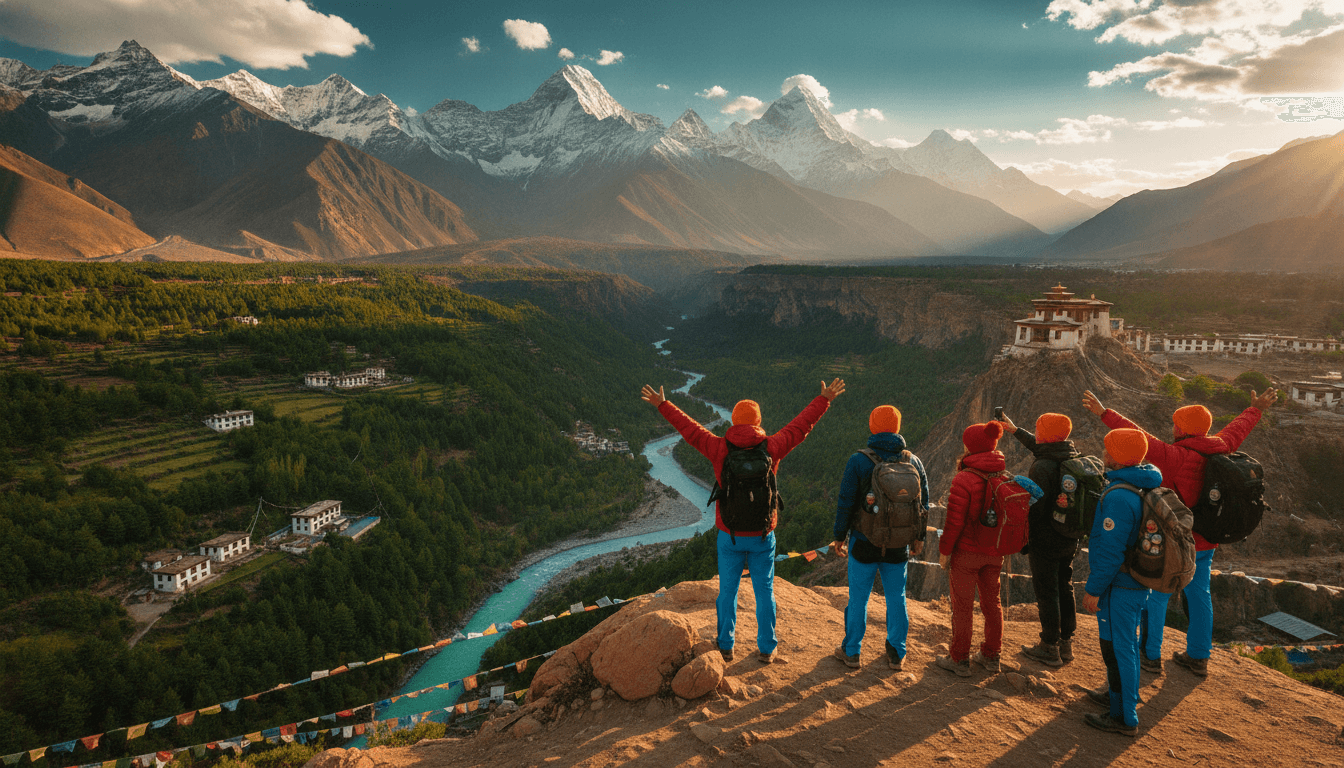
Discover Bhutan and Nepal — Self-Launched
12 days · Nepal & Bhutan
Bhutan Acorn Tours & Travel charges £2,850
No-markup version: ~£1,050 per person
Estimate only, not a guaranteed price. Always verify costs independently before booking.
A self-launched 12-day version of Bhutan Acorn's "Discover Bhutan and Nepal" tour: five days of Kathmandu Valley temples and Pokhara lakeside views, then a short Drukair hop into Bhutan for Thimphu, Punakha, the Phobjikha valley and the Tiger's Nest hike. You'll arrange your own Bhutan visa and Sustainable Development Fee (US$100/night) through the official Department of Immigration portal, book a licensed Bhutanese guide and driver locally in Thimphu or Paro (Bhutan law requires a guide for independent travellers), and use tourist buses and shared taxis everywhere else. Costs are rough backpacker-to-mid-range estimates and exclude international flights.
Day-by-day
Arrive Kathmandu — Thamel orientation
Kathmandu
Land at Tribhuvan International Airport, grab a prepaid taxi to Thamel (NPR 800–1,000, ~£5–6) or take the local Sajha bus if you're feeling brave. Check into a Thamel guesthouse, sort a Ncell/Namaste SIM with data (~£4 for 30 days), then wander the old bazaar lanes and Durbar Marg at dusk. Book your Kathmandu–Pokhara tourist bus for tomorrow morning at any Thamel agent (NPR 1,200–1,800, ~£8–11) and confirm your Drukair/Bhutan Airlines Kathmandu–Paro ticket (roughly US$455 return, so ~£240 one-way if you fly into Paro and out of Paro — or book the return if you loop back to Kathmandu).
🚌Airport prepaid taxi ~£6
🛏Thamel guesthouse, private room with shared bath
- →Thamel orientation walk
- →Buy local SIM card
- →Book Pokhara tourist bus
Kathmandu Valley temple circuit
Kathmandu
Do the classic valley loop with local transport and a shared guide where it helps. Start early at Swayambhunath (monkey temple) — taxi from Thamel ~NPR 400 (~£2.50), entry NPR 200. Then a local bus or Pathao ride to Boudhanath for kora (circumambulation) with the Tibetan community, entry NPR 400. Afternoon: Pashupatinath ghats (NPR 1,000), then a local bus south to Patan Durbar Square (NPR 1,000) — the Patan Museum is worth the extra. If time allows, hop a shared taxi to Bhaktapur (NPR 1,500 entry, plus ~NPR 500 transport) and stay for the pottery square at golden hour. A licensed city guide is ~£25/day if you split it — otherwise use a good audio guide app.
🚌Local buses and shared taxis ~£6
🛏Thamel guesthouse, private room with shared bath
- →Swayambhunath Stupa
- →Boudhanath Stupa kora walk
- →Pashupatinath Temple ghats
- →Patan Durbar Square
- →Optional Bhaktapur Durbar Square
Bus to Pokhara — caves and the Peace Pagoda
Pokhara
Take the 6:30–7:00am tourist bus from Kathmandu to Pokhara (6–7 hours, NPR 1,200–1,800, ~£9). Drop bags at a Lakeside guesthouse. Afternoon: cycle or take a shared taxi to Devi's Fall (NPR 100), the Gupteshwar Mahadev Cave next door (NPR 100), and the International Mountain Museum (NPR 500) if you still have energy. Late afternoon, hike or taxi up to the World Peace Pagoda for sunset over Phewa Lake (free, ~45 min walk from Damside), and if you're feeling ambitious add the Pumdikot Shiva statue viewpoint (NPR 300, taxi ~£6 return).
🚌Tourist bus Kathmandu–Pokhara ~£9; local taxis ~£4
🛏Lakeside guesthouse, Pokhara
- →Devi's Fall
- →Gupteshwar Mahadev Cave
- →International Mountain Museum
- →World Peace Pagoda sunset
- →Pumdikot Shiva statue (optional)
Sarangkot sunrise and Pokhara old town
Pokhara
Book a shared jeep or taxi to Sarangkot for sunrise (leave ~4:45am; ~NPR 1,500 return split between 3–4 people, or hike up from Lakeside in 1.5–2 hours if you're up for it). Watch Annapurna and Machhapuchhre light up, grab breakfast at a viewpoint teahouse, then walk down or ride back. Midday: the Gurkha Memorial Museum (NPR 300) and a stroll along the Seti River gorge viewpoint near Old Bazaar, plus Bindhyabasini Temple. Late afternoon rent a rowing boat across Phewa Lake to Tal Barahi Temple (boat NPR 300–600 plus NPR 100 temple entry) — cheapest and best at golden hour. Dinner in Lakeside: dal bhat ~NPR 400.
🚌Shared jeep to Sarangkot ~£5 return split
🛏Lakeside guesthouse, Pokhara
- →Sarangkot sunrise viewpoint
- →Gurkha Memorial Museum
- →Seti River Gorge
- →Bindhyabasini Temple and Old Bazaar
- →Boat to Tal Barahi Temple
Pokhara back to Kathmandu via Newari villages
Kathmandu
Morning tourist bus back to Kathmandu (leaves ~7am, arrives mid-afternoon, ~£9). Instead of heading straight into Thamel, get off at Balkhu or Satdobato and take a local bus south to Bungamati and Khokana, two traditional Newari settlements famous for wood carving and mustard-oil pressing — quiet, untouristed and free to wander. Local buses between the two villages cost pennies. Return to Kathmandu in the evening for a momo and Newari feast (bhara, choila) in Thamel or Ason.
🚌Tourist bus Pokhara–Kathmandu ~£9; local buses ~£2
🛏Thamel guesthouse, private room with shared bath
- →Bungamati Newari settlement
- →Khokana mustard-oil village
- →Newari dinner in Thamel
Fly Kathmandu to Paro, transfer to Thimphu
Thimphu
Take the morning Drukair or Bhutan Airlines flight Kathmandu–Paro (~1 hour, around US$455 return / ~£240 one way — book well ahead; the Paro approach is one of the world's great landings). Have your Bhutan visa approved in advance via the official Department of Immigration portal, and pay the Sustainable Development Fee of US$100 per night (~£78) for your six Bhutan nights plus the one-off visa fee. On arrival, arrange your licensed Bhutanese guide and driver — Bhutan requires independent travellers to be accompanied, and a guide+driver is roughly US$60–80/day split between a small group; book directly with a Thimphu-based freelancer or small agency. Drive to Thimphu (~1 hour) and visit the National Museum at Ta Dzong in Paro en route if timing allows, plus the giant Buddha Dordenma at Kuensel Phodrang above Thimphu. Evening walk through Thimphu's clock tower square; try the local weavers' stalls if time permits.
🚌Flight Paro ~£240 one way; shared transfer to Thimphu ~£10
🛏Budget hotel/guesthouse, Thimphu
- →Drukair Kathmandu–Paro flight
- →National Museum of Bhutan (Ta Dzong)
- →Buddha Dordenma statue
- →Thimphu clock tower evening walk
Thimphu — Tango Monastery hike and craft culture
Thimphu
Early hike to Tango Monastery (~1 hour uphill from the road end, free) — a working monastic university with beautiful murals; dress respectfully and carry water. Back in town, lunch at the Folk Heritage Museum restaurant for a traditional set (EMA Datshi, red rice, ~£8). Afternoon: the National Institute for Zorig Chusum (the 13 traditional arts school, ~£2), the National Library of Bhutan, and the Centenary Farmers' Market for local produce and yak cheese. Finish by watching archery at Changlimithang range — Bhutan's national sport, free to spectate and genuinely fun.
🚌Guide's car / shared taxi ~£8
🛏Budget hotel/guesthouse, Thimphu
- →Tango Monastery hike
- →Folk Heritage Museum traditional lunch
- →Zorig Chusum arts school
- →National Library of Bhutan
- →Centenary Farmers' Market
- →Changlimithang archery range
Thimphu to Punakha over Dochula Pass
Punakha
Drive east over the Dochula Pass (3,100m) — on a clear day the 108 chortens frame the whole eastern Himalaya. Stop at the Druk Wangyal Lhakhang café for tea. Descend to Lobesa and walk 20 minutes through rice paddies to Chimi Lhakhang, the Temple of Fertility, then continue to Punakha Dzong at the river confluence, arguably Bhutan's most beautiful fortress. If time permits, the Sangchhen Dorji Lhuendrup nunnery above Punakha has valley views and a lovely café. Optional: walk the long suspension bridge over the Pho Chhu below the dzong before dark.
🚌Guide's car Thimphu–Punakha (~2.5 hrs)
🛏Guesthouse in Khuruthang/Punakha
- →Dochula Pass and 108 chortens
- →Chimi Lhakhang fertility temple
- →Punakha Dzong
- →Sangchhen Dorji Lhuendrup nunnery
- →Pho Chhu suspension bridge
Punakha to Phobjikha — valley hikes
Phobjikha
Morning hike to Khamsum Yulley Namgyal Chorten (45–60 min up through rice terraces, free, superb valley views). Then drive west and up to the glacial Phobjikha valley (~3 hours) — home to black-necked cranes from late October to March. Wander the Gangtey Nature Trail (about 1.5 hours, easy, free) past junipers and potato fields, and stop for a picnic lunch by the Mochu river if the weather's kind. Bring warm layers — nights here drop below freezing from November.
🚌Guide's car Punakha–Phobjikha (~3 hrs)
🛏Rural guesthouse or homestay, Phobjikha
- →Khamsum Yulley Namgyal Chorten hike
- →Drive to Phobjikha valley
- →Gangtey Nature Trail
- →Black-necked crane spotting (seasonal)
Gangtey Goenpa and drive to Paro
Paro
Visit Gangtey Goenpa, a 17th-century Nyingma monastery perched above the valley, in the morning light. Then the long scenic drive west to Paro (5–6 hours via Wangdue and the Dochula road again) — factor in a lunch stop in Thimphu. If you arrive with daylight to spare, pop into Kyichu Lhakhang, one of Bhutan's oldest temples. Settle into a farmhouse stay or simple Paro town guesthouse and rest up for Tiger's Nest tomorrow.
🚌Guide's car Phobjikha–Paro (~5-6 hrs)
🛏Simple guesthouse or farmhouse, Paro
- →Gangtey Goenpa monastery
- →Scenic drive back across Dochula
- →Kyichu Lhakhang (if time)
Tiger's Nest hike and farmhouse dinner
Paro
Start early for Taktsang (Tiger's Nest). The hike is about 2 hours up and 1.5 down on a well-maintained trail — entry ~£8, and the café at the halfway viewpoint is the classic stop. Horses can be hired one-way to the cafeteria for about US$20 (~£16) if the climb feels tough. Back in the valley, rest your legs at a traditional hot-stone bath (~US$15 / ~£12 per person, book via your guesthouse). In the evening, arrange a farmhouse dinner with a local family through your guide — home-cooked ema datshi, kewa datshi and red rice, often with the chance to help cook (~£12–15 per person).
🚌Local transfers ~£8
🛏Simple guesthouse or farmhouse, Paro
- →Tiger's Nest (Taktsang) hike
- →Optional horse ride to viewpoint
- →Traditional hot-stone bath
- →Farmhouse dinner with cooking demo
Fly out of Paro
Paro
Easy breakfast, then a short transfer to Paro International Airport for your departure — the takeoff over the Paro valley is as dramatic as the landing. If you're on an afternoon flight, squeeze in a last walk around Paro Rinpung Dzong and the town's handicraft shops. Note the airline baggage allowance is typically 25kg checked plus 5kg carry-on.
- →Paro town wander
- →Departure from Paro International Airport
Self-launched vs. Bhutan Acorn Tours & Travel
| This itinerary (self-launched) | Bhutan Acorn Tours & Travel | |
|---|---|---|
| Price per person | ~£1,050 | £2,850 |
| Duration | 12 days | 12 days |
| Who books it | You and your group, direct | Tour operator, guided group |
| Savings | £1,800 per person (63%) | |
Estimate only, not a guaranteed price. Always verify costs independently before booking.
Want to see more Bhutan Acorn Tours & Travel-style trips? Check them out here.~£1,050
estimated per person
You never pay Travel Crew for this — you pay hostels, transport, and activity providers directly, the same as if you'd booked it all yourself.
This publishes your dates so other travellers can find and join you — no tour operator needed.
Customise with Tour BusterCreated by

Travel Crew
0 trips
Frequently asked questions
How much does Discover Bhutan and Nepal — Self-Launched cost?+
Doing it yourself with this self-launched itinerary costs an estimated £1,050 per person for 12 days in Nepal & Bhutan. This is an AI-generated estimate based on typical budget-traveller prices — actual costs will vary by season and how you book.
Is this cheaper than booking with Bhutan Acorn Tours & Travel?+
Yes — Bhutan Acorn Tours & Travel charges around £2,850 per person for a similar tour. Doing the same route independently, using the same standard of accommodation and activities, costs an estimated £1,050 — a saving of roughly £1,800 (63%) per person.
How long is the Nepal & Bhutan trip?+
This itinerary runs 12 days, covering 12 day-by-day stops through Nepal & Bhutan.
How do I join this trip?+
You can join an existing open departure using this itinerary if one is scheduled, or launch your own departure with your own dates and invite other travellers to join you — no tour operator required.
Isn't it easier to just use a tour operator?+
Well, yes, a tour operator will book all the individual parts of your travel for you and provide a guide. That's obvious, but doing this has the potential to save the group thousands, which can in turn improve your itinerary substantially or save you huge amounts of money. Also, when you launch a departure, Travel Crew has tools in place to help you book the individual sections of the trip or make it easier for you to do this as a group. Really, you do not need a middle man. If you are more comfortable paying more and using a middle man, then you should certainly do this.
Is it safer to book through a tour operator?+
Arguably, there isn't much difference. A self-launched trip runs on the same principle as a group travel crew: collective responsibility, everyone looking out for each other, the same way it would if a group of friends organised the trip themselves — because that's exactly what's happening. You should always take out travel insurance before you go, self-launched or not; that doesn't change either way. Every open departure is published publicly with real dates and a real trip organiser, so it's never an anonymous arrangement, and our support team is reachable any time you need help, including in an emergency while you're away. Longer-term, we're building direct relationships with ground DMCs in popular destinations, offered as an optional paid add-on for extra on-the-ground support. Ultimately, though, the group is responsible for its own conduct and safety on a self-launched trip, same as on any trip you plan yourself.
What kind of trip is this?+
This is a culture, adventure, hiking trip through Nepal & Bhutan, self-launched rather than run by a tour operator — you organise it with a group you find or bring yourself.
Would you like to name the operator, name the trip, or have any suggestions about how to improve this itinerary?
Drop your comment below — if you've done a similar route, tell us what worked, what you'd add, or what you'd skip.
No comments yet — be the first to share your take.
Sign in to leave a comment.