
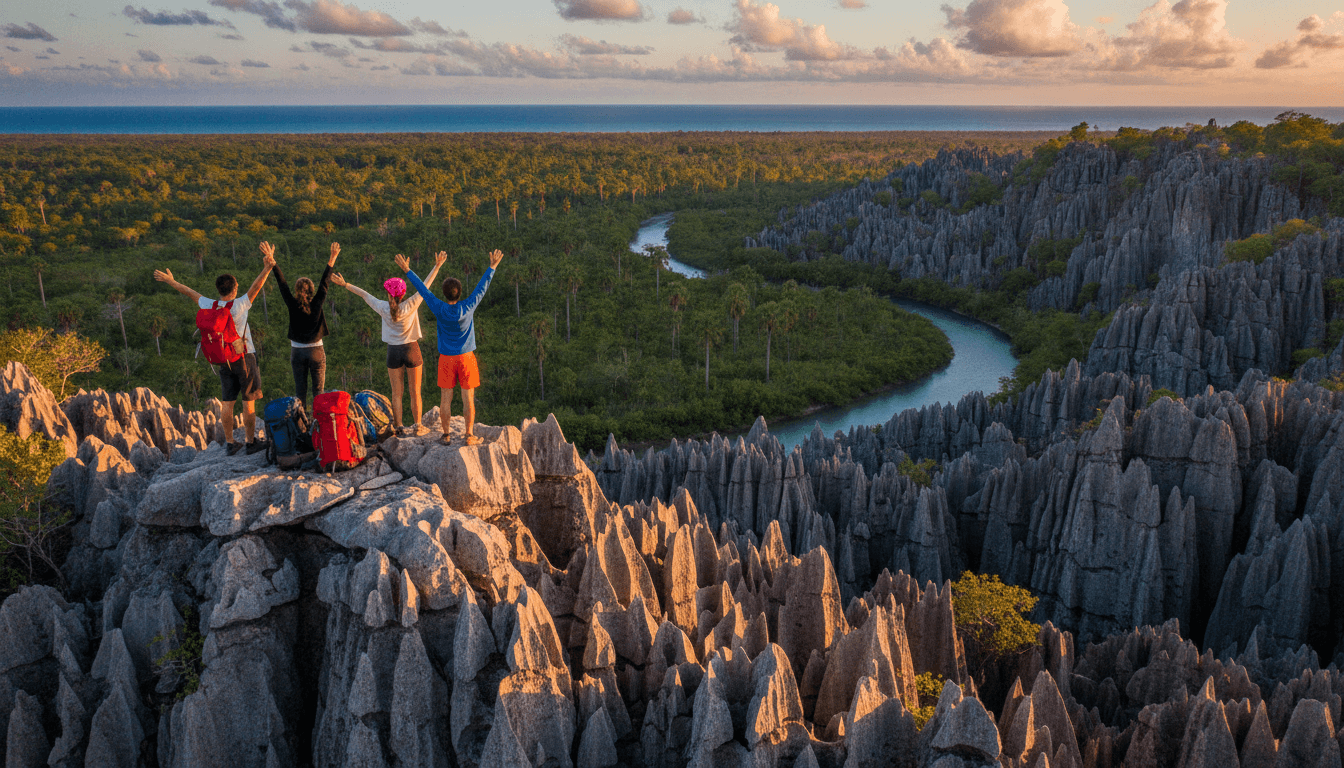
Self-Launched Madagascar Wildlife Adventure
16 days · Madagascar
Exodus charges £3,999
No-markup version: ~£1,350 per person
Estimate only, not a guaranteed price. Always verify costs independently before booking.
Madagascar is one of the world's great wildlife destinations — 80 million years of isolation have produced creatures found nowhere else on Earth. This self-launched equivalent of Exodus's Madagascar Wildlife Adventure covers the same south and west circuit: Kirindy Forest, the Avenue of the Baobabs, the dramatic stone forests of Tsingy de Bemaraha, cycling around Antsirabe, two full days in Ranomafana's rainforest, and the canyon landscapes of Isalo. By booking local transport, guesthouses, and park guides directly, you can experience the same extraordinary wildlife moments at a fraction of the guided group price. Budget accommodation in Madagascar is generally simple but comfortable — basic en-suite guesthouses and small hotels are the norm outside Tana. Allow extra flexibility for internal flights, which can be pricey and have limited availability — book these as early as possible via Air Madagascar / Tsaradia.
Day-by-day
Arrive in Antananarivo
Antananarivo
Fly into Ivato International Airport (TNR). Antananarivo — Tana to locals — is a sprawling, hilly capital with a charming old quarter and great street food. Check into your guesthouse in the Haute-Ville area, grab a hearty Malagasy meal of romazava (beef and greens stew) at a local hotely (local restaurant), and pick up an Airtel or Telma SIM card for data. Spend the evening studying your onward internal flight booking and sorting any last-minute supplies.
🚌International flight to Ivato International Airport (TNR). Airport taxi to city centre ~£8–12; agree the price before you get in.
🛏Hotel Sakamanga or La Varangue guesthouse, Antananarivo — budget rooms ~£20–30/night
- →Explore the Haute-Ville (Upper Town) on foot — wander the steep alleys and market stalls
- →Visit the Zoma-like Analakely market for provisions
- →Grab dinner at a local hotely — try romazava or ravitoto for under £3
Fly to Morondava • Avenue of the Baobabs • Kirindy Forest Night Walk
Kirindy Forest
Take an early Tsaradia domestic flight from Tana to Morondava (approx. 1.5 hrs, book well in advance). At Morondava, hire a local taxi-brousse (shared minibus) or negotiate a shared 4WD with other travellers heading to Kirindy Forest — the road is unpaved and takes about 3 hours. En route, stop at the iconic Avenue of the Baobabs, a short section of dirt road flanked by ancient baobab trees up to 1,000 years old. Arrive at Kirindy Forest and arrange a night walk with the on-site guides — the reserve charges an entry fee and guides are mandatory but bookable directly at the gate.
🚌Tsaradia flight Tana–Morondava (~£70 avg). Shared 4WD/taxi-brousse Morondava–Kirindy ~£5–8pp.
🛏Relais du Kirindy or Camp Amoureux guesthouse, Kirindy — basic bungalows ~£18–25/night
- →Tsaradia domestic flight Tana–Morondava (book via tsaradia.com or a local agent, ~£60–90 one way)
- →Stop at the Avenue of the Baobabs — free to walk; best light is late afternoon
- →Night walk in Kirindy Forest private reserve — entry + guide bookable at gate ~£10–15pp
- →Spot up to 8 lemur species including Verreaux's sifaka and fossa
Early Morning Forest Walk • Drive to Bemaraha National Park
Bekopaka / Tsingy de Bemaraha
Wake before dawn for a guided morning walk in Kirindy Forest — the light is spectacular and sifaka lemurs are most active at this time. After breakfast, begin the long drive to Bekopaka village at the entrance of Tsingy de Bemaraha National Park. You'll pass through Belo Tsiribihina and take two ferry crossings over the Tsiribihina River — a memorable part of the journey in itself. The road is rough and the full journey takes around 7 hours; sharing a 4WD with other travellers keeps costs down. Book accommodation in Bekopaka in advance — options are limited.
🚌Shared 4WD Kirindy–Bekopaka via Belo Tsiribihina ~£15–20pp (negotiate with other travellers at the guesthouse).
🛏Orchidée du Bemaraha or Chez Gaspard guesthouse, Bekopaka — basic bungalows ~£20–30/night
- →Early morning guided walk in Kirindy Forest — included with gate entry
- →Two river ferry crossings over the Tsiribihina River (small fee, paid locally ~£1–2pp each)
- →Arrive Bekopaka village and book Big and Small Tsingy park permits for following days directly at the ANGAP office (~£15–20pp per day)
Canoe Ride on the Manambolo River • Small Tsingy
Tsingy de Bemaraha National Park
Today is spent inside Tsingy de Bemaraha National Park, a UNESCO World Heritage Site. Begin with a two-hour guided canoe ride on the Manambolo River — pirogues (dugout canoes) with a local steersperson can be arranged through your guesthouse or directly at the park office for a small fee. Your Bara guide will explain the local customs, sacred caves, and funerary traditions of the river valley. In the afternoon, walk the Small Tsingy circuit (~5km), an eerie maze of needle-sharp limestone pinnacles where ring-tailed lemurs, white Decken's sifakas, and giant chameleons are regularly spotted. Harnesses and helmets are provided at the park gate.
🚌Short transfer within park by vehicle (~£3–5pp, shared).
🛏Orchidée du Bemaraha or Chez Gaspard guesthouse, Bekopaka — basic bungalows ~£20–30/night
- →Guided canoe (pirogue) ride on the Manambolo River — arrange at park office ~£8–12pp
- →Small Tsingy circuit walk (~5km) with park guide — included in daily park permit
- →Spot ring-tailed lemurs, Bemaraha woolly lemurs and giant chameleons
- →Learn about Bara ethnic group customs and traditions from your local guide
Big Tsingy — The Giant Stone Forest
Tsingy de Bemaraha National Park
An unforgettable and physically demanding day navigating the Big Tsingy, where limestone needles soar up to 60 metres high. The park provides harnesses and helmets at the entrance (small fee). A mandatory park guide will lead you along suspended walkways, through narrow cissures, and up ladders bolted into the rock face. Pack a lunch from your guesthouse to eat with extraordinary views at the summit plateau. Allow a full day — most circuits take 5–7 hours. This is one of the most extraordinary landscapes on Earth and well worth the effort.
🚌Short transfer to Big Tsingy entrance (~£3–5pp, shared).
🛏Orchidée du Bemaraha or Chez Gaspard guesthouse, Bekopaka — basic bungalows ~£20–30/night
- →Full-day Big Tsingy circuit with mandatory park guide — included in park permit (~£15–20pp)
- →Harness and helmet hire at gate ~£3–5pp
- →Spot endemic birds, chameleons and lemurs in the canyons
- →Packed lunch from guesthouse to eat at viewpoint — arrange the evening before
Return to Morondava • Sunset at the Avenue of the Baobabs
Morondava
A long day on the road retracing the route back to Morondava via the two ferry crossings. Time your arrival to hit the Avenue of the Baobabs around golden hour — the silhouettes of the ancient trees against the sunset sky is one of Africa's great photographic moments. Stay in Morondava tonight; it's a pleasant coastal town with seafood restaurants along the beachfront strip.
🚌Shared 4WD Bekopaka–Morondava ~£15–20pp (8 hrs on dirt roads).
🛏Hotel Chez Maggie or Hotel Les Bougainvillées, Morondava — rooms ~£20–30/night
- →Return ferry crossings over the Tsiribihina River (~£1–2pp each)
- →Sunset at the Avenue of the Baobabs — free access, arrive by 5pm for best light
- →Seafood dinner in Morondava waterfront — fresh crab and zebu dishes ~£5–8pp
Drive to Miandrivazo
Miandrivazo
A full day's drive east through the arid, wide-open landscapes of western Madagascar to the riverside town of Miandrivazo. The scenery is remarkably varied — dry savannah gives way to agricultural plains and the occasional small market town. Taxi-brousse (shared minibus) services connect Morondava to Miandrivazo; alternatively, share a private 4WD with fellow travellers for comfort on the rough roads. Miandrivazo is a transit town — accommodation is basic but adequate.
🚌Taxi-brousse or shared 4WD Morondava–Miandrivazo ~£8–12pp (8 hrs).
🛏Princesse Tsiribihina guesthouse or similar basic hotel, Miandrivazo — rooms ~£12–18/night
- →Watch the dramatic landscape change from coastal scrub to highland approaches
- →Stop at roadside villages and sample street snacks — skewered zebu meat and fresh coconut
- →Optional: ask your accommodation about a short evening walk along the Mahajilo riverbank
Drive to Antsirabe
Antsirabe
Another long driving day heads east and up into the cool central highlands, arriving in Antsirabe — a charming colonial-era town known for its rickshaws, thermal springs, and craft workshops. The landscape shifts dramatically from scrubby western plains to terraced rice paddies and forested hillsides. If you have time before departing Miandrivazo, you can arrange a short pirogue excursion on the Mahajilo River through your guesthouse. Antsirabe has decent guesthouses, good restaurants, and is large enough to stock up on supplies.
🚌Taxi-brousse or shared 4WD Miandrivazo–Antsirabe ~£8–12pp (8 hrs).
🛏Chambres du Voyageur or Hotel Trianon, Antsirabe — rooms ~£20–28/night
- →Optional morning pirogue ride on the Mahajilo River at Miandrivazo (~£5pp, arrange through guesthouse)
- →Arrive Antsirabe and take a rickshaw (pousse-pousse) orientation ride around the colonial centre ~£2
- →Visit the Craft Artisans Centre — Antsirabe is famous for recycled aluminium crafts and embroidery
- →Sample vary (local rice and beans) at a hotely restaurant
Cycling Adventure Around Antsirabe
Antsirabe
Spend today exploring Antsirabe and its surrounding villages by bicycle — one of the best ways to get under the skin of Malagasy rural life. Bikes can be hired from several guesthouses or local rental shops for around £5–8/day. The classic route heads out of town on dirt roads past rice paddies, brick kilns, and vegetable fields, looping around Lake Andraikiba (~35km round trip). The terrain is gently hilly and suitable for most fitness levels. Local cycling guides can be hired through your guesthouse for around £10–15 and are worth it for village access and introductions.
🚌Bicycle (hired locally). Short taxi transfer back to town if needed ~£2.
🛏Chambres du Voyageur or Hotel Trianon, Antsirabe — rooms ~£20–28/night
- →Hire a bicycle from your guesthouse or local rental shop ~£5–8/day
- →Optional local cycling guide ~£10–15 (recommended for village visits)
- →Cycle to Lake Andraikiba via rice paddies and brick-making villages (~35km loop)
- →Visit traditional highland villages and meet Betsileo farmers
- →Optional: visit Antsirabe thermal baths in the afternoon ~£3pp
Drive to Ranomafana National Park
Ranomafana
Head southeast from Antsirabe toward Ranomafana National Park, stopping in Ambositra — the woodcarving capital of Madagascar — to browse artisan workshops and pick up handcrafted souvenirs. The road descends from cool highlands into increasingly lush, steamy rainforest as you approach Ranomafana. The park entrance is in the village of the same name, where several guesthouses cluster along the main road. Book your park permits and guide on arrival at the ANGAP park office for the following two days of wildlife watching.
🚌Taxi-brousse or shared 4WD Antsirabe–Ranomafana ~£8–12pp (7 hrs, with Ambositra stop).
🛏Hotel Manja or Setam Lodge, Ranomafana — rooms ~£18–28/night
- →Stop in Ambositra to visit woodcarving workshops — free to browse, items from £2
- →Arrive Ranomafana and book two-day park permit + guide at ANGAP office (~£15–20pp/day)
- →Evening stroll along the roadside near the park entrance — look for chameleons at dusk
Full-Day Wildlife Walk in Ranomafana National Park
Ranomafana National Park
Spend a full day deep inside Ranomafana, a UNESCO World Heritage rainforest famous as the discovery site of the golden bamboo lemur. Your mandatory park guide (booked at the ANGAP office) will lead you along ~10km of forest trails in search of flagship species. Black-and-white ruffed lemurs, greater bamboo lemurs, and the rare golden bamboo lemur are the stars; there are also nearly 100 amphibian species, endemic birds, and extraordinary flora. After dinner, join an optional night walk along the forest edge near the park entrance — your guesthouse can arrange this for ~£8–12pp.
🚌Walk or short taxi to park entrance ~£1–2.
🛏Hotel Manja or Setam Lodge, Ranomafana — rooms ~£18–28/night
- →Full-day guided walk in Ranomafana NP with mandatory park guide (~10km trails)
- →Search for golden bamboo lemurs, ruffed lemurs, and greater bamboo lemurs
- →Spot chameleons, leaf-tailed geckos, and endemic birds
- →Optional night walk along forest edge near park entrance ~£8–12pp (arrange through guesthouse)
Second Day in Ranomafana — More Wildlife & Optional Hot Springs
Ranomafana National Park
A second full day in Ranomafana maximises your chances of encountering different species — no two days in the rainforest are the same. Take a different trail with your guide and focus on birds and amphibians if you've already ticked off the main lemur species. In the afternoon, visit the Ranomafana thermal pool in the village — you can soak in natural hot spring water for a small fee (~£2). Alternatively, join another optional night walk for a second chance at nocturnal species like mouse lemurs and giant pill millipedes.
🚌Walk or short taxi to park entrance ~£1–2.
🛏Hotel Manja or Setam Lodge, Ranomafana — rooms ~£18–28/night
- →Second guided day walk in Ranomafana NP on different trail — park permit + guide ~£15–20pp
- →Focus on birds: ground-rollers, vangas, and the endemic Pitta-like ground roller
- →Afternoon visit to Ranomafana hot spring thermal pool ~£2pp
- →Optional second night walk ~£8–12pp
Drive to Isalo via Anjà Community Reserve
Isalo National Park
Set out early on the long drive southwest to Isalo National Park, breaking the journey with a stop at the Anjà Community Reserve near Ambalavao. Anjà is a small, community-run reserve where ring-tailed lemurs are easily spotted among the giant boulders — it's one of the best places in Madagascar for close encounters. Your entry fee goes directly to the local Betsileo community. Ask your guide to point out the two ancient family tombs carved into the cliff face, which give fascinating insight into local funerary customs.
🚌Shared 4WD or taxi-brousse Ranomafana–Ranohira (Isalo) via Anjà ~£10–15pp (8 hrs total).
🛏Isalo Rock Lodge budget room or Chez Alice guesthouse, Ranohira — rooms ~£20–30/night
- →Stop at Anjà Community Reserve (~1.5 hrs from Ranomafana) — entry + guide ~£5–8pp
- →Spot ring-tailed lemurs at close range among the boulders
- →Visit Betsileo family tombs on the cliffs — learn about local funerary traditions
- →Arrive Isalo and book park permits for tomorrow at the park office (~£12–18pp)
Explore Isalo National Park — Canyons, Lemurs & Bara Tombs
Isalo National Park
A full day exploring Isalo, a vast and visually stunning park of sandstone canyons, gorges, and rock formations sculpted by millennia of wind and water. The landscape shifts between ochre-red rock, grassy plains, and lush canyon oases fed by crystal-clear streams — you can swim in the natural rock pools mid-hike. A mandatory guide from the park office will lead you on a trail of up to 15km, passing Bara people's painted cliff tombs and spotting lemur species including ringtails and Verreaux's sifakas. This is one of the most rewarding days on the whole trip.
🚌Short transfer to trailhead ~£2–4pp.
🛏Isalo Rock Lodge budget room or Chez Alice guesthouse, Ranohira — rooms ~£20–30/night
- →Full-day guided hike in Isalo NP with mandatory park guide (~12–15km circuit)
- →Swim in natural rock pool oasis within the canyon
- →Spot ring-tailed lemurs, Verreaux's sifaka, and endemic birds
- →Visit Bara people's painted cliff tombs and learn about local mortuary traditions
- →Watch sunset over the sandstone formations from the viewpoint near Ranohira
Drive to Ifaty (or Tuléar) • Farewell Dinner
Ifaty / Tuléar
A long final driving day heads southwest to the coast. Depending on your Tsaradia return flight schedule from Tuléar (TLE) back to Tana, you'll either stay overnight in Ifaty (a laid-back beach village famous for its coral reef and baobab forest) or push straight to Tuléar for an afternoon or evening flight. Ifaty is a wonderful final night spot — beachside bungalows, fresh lobster, and an atmosphere a world away from the national parks. Celebrate your adventure with a farewell dinner and a local THB beer.
🚌Shared 4WD or taxi-brousse Ranohira–Ifaty/Tuléar ~£10–15pp (8.5 hrs).
🛏Le Paradisier bungalows or Bamboo Club, Ifaty — beachside bungalows ~£20–30/night; or Hotel Central, Tuléar if flying same day
- →Arrive Ifaty beach — relax on the beach or snorkel the offshore coral reef ~£8–12 with local boat
- →Visit the Reniala private nature reserve in Ifaty for spiny forest baobabs ~£5pp
- →Farewell dinner at a beachside restaurant — fresh lobster or reef fish ~£8–15pp
- →Optional: book early morning flight Tuléar–Tana via tsaradia.com (~£50–80pp)
Return to Antananarivo — Adventure Ends
Antananarivo
If you stayed in Ifaty, take a short taxi transfer (1 hr) to Tuléar Airport (TLE) for the Tsaradia domestic flight back to Tana (~1 hr). If staying on for extra nights in Tana, Hotel Sakamanga or La Varangue are excellent bases. Tana's Zoma market is worth revisiting for last-minute souvenirs — vanilla, ylang-ylang oil, handwoven raffia, and carved zebu horn items are Madagascar's best buys. International departures from Ivato Airport (TNR).
🚌Taxi Ifaty–Tuléar ~£8pp. Tsaradia flight Tuléar–Tana ~£65 avg. Airport taxi Tana ~£8–12.
🛏Hotel Sakamanga, Antananarivo (if overnight needed) — rooms ~£25–35/night
- →Tsaradia flight Tuléar–Antananarivo ~£50–80pp (book in advance)
- →Last-minute souvenir shopping at Analakely market in Tana — vanilla and artisan crafts
- →Optional lunch at a Tana rooftop restaurant with highland views
- →Transfer to Ivato International Airport for onward international flight
Self-launched vs. Exodus
| This itinerary (self-launched) | Exodus | |
|---|---|---|
| Price per person | ~£1,350 | £3,999 |
| Duration | 16 days | 16 days |
| Who books it | You and your group, direct | Tour operator, guided group |
| Savings | £2,649 per person (66%) | |
Estimate only, not a guaranteed price. Always verify costs independently before booking.
Want to see more Exodus-style trips? Check them out here.~£1,350
estimated per person
You never pay Travel Crew for this — you pay hostels, transport, and activity providers directly, the same as if you'd booked it all yourself.
This publishes your dates so other travellers can find and join you — no tour operator needed.
Customise with Tour BusterCreated by

Travel Crew
0 trips
Frequently asked questions
How much does Self-Launched Madagascar Wildlife Adventure cost?+
Doing it yourself with this self-launched itinerary costs an estimated £1,350 per person for 16 days in Madagascar. This is an AI-generated estimate based on typical budget-traveller prices — actual costs will vary by season and how you book.
Is this cheaper than booking with Exodus?+
Yes — Exodus charges around £3,999 per person for a similar tour. Doing the same route independently, using the same standard of accommodation and activities, costs an estimated £1,350 — a saving of roughly £2,649 (66%) per person.
How long is the Madagascar trip?+
This itinerary runs 16 days, covering 16 day-by-day stops through Madagascar.
How do I join this trip?+
You can join an existing open departure using this itinerary if one is scheduled, or launch your own departure with your own dates and invite other travellers to join you — no tour operator required.
Isn't it easier to just use a tour operator?+
Well, yes, a tour operator will book all the individual parts of your travel for you and provide a guide. That's obvious, but doing this has the potential to save the group thousands, which can in turn improve your itinerary substantially or save you huge amounts of money. Also, when you launch a departure, Travel Crew has tools in place to help you book the individual sections of the trip or make it easier for you to do this as a group. Really, you do not need a middle man. If you are more comfortable paying more and using a middle man, then you should certainly do this.
Is it safer to book through a tour operator?+
Arguably, there isn't much difference. A self-launched trip runs on the same principle as a group travel crew: collective responsibility, everyone looking out for each other, the same way it would if a group of friends organised the trip themselves — because that's exactly what's happening. You should always take out travel insurance before you go, self-launched or not; that doesn't change either way. Every open departure is published publicly with real dates and a real trip organiser, so it's never an anonymous arrangement, and our support team is reachable any time you need help, including in an emergency while you're away. Longer-term, we're building direct relationships with ground DMCs in popular destinations, offered as an optional paid add-on for extra on-the-ground support. Ultimately, though, the group is responsible for its own conduct and safety on a self-launched trip, same as on any trip you plan yourself.
What kind of trip is this?+
This is a wildlife, adventure, culture trip through Madagascar, self-launched rather than run by a tour operator — you organise it with a group you find or bring yourself.
Would you like to name the operator, name the trip, or have any suggestions about how to improve this itinerary?
Drop your comment below — if you've done a similar route, tell us what worked, what you'd add, or what you'd skip.
No comments yet — be the first to share your take.
Sign in to leave a comment.