
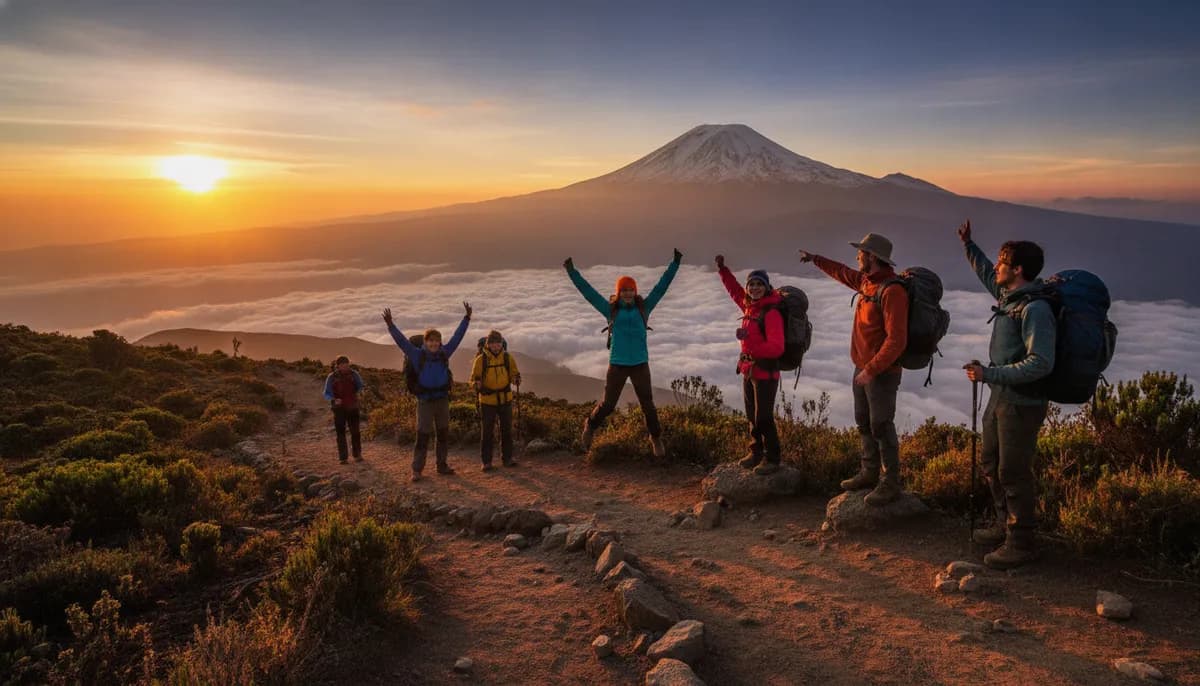
Kilimanjaro Rongai Route — 6 Days Self-Launched Trek
6 days · Kilimanjaro, Tanzania
Samora Explorers Ltd charges £1,470
No-markup version: ~£1,290 per person
Estimate only, not a guaranteed price. Always verify costs independently before booking.
A self-launched version of the classic 6-day Rongai Route on Kilimanjaro — the quietest, driest approach from the Kenyan side of the mountain. Instead of booking the full package tour, you'll arrange a licensed guide, cook and porters directly in Moshi or Arusha (mandatory by Tanzanian park rules, but far cheaper booked direct or via a locally-owned operator), hire any cold-weather gear, and take a shared shuttle to the Rongai Gate yourself. You climb through farmland, pine forest, moorland and the lunar saddle between Mawenzi and Kibo before a midnight summit push to Uhuru Peak (5,895 m). Costs here assume a shared self-arranged crew — a solo climber will pay noticeably more; pairing up with another trekker in Moshi is the single biggest saving.
Day-by-day
Moshi → Rongai Gate → Simba Camp (2,600 m)
Moshi / Rongai Gate / Simba Camp
Get an early shared shuttle or dalla-dalla from Moshi to the Rongai Gate on the Kenyan border (about 3 hours, ~£25 for a seat in a shared 4x4 with your crew). Register and pay park fees at the gate, then walk gently up through maize fields, pine forest and heather. Keep an eye out for colobus monkeys and the occasional elephant or buffalo — this northern side is much quieter than Marangu. It's a short 4–5 hour day designed purely to get you high and acclimatising early.
🚌Shared 4x4 shuttle from Moshi to Rongai Gate (~£25), then on foot
🛏Tent at Simba Camp (provided by your arranged trek crew)
- →Gate registration and permit check
- →Trek through farmland and pine forest
- →Wildlife spotting — colobus monkeys, birds
Simba Camp → First Caves → Kikelewa Camp (3,634 m)
Simba Camp / First Caves / Kikelewa Camp
A solid 6–7 hour day climbing steadily through heathland to the First Caves for lunch — a natural lava-tube overhang that makes a memorable lunch stop. In the afternoon the vegetation thins out completely as you cross open moorland to Kikelewa Camp, tucked under the jagged spires of Mawenzi. Drink as much water as you can (3–4 litres) and go slow — today is where altitude starts to bite if you rush it.
🚌On foot (~9 km)
🛏Tent at Kikelewa Camp
- →Lunch stop at First Caves
- →Moorland trek to Kikelewa Camp
- →Acclimatisation walking
Kikelewa Camp → Mawenzi Tarn (4,330 m)
Kikelewa Camp / Mawenzi Tarn
A short but steep day — only about 4 hours, climbing grassy slopes and rock steps onto the saddle beneath Mawenzi, Kilimanjaro's second-highest peak. The campsite at Mawenzi Tarn is one of the most spectacular on the mountain: a green glacial tarn ringed by dark volcanic towers. Spend the afternoon on an acclimatisation walk up one of the ridges above camp, then eat early and sleep.
🚌On foot (~6 km, steep)
🛏Tent at Mawenzi Tarn
- →Steep climb up grassy slopes
- →Acclimatisation ridge walk above camp
- →Sunset over Mawenzi's spires
Mawenzi Tarn → Saddle → Kibo Hut (4,703 m)
Mawenzi Tarn / Kibo Hut
The long, exposed walk across the alpine desert saddle between Mawenzi and Kibo — 5–6 hours on a lunar, waterless landscape at 4,500 m+. You'll arrive at Kibo Hut in early afternoon, right at the foot of the summit scree. Eat a big early dinner (5 pm) and try to sleep before the midnight start. Keep your summit layers and headtorch packed and ready by the door.
🚌On foot (~9 km across the saddle)
🛏Tent or hut dorm at Kibo Hut
- →Trek across the Mawenzi–Kibo saddle
- →Arrival and rest at Kibo Hut
- →Summit brief with guide
Summit Day — Uhuru Peak (5,895 m) → Horombo Hut (3,720 m)
Kibo Hut / Gilman's Point / Uhuru Peak / Horombo Hut
The big one. Up at around 11 pm for tea and biscuits, then a slow zigzag on scree in the dark — 5–6 hours to Gilman's Point (5,681 m) on the crater rim, then another 1.5–2 hours around the crater edge to Uhuru Peak, Africa's highest point at 5,895 m. Take photos, celebrate briefly, then get down — the descent to Kibo Hut is a fast scree scree-run (2 hours), followed by a 3–4 hour walk down to Horombo Hut. This is the toughest day of the trek; keep moving on the descent and don't skip water.
🚌On foot (~16 km up and down, 12–14 hours)
🛏Tent or hut dorm at Horombo Hut
- →Midnight summit push
- →Hans Meyer Cave (5,150 m)
- →Gilman's Point (5,681 m)
- →Uhuru Peak (5,895 m)
- →Long descent to Horombo Hut
Horombo Hut → Marangu Gate → Moshi / Arusha
Horombo Hut / Mandara Hut / Marangu Gate / Moshi
A relaxed 5–6 hour descent through the rainforest, passing Mandara Hut and keeping an eye out for blue monkeys. Sign out and collect your summit certificate at Marangu Gate (bring cash for tips for your guide, cook and porters — budget roughly £80–120 per trekker for a 6-person crew). Catch a shared shuttle or dalla-dalla back down to Moshi or Arusha, then a cheap guesthouse, a hot shower and a very large meal.
🚌On foot (~20 km descent), then shared shuttle Marangu to Moshi (~£10)
🛏Budget guesthouse in Moshi (~£15)
- →Descent past Mandara Hut
- →Certificate collection at Marangu Gate
- →Tip distribution to your crew
Self-launched vs. Samora Explorers Ltd
| This itinerary (self-launched) | Samora Explorers Ltd | |
|---|---|---|
| Price per person | ~£1,290 | £1,470 |
| Duration | 6 days | 6 days |
| Who books it | You and your group, direct | Tour operator, guided group |
| Savings | £180 per person (12%) | |
Estimate only, not a guaranteed price. Always verify costs independently before booking.
Want to see more Samora Explorers Ltd-style trips? Check them out here.~£1,290
estimated per person
You never pay Travel Crew for this — you pay hostels, transport, and activity providers directly, the same as if you'd booked it all yourself.
This publishes your dates so other travellers can find and join you — no tour operator needed.
Customise with Tour BusterCreated by

Travel Crew
0 trips
Frequently asked questions
How much does Kilimanjaro Rongai Route — 6 Days Self-Launched Trek cost?+
Doing it yourself with this self-launched itinerary costs an estimated £1,290 per person for 6 days in Kilimanjaro, Tanzania. This is an AI-generated estimate based on typical budget-traveller prices — actual costs will vary by season and how you book.
Is this cheaper than booking with Samora Explorers Ltd?+
Yes — Samora Explorers Ltd charges around £1,470 per person for a similar tour. Doing the same route independently, using the same standard of accommodation and activities, costs an estimated £1,290 — a saving of roughly £180 (12%) per person.
How long is the Kilimanjaro, Tanzania trip?+
This itinerary runs 6 days, covering 6 day-by-day stops through Kilimanjaro, Tanzania.
How do I join this trip?+
You can join an existing open departure using this itinerary if one is scheduled, or launch your own departure with your own dates and invite other travellers to join you — no tour operator required.
Isn't it easier to just use a tour operator?+
Well, yes, a tour operator will book all the individual parts of your travel for you and provide a guide. That's obvious, but doing this has the potential to save the group thousands, which can in turn improve your itinerary substantially or save you huge amounts of money. Also, when you launch a departure, Travel Crew has tools in place to help you book the individual sections of the trip or make it easier for you to do this as a group. Really, you do not need a middle man. If you are more comfortable paying more and using a middle man, then you should certainly do this.
Is it safer to book through a tour operator?+
Arguably, there isn't much difference. A self-launched trip runs on the same principle as a group travel crew: collective responsibility, everyone looking out for each other, the same way it would if a group of friends organised the trip themselves — because that's exactly what's happening. You should always take out travel insurance before you go, self-launched or not; that doesn't change either way. Every open departure is published publicly with real dates and a real trip organiser, so it's never an anonymous arrangement, and our support team is reachable any time you need help, including in an emergency while you're away. Longer-term, we're building direct relationships with ground DMCs in popular destinations, offered as an optional paid add-on for extra on-the-ground support. Ultimately, though, the group is responsible for its own conduct and safety on a self-launched trip, same as on any trip you plan yourself.
What kind of trip is this?+
This is a adventure, hiking, gap-year trip through Kilimanjaro, Tanzania, self-launched rather than run by a tour operator — you organise it with a group you find or bring yourself.
Would you like to name the operator, name the trip, or have any suggestions about how to improve this itinerary?
Drop your comment below — if you've done a similar route, tell us what worked, what you'd add, or what you'd skip.
No comments yet — be the first to share your take.
Sign in to leave a comment.