
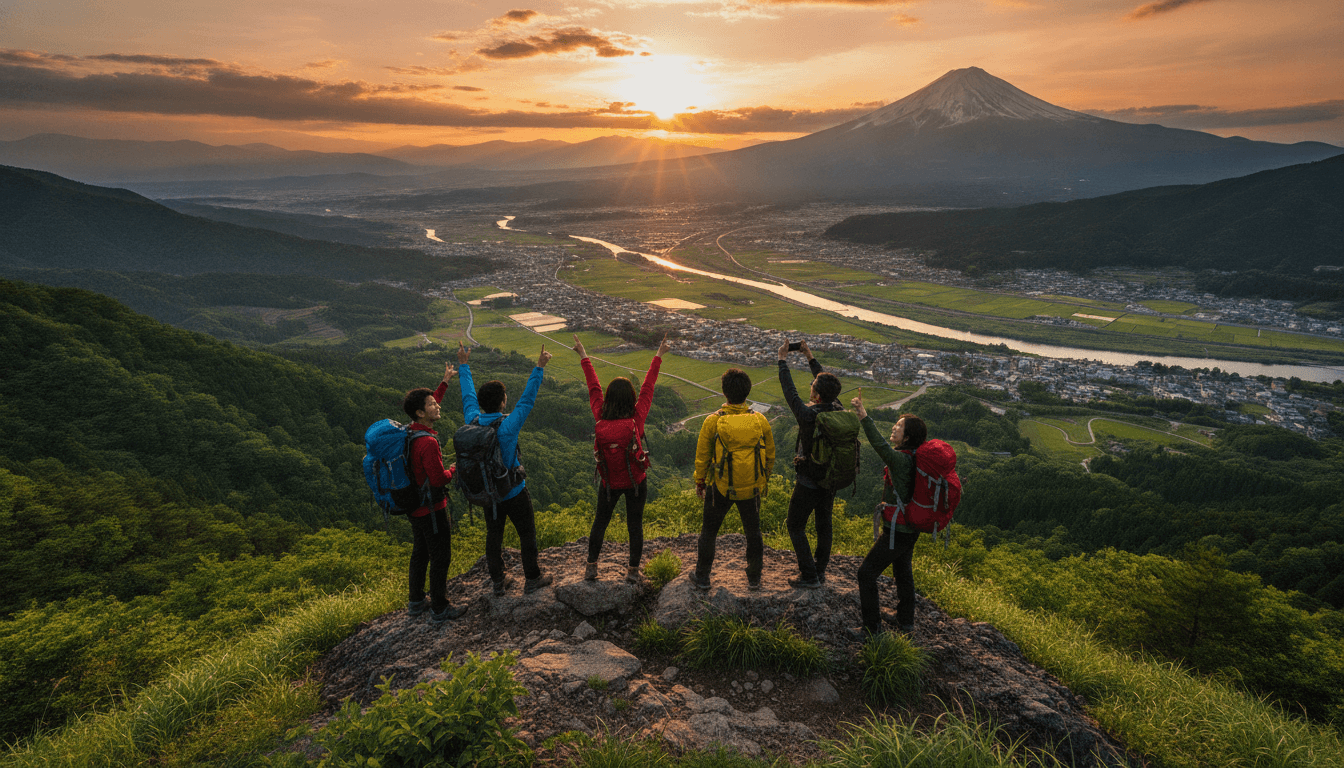
Self-Launched Highlights of Japan: Tokyo to Osaka in 8 Days
8 days · Japan
Exodus charges £3,930
No-markup version: ~£1,050 per person
Estimate only, not a guaranteed price. Always verify costs independently before booking.
Same iconic route as the Exodus guided group tour — Tokyo, Nikko, Kyoto, Hiroshima, Miyajima and Osaka — but done independently at a fraction of the price. You'll ride the same Shinkansen bullet trains, visit the same UNESCO shrines, temples and peace memorials, and stay in comparable hotels and traditional guesthouses. Japan is one of the most self-launched-friendly countries in the world: public transport is world-class, signage is excellent in English, and almost every attraction is independently bookable. All costs are approximate estimates per person based on budget/mid-range travel in 2024–25.
Day-by-day
Arrive in Tokyo — First Impressions of the Capital
Tokyo
Arrive into Tokyo Narita (NRT) or Haneda (HND) and make your way to your accommodation in central Tokyo. From Narita, take the Narita Express (N'EX) to Shinjuku or Tokyo Station (~£20, ~90 mins). From Haneda, the Tokyo Monorail or Keikyu Line gets you into the city in under 30 minutes (~£4). Check in, pick up a Suica or Pasmo IC card from any station — this prepaid card works on almost all metro, bus and rail in Japan, so top it up and keep it handy throughout the trip. Spend the evening exploring your neighbourhood. If you're staying near Akasaka or Shinjuku, grab dinner at a local ramen or izakaya spot — budget around £10–15 for a solid meal and a beer.
🚌Narita Express from airport to central Tokyo (~£20) or Keikyu Line from Haneda (~£4). Use Suica card on Tokyo Metro throughout the trip.
🛏Khaosan Tokyo Kabuki Hostel (Asakusa area, ~£18–22/night) or K's House Tokyo (budget-friendly, highly rated for solo travellers)
- →Arrive and navigate to central Tokyo via Narita Express (~£20) or Keikyu/Monorail from Haneda (~£4)
- →Pick up a Suica or Pasmo IC card at the station for seamless travel throughout Japan
- →Evening wander around Akasaka or Shinjuku — find a local izakaya or ramen shop for dinner
Tokyo City Day — Asakusa, Senso-ji, Ginza & Harajuku
Tokyo
Today mirrors the Exodus guided day: use the Tokyo Metro to explore the city's highlights under your own steam. Start early at Asakusa to beat the crowds at Senso-ji Temple, Tokyo's oldest Buddhist temple — entry is free. Browse Nakamise-dori, the street of traditional craft shops leading to the temple. Hop the metro to Ginza for a window-shop along the famous luxury boulevard, then continue to Harajuku to visit Meiji Shrine (free entry), set within a calming 120,000-tree forest. Stroll Omotesando Avenue afterwards. The afternoon and evening are yours — consider Shibuya Crossing at dusk for the full sensory overload. A day metro pass costs ~£7.
🚌Tokyo Metro — buy a 24-hour day pass for ~£7, or use your Suica IC card for individual journeys (~£1–2 per ride)
🛏Khaosan Tokyo Kabuki Hostel or K's House Tokyo (same as Day 1)
- →Morning visit to Senso-ji Temple and Nakamise-dori shopping street in Asakusa (free entry)
- →Metro to Ginza for a stroll along Tokyo's most glamorous boulevard
- →Visit Meiji Shrine in Harajuku — a tranquil forested escape (free entry)
- →Walk Omotesando Avenue and explore Harajuku's Takeshita Street
- →Optional: evening visit to Shibuya Crossing — the world's busiest pedestrian scramble
Day Trip to Nikko — Shrines, Cedar Forests & a Traditional Guesthouse
Nikko
After breakfast, travel from Tokyo to Nikko. The most budget-friendly option is the Tobu Nikko Line from Asakusa Station using the Tobu Nikko Pass (~£17 return), which includes unlimited local bus use in Nikko. Alternatively, take a JR train to Utsunomiya and change for Nikko (~£25 each way, covered by JR Pass if you have one). Journey time is approximately 2 hours. In Nikko, walk the main shrine area: start at the iconic vermillion Shinkyo Bridge (small entry fee ~£3), then head up to the lavishly decorated Toshogu Shrine complex (~£9 entry). The forested mountain setting is stunning in any season. Pack a small overnight bag before leaving Tokyo — you'll be reunited with your main luggage in Kyoto. Overnight at Turtle Inn Nikko, a beloved traditional guesthouse, or a similar budget ryokan.
🚌Tobu Nikko Pass from Asakusa (~£17 return) includes unlimited local buses in Nikko. Journey ~2 hours each way.
🛏Turtle Inn Nikko (~£40–50/night including dinner and breakfast, traditional guesthouse) or Nikko Tokanso (budget ryokan option)
- →Travel from Tokyo (Asakusa) to Nikko via Tobu Nikko Line (~£17 return with Tobu Nikko Pass)
- →Visit the Shinkyo Bridge — one of Japan's most photographed landmarks (~£3 entry)
- →Explore Toshogu Shrine complex, the ornate mausoleum of Tokugawa Ieyasu (~£9 entry)
- →Wander the cedar-lined paths and surrounding forest trails
- →Overnight in a traditional Japanese guesthouse (tatami rooms, communal baths)
Nikko to Kyoto — Nishiki Market & the Gion Geisha District
Kyoto
Travel from Nikko to Kyoto, a longer journey of around 4–5 hours total. Head back to Tokyo or Utsunomiya first, then pick up the Shinkansen Tokaido Line to Kyoto Station (from Tokyo ~£80–100 without JR Pass, or covered by JR Pass). If you're doing the full 8-day itinerary, purchasing a 7-day JR Pass (~£280) before you leave home can offer good value covering this and other Shinkansen legs. Pick up a bento lunch at the station — this is a true Japanese travel ritual! After checking in, head straight to Nishiki Market ('Kyoto's Kitchen') — a narrow covered arcade of food stalls and specialist shops, perfect for grazing on Japanese street snacks. In the late afternoon, walk to the Gion district and stroll Hanami-koji street as dusk falls — your best chance of spotting a Geiko or Maiko heading to an evening engagement.
🚌Tobu Nikko to Utsunomiya or Tokyo (~£15), then Shinkansen Tokaido Line Tokyo–Kyoto (~£80–100 standard, or JR Pass). Total ~4.5 hours.
🛏Piece Hostel Sanjo Kyoto (~£20–28/night, excellent central location) or Guesthouse Waraku-An (near Gion)
- →Travel from Nikko to Kyoto via Shinkansen from Tokyo (~£80–100 without JR Pass, or use 7-day JR Pass ~£280)
- →Pick up an ekiben (station bento box) for lunch on the train — a beloved Japanese tradition
- →Explore Nishiki Market — 'Kyoto's Kitchen' — a covered arcade of food stalls and artisan shops (free to browse, budget ~£8–12 for tastings)
- →Late afternoon stroll through the Gion district and Hanami-koji street to spot geisha
Kyoto Highlights — Fushimi Inari, Arashiyama Bamboo Grove & Golden Pavilion
Kyoto
A full day exploring Kyoto's unmissable highlights using the city's excellent bus and metro network. Start early (before 8am) at Fushimi Inari Shrine to beat the crowds — the thousands of vermillion torii gates winding up Mount Inari are free to enter and utterly otherworldly. Take bus or subway to Arashiyama: cross the Togetsukyo Bridge, then walk the bamboo forest path and visit the small Nonomiya Shrine. After lunch at a local noodle shop (~£8), head to Ryoan-ji Temple for its legendary zen rock garden (~£5 entry), then walk to the nearby Kinkaku-ji (Golden Pavilion) — one of Japan's most iconic buildings, its gold-leaf exterior reflected in a mirror pond (~£5 entry). A Kyoto bus day pass costs ~£5 and gives unlimited rides on most city buses.
🚌Kyoto City Bus 1-day pass (~£5) covers most routes. Fushimi Inari is also a short JR Nara Line ride from Kyoto Station (~£1).
🛏Piece Hostel Sanjo Kyoto or Guesthouse Waraku-An (same as Day 4)
- →Early morning visit to Fushimi Inari Shrine — thousands of torii gates on Mount Inari (free entry, arrive before 8am to beat crowds)
- →Arashiyama: Togetsukyo Bridge, Bamboo Grove path and Nonomiya Shrine (free)
- →Lunch at a local soba or udon restaurant in Arashiyama (~£8)
- →Ryoan-ji Temple and its famous zen rock garden (~£5 entry)
- →Kinkaku-ji (Golden Pavilion) — the gold-leaf temple reflected in its pond (~£5 entry)
Kyoto to Hiroshima via Himeji Castle — Peace Park & Museum
Hiroshima
Pack a small overnight bag again before heading out — main luggage will be sent ahead to Osaka. Take the Shinkansen west from Kyoto, breaking the journey at Himeji Station to visit the spectacular Himeji Castle (~45 mins from Kyoto, ~£10 entry). Known as the White Heron Castle, this is Japan's finest surviving feudal castle and a UNESCO World Heritage Site — allow 2 hours to explore. Pick up lunch from a local convenience store or station kiosk, then re-board the Shinkansen to Hiroshima (~1 hour from Himeji). In the afternoon, walk or take the tram to the Peace Memorial Park (free entry) and Peace Memorial Museum (~£2 entry). Allow at least 1.5 hours for the museum — it is a sobering, deeply moving and essential experience.
🚌Shinkansen Kyoto–Himeji–Hiroshima covered by JR Pass, or pay ~£37 total without. City trams in Hiroshima run a flat fare of ~£1.
🛏Urbain Hiroshima Executive (~£35–45/night) or Knit Hiroshima Hostel (budget, ~£18–22/night, highly rated)
- →Shinkansen from Kyoto to Himeji (~45 mins, ~£17 or JR Pass)
- →Visit Himeji Castle — Japan's most iconic feudal castle, a UNESCO World Heritage Site (~£10 entry)
- →Shinkansen from Himeji to Hiroshima (~1 hour, ~£20 or JR Pass)
- →Hiroshima Peace Memorial Park — a place of reflection and hope (free entry)
- →Peace Memorial Museum — essential and deeply moving (~£2 entry, allow 1.5 hours)
Miyajima Island Floating Torii, then Shinkansen to Osaka
Osaka
An early start for the ferry crossing to Miyajima Island — one of Japan's 'Three Views' and the location of the iconic floating torii gate of Itsukushima Shrine. From Hiroshima, take the JR Sanyo Line to Miyajimaguchi Station (~25 mins, ~£3), then catch the JR Ferry to the island (~£2 each way, covered by JR Pass). Explore the island at your own pace: wander the shrine complex (~£4 entry), walk the seafront, and keep an eye out for the famously bold semi-wild deer. Try the island's specialty — momiji manju (maple leaf-shaped cakes with various fillings, ~£1 each). Allow 2–3 hours on the island, then return to Hiroshima and take the Shinkansen to Osaka (~90 mins, ~£40 or JR Pass). Check into your Osaka accommodation and spend the final evening in Japan's food and nightlife capital — Dotonbori district is a must. Try takoyaki and okonomiyaki, Osaka's signature street foods.
🚌JR Sanyo Line Hiroshima–Miyajimaguchi (~£3), JR Ferry (~£2 each way), Shinkansen Hiroshima–Osaka (~£40 without JR Pass). Total travel ~3 hours.
🛏Hana Hostel Osaka (~£18–25/night) or Osaka Guesthouse Yasuragi (near Namba, great value)
- →JR train from Hiroshima to Miyajimaguchi Station (~25 mins, ~£3) then JR Ferry to Miyajima (~£2 each way, free with JR Pass)
- →Visit Itsukushima Shrine and the iconic floating torii gate (~£4 entry)
- →Stroll the island, encounter free-roaming deer, and try momiji manju cakes (~£1–2)
- →Return to Hiroshima and take Shinkansen to Osaka (~90 mins, ~£40 or JR Pass)
- →Evening in Dotonbori — Osaka's neon-lit street food and entertainment district (free to explore)
Final Morning in Osaka — Departure Day
Osaka
The trip ends this morning after breakfast. If you have time before your flight, Osaka has plenty more to offer: Osaka Castle and its park are a short metro ride away (~£5 entry), or lose yourself in the covered Shinsaibashi and Kuromon Ichiba ('Osaka's Kitchen') markets for final souvenir shopping and street food. For the airport, take the Haruka Express from Shin-Osaka or Osaka Station to Kansai International Airport (KIX, ~£12, 75 mins) or a cheaper JR/Nankai combination. If flying from Osaka Itami (ITM), the airport limousine bus is easiest (~£6, 30 mins). Check out by 10am and use coin lockers at the station (~£3–4) to store bags if you're exploring before departure.
🚌Haruka Express to KIX (~£12, 75 mins) or Nankai Rapi:t limited express (~£10). Airport limousine bus to Itami (ITM) ~£6.
🛏Check out — no accommodation needed
- →Optional: visit Osaka Castle and its surrounding park (~£5 entry)
- →Browse Kuromon Ichiba Market — Osaka's legendary covered food market (free entry)
- →Final street food session in Shinsaibashi or Dotonbori (budget ~£10–15)
- →Haruka Express to Kansai International Airport (~£12, 75 mins) or Nankai Rapi:t (~£10)
Self-launched vs. Exodus
| This itinerary (self-launched) | Exodus | |
|---|---|---|
| Price per person | ~£1,050 | £3,930 |
| Duration | 8 days | 8 days |
| Who books it | You and your group, direct | Tour operator, guided group |
| Savings | £2,880 per person (73%) | |
Estimate only, not a guaranteed price. Always verify costs independently before booking.
Want to see more Exodus-style trips? Check them out here.~£1,050
estimated per person
You never pay Travel Crew for this — you pay hostels, transport, and activity providers directly, the same as if you'd booked it all yourself.
This publishes your dates so other travellers can find and join you — no tour operator needed.
Customise with Tour BusterCreated by

Travel Crew
0 trips
Frequently asked questions
How much does Self-Launched Highlights of Japan: Tokyo to Osaka in 8 Days cost?+
Doing it yourself with this self-launched itinerary costs an estimated £1,050 per person for 8 days in Japan. This is an AI-generated estimate based on typical budget-traveller prices — actual costs will vary by season and how you book.
Is this cheaper than booking with Exodus?+
Yes — Exodus charges around £3,930 per person for a similar tour. Doing the same route independently, using the same standard of accommodation and activities, costs an estimated £1,050 — a saving of roughly £2,880 (73%) per person.
How long is the Japan trip?+
This itinerary runs 8 days, covering 8 day-by-day stops through Japan.
How do I join this trip?+
You can join an existing open departure using this itinerary if one is scheduled, or launch your own departure with your own dates and invite other travellers to join you — no tour operator required.
Isn't it easier to just use a tour operator?+
Well, yes, a tour operator will book all the individual parts of your travel for you and provide a guide. That's obvious, but doing this has the potential to save the group thousands, which can in turn improve your itinerary substantially or save you huge amounts of money. Also, when you launch a departure, Travel Crew has tools in place to help you book the individual sections of the trip or make it easier for you to do this as a group. Really, you do not need a middle man. If you are more comfortable paying more and using a middle man, then you should certainly do this.
Is it safer to book through a tour operator?+
Arguably, there isn't much difference. A self-launched trip runs on the same principle as a group travel crew: collective responsibility, everyone looking out for each other, the same way it would if a group of friends organised the trip themselves — because that's exactly what's happening. You should always take out travel insurance before you go, self-launched or not; that doesn't change either way. Every open departure is published publicly with real dates and a real trip organiser, so it's never an anonymous arrangement, and our support team is reachable any time you need help, including in an emergency while you're away. Longer-term, we're building direct relationships with ground DMCs in popular destinations, offered as an optional paid add-on for extra on-the-ground support. Ultimately, though, the group is responsible for its own conduct and safety on a self-launched trip, same as on any trip you plan yourself.
What kind of trip is this?+
This is a culture, city-breaks, foodie trip through Japan, self-launched rather than run by a tour operator — you organise it with a group you find or bring yourself.
Would you like to name the operator, name the trip, or have any suggestions about how to improve this itinerary?
Drop your comment below — if you've done a similar route, tell us what worked, what you'd add, or what you'd skip.
No comments yet — be the first to share your take.
Sign in to leave a comment.