
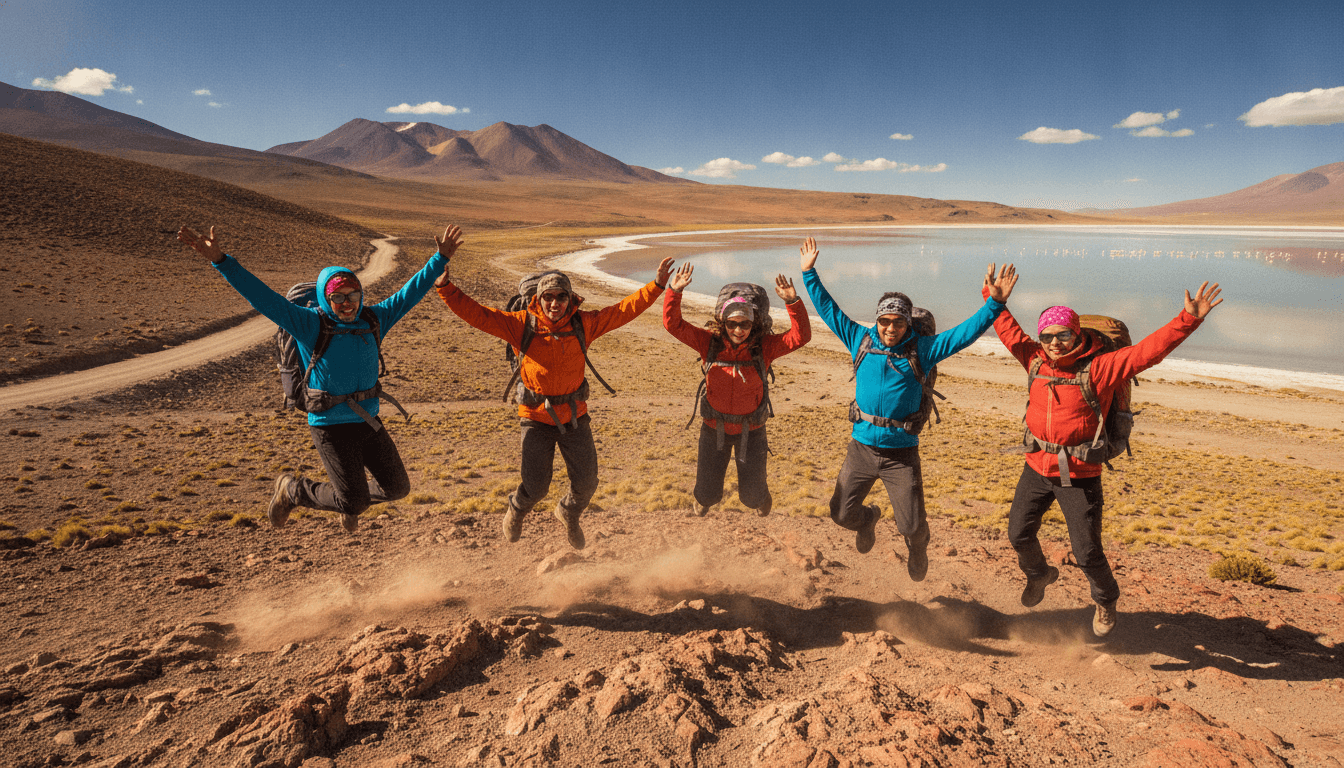
Bolivia Discovery: Self-Launched Salar & Colonial Cities
11 days · Bolivia
G Adventures charges £1,329
No-markup version: ~£665 per person
Estimate only, not a guaranteed price. Always verify costs independently before booking.
An independent 11-day Bolivia loop hitting the same highlights as the G Adventures 'Bolivia Discovery' tour: La Paz's markets and Mi Teleférico, colonial Sucre, silver-mining Potosí, and a three-day shared 4x4 crossing of the Salar de Uyuni and the desert altiplano with a night in a community lodge near Santiago de Agencha. You book your own hostel beds, take the same public buses G uses, join a local 4x4 salt-flats operator (most agencies in Uyuni and Tupiza run the classic 3-day route), and fly or bus La Paz–Sucre yourself. Costs are rough backpacker estimates in GBP, exclude international flights, and will shift with season and how well you haggle.
Day-by-day
Arrive La Paz — acclimatise at 3,600m
La Paz
Land at El Alto airport (4,000m) and take an official airport taxi or shared minibus down into the city bowl (~BOB 80-100 / £9-11 for a taxi, BOB 15 for a shared micro). Check into a hostel in the historic centre or Sopocachi. Take it very easy on day one: drink coca tea, walk slowly, and treat the altitude with respect. In the late afternoon stroll the Witches' Market (Mercado de las Brujas) on Calle Linares and get your bearings on the steep streets, then eat an early dinner — try a salteña and api (a purple corn drink) for under £3. Sleep high, walk low.
🚌Airport taxi or shared minibus to the centre (~£3-11 depending on option)
🛏Hostel or guesthouse in central La Paz / Sopocachi, dorm bed or private with shared bath (~£10-14 per night)
- →Witches' Market wander
- →Acclimatisation walk in the historic centre
- →Coca tea and salteña orientation
La Paz → Sucre, colonial capital on foot
Sucre
Either take the early morning flight on BoA (Boliviana de Aviación) La Paz–Sucre, roughly 45 minutes and usually £45-70 one-way if booked a week or two out — or save the money and take a night/early bus (~13-15 hrs, BOB 120-180 / £13-20) if you have the time. Flying keeps you matching the tour's pace. Once in Sucre you're at a comfortable 2,800m, so breathe easier. A self-guided walk covers the whitewashed Plaza 25 de Mayo, the Cathedral, the Casa de la Libertad (BOB 30) and the Recoleta hillside viewpoint — or pay a local guide BOB 80-120 for a two-hour walking tour booked through your hostel. Evening: cheap set menus around Calle Bolívar.
🚌Internal flight La Paz–Sucre (~£50-65) or overnight bus (~£15)
🛏Hostel or guesthouse in Sucre's historic centre (~£9-14)
- →Self-guided colonial city walk
- →Casa de la Libertad
- →Recoleta viewpoint at sunset
Sucre — dinosaur tracks and Tarabuco market
Sucre
A free day in Sucre. Head to Cal Orcko at the Parque Cretácico (BOB 30, plus BOB 10-15 for a micro or taxi out to the cement works) to see one of the world's largest collections of 68-million-year-old dinosaur footprints on a sheer quarry wall. If it's a Sunday, take a shared taxi or local bus to Tarabuco (~BOB 20-30, 1.5 hrs) for the famous textile market — much better than any guided version. Afternoon: chocolate and coffee in one of the courtyard cafés, or head up to La Recoleta for the view. Book tonight for a two- or three-day salt-flats trip with a Sucre or Tupiza agency, or plan to sort it in Uyuni.
🚌Micro/taxi to Parque Cretácico and back (~£3); optional shared taxi to Tarabuco (~£3)
🛏Hostel or guesthouse in Sucre (~£9-14)
- →Parque Cretácico dinosaur tracks (BOB 30)
- →Tarabuco market (Sundays)
- →Café and market browsing
Sucre — hike, bike, or slow day
Sucre
Another full day in Sucre. Options: a hike on the outskirts towards Chataquila or the Mirador de la Recoleta trail (free, just transport), or a half-day mountain-bike ride booked through a local agency (BOB 150-250 / £17-28). If you want pure culture, the Museo de Etnografía y Folklore and the Convento de Santa Clara are both cheap (BOB 20-30). Remember the tour's own recommendation: grab a salteña from the Mercado Central (about BOB 5 / 55p) and eat it standing up like a local. Sort cash today — ATMs can be unreliable outside La Paz, so draw bolivianos before the salt flats.
🚌Local buses/taxis within Sucre (~£3)
🛏Hostel or guesthouse in Sucre (~£9-14)
- →Half-day mountain biking or hiking (optional, ~£20)
- →Museum visits
- →Market food crawl
Sucre → Potosí and the Cerro Rico mines
Potosí
Take a morning bus to Potosí with a local company (Flota Copacabana, Trans Belén, etc.) — about 3 hours, BOB 30-50 / £3-6. Potosí sits at 4,090m, so keep the pace slow on arrival. Afternoon: join a cooperative mine tour at Cerro Rico (BOB 250-350 / £28-40 including gear, transport and usually a gift of coca/dynamite for the miners) — sobering, memorable and far more personal than a big-group version. Alternatively, the Casa de la Moneda mint museum (BOB 40) is excellent. Note: mine visits are not for everyone and involve tight, hot, dusty tunnels — it's entirely fine to skip.
🚌Public bus Sucre–Potosí (BOB 30-50, ~3 hrs)
🛏Guesthouse or basic hotel in Potosí (~£9-14)
- →Cerro Rico mine visit (optional, ~£30)
- →Casa de la Moneda
- →Plaza and colonial streets
Potosí → Uyuni, prep for the salt flats
Uyuni
Morning bus or shared minivan south to Uyuni (3-4 hrs, BOB 30-60). Once in Uyuni, shop around the agencies clustered around Calle Ferroviaria and Avenida Arce — a standard 3-day/2-night 4x4 tour of the Salar and the desert altiplano runs about BOB 700-950 / £80-110 per person in a shared vehicle of 6, including driver, meals, and basic lodge nights. Confirm what's included (park entry costs extra) and pay a deposit. Afternoon: visit the Train Cemetery (free walk or BOB 10 taxi) and stock up on water, snacks, sunscreen and a warm layer. Rent a sleeping bag or bring one — nights on the altiplano drop well below freezing.
🚌Public bus/minivan Potosí–Uyuni (BOB 30-60); local taxi to Train Cemetery (~£1)
🛏Hostel in Uyuni (~£8-12)
- →Train Cemetery
- →Uyuni agency comparison
- →Salt-flats tour booking
Salar de Uyuni — day one of the 4x4 crossing
Salar de Uyuni
Depart around 10:00 in a shared Land Cruiser with five or six other travellers. Start at the Train Cemetery then drive out onto the blinding white salt flats — the classic stops are Colchani's salt mountains, the Salt Hotel, the Dakar Monument and the 'Eyes of the Salar' pools. Lunch is cooked off the back of the truck (included in the tour price). By late afternoon you climb to Isla Incahuasi, the cactus-covered island in the middle of the salar (entry ~BOB 30), then continue south as dusk falls. Night in a basic salt-brick lodge with a shared dorm and a simple included dinner.
🚌Shared 4x4 Land Cruiser with local driver-guide (part of tour package)
🛏Basic salt hotel/refugio, multi-share (included in the 4x4 tour, ~£80-110 for all three days)
- →Train Cemetery
- →Salt flats photo stops
- →Isla Incahuasi cactus island
Desert altiplano and a community lodge in Santiago de Agencha
Santiago de Agencha
An early start heading south through the high desert: Laguna Cañapa and its flamingos, the red-rock Siloli Desert and the Árbol de Piedra (Stone Tree). This is exactly the landscape the group tour covers, just self-booked. Depending on your agency's routing you may reach the Eduardo Avaroa Reserve's red lagoon at Laguna Colorada (entry ~BOB 150) this afternoon or on day nine. Spend the night at a community-run lodge/guesthouse near Santiago de Agencha, the small agricultural village in a desert oasis surrounded by towering cacti — the same kind of Planeterra-style community stay the operator builds in. Basic dorm beds, hot-ish water if you're lucky, stunning night sky.
🚌Shared 4x4 (included)
🛏Community lodge / basic guesthouse near Santiago de Agencha, multi-share (included)
- →Laguna Cañapa flamingos
- →Árbol de Piedra
- →Laguna Colorada (reserve entry ~BOB 150)
- →Desert altiplano driving
Geysers, hot springs and the overnight bus to La Paz
Uyuni → La Paz
Final morning on the altiplano: sunrise at the Sol de Mañana geyser field (sulphur pools and steam at 4,800m), a soak in the roadside hot springs (BOB 10-20), and the Laguna Blanca and Laguna Verde vistas before the long drive back — most standard tours return to Uyuni around 17:00-18:00. Freshen up, eat a proper meal, then take the overnight bus to La Paz (BOB 120-180 / £13-20, roughly 10-11 hours, arriving early morning). Sleeper-style reclining seats are standard; bring layers, earplugs and a warm hat.
🚌Shared 4x4 return to Uyuni (included); overnight bus Uyuni–La Paz (BOB 120-180)
🛏Overnight bus (included in transport cost)
- →Sol de Mañana geysers
- →Thermal hot springs
- →Laguna Verde and Laguna Blanca
La Paz — city tour and Death Road (optional)
La Paz
You arrive in La Paz early morning with a full day to play with. Options: a self-guided ride on the Mi Teleférico cable car network (BOB 3 per ride / 30p — the best value sightseeing in South America) linking El Alto's markets to the city bowl; a cheap walking tour from Plaza San Francisco; or, for the adventurous, the Death Road mountain-bike descent (BOB 350-500 / £40-55 booked direct through a reputable agency such as Gravity or Barracuda — the operator sells this as an optional extra, you simply book it yourself). That's a long day after a night bus, so a nap first is sensible. Evening: sopa de maní or a lomo montado and a beer in Sopocachi.
🚌Mi Teleférico (~£1-2 total), local taxis (~£3)
🛏Hostel or guesthouse in central La Paz (~£10-14)
- →Mi Teleférico cable car
- →Free walking tour or Valley of the Moon tour (~£13)
- →Death Road mountain biking (optional, ~£40-55)
La Paz — markets, museums and departure
La Paz
Last morning: pick up souvenirs at the Mercado Rodríguez or the Alpaca/artisan stalls around Sagárnaga, and if time allows visit the Museo de la Coca or the excellent Museo Nacional de Etnografía y Folklore (BOB 20). Check museum and flight times against El Alto's notoriously fickle traffic — allow 75 minutes to the airport. Take a taxi or shared minibus to El Alto and fly out. If your flight leaves late, the Valle de la Luna (Moon Valley, BOB 15 entry plus BOB 15 return minibus) is a nice final low-effort outing.
🚌Taxi to El Alto airport (~£9-11)
🛏None (departure day)
- →Market shopping
- →Museum visit
- →Valley of the Moon (optional, ~£4)
Self-launched vs. G Adventures
| This itinerary (self-launched) | G Adventures | |
|---|---|---|
| Price per person | ~£665 | £1,329 |
| Duration | 11 days | 11 days |
| Who books it | You and your group, direct | Tour operator, guided group |
| Savings | £664 per person (50%) | |
Estimate only, not a guaranteed price. Always verify costs independently before booking.
Want to see more G Adventures-style trips? Check them out here.~£665
estimated per person
You never pay Travel Crew for this — you pay hostels, transport, and activity providers directly, the same as if you'd booked it all yourself.
This publishes your dates so other travellers can find and join you — no tour operator needed.
Customise with Tour BusterCreated by

Travel Crew
0 trips
Frequently asked questions
How much does Bolivia Discovery: Self-Launched Salar & Colonial Cities cost?+
Doing it yourself with this self-launched itinerary costs an estimated £665 per person for 11 days in Bolivia. This is an AI-generated estimate based on typical budget-traveller prices — actual costs will vary by season and how you book.
Is this cheaper than booking with G Adventures?+
Yes — G Adventures charges around £1,329 per person for a similar tour. Doing the same route independently, using the same standard of accommodation and activities, costs an estimated £665 — a saving of roughly £664 (50%) per person.
How long is the Bolivia trip?+
This itinerary runs 11 days, covering 11 day-by-day stops through Bolivia.
How do I join this trip?+
You can join an existing open departure using this itinerary if one is scheduled, or launch your own departure with your own dates and invite other travellers to join you — no tour operator required.
Isn't it easier to just use a tour operator?+
Well, yes, a tour operator will book all the individual parts of your travel for you and provide a guide. That's obvious, but doing this has the potential to save the group thousands, which can in turn improve your itinerary substantially or save you huge amounts of money. Also, when you launch a departure, Travel Crew has tools in place to help you book the individual sections of the trip or make it easier for you to do this as a group. Really, you do not need a middle man. If you are more comfortable paying more and using a middle man, then you should certainly do this.
Is it safer to book through a tour operator?+
Arguably, there isn't much difference. A self-launched trip runs on the same principle as a group travel crew: collective responsibility, everyone looking out for each other, the same way it would if a group of friends organised the trip themselves — because that's exactly what's happening. You should always take out travel insurance before you go, self-launched or not; that doesn't change either way. Every open departure is published publicly with real dates and a real trip organiser, so it's never an anonymous arrangement, and our support team is reachable any time you need help, including in an emergency while you're away. Longer-term, we're building direct relationships with ground DMCs in popular destinations, offered as an optional paid add-on for extra on-the-ground support. Ultimately, though, the group is responsible for its own conduct and safety on a self-launched trip, same as on any trip you plan yourself.
What kind of trip is this?+
This is a adventure, culture, hiking trip through Bolivia, self-launched rather than run by a tour operator — you organise it with a group you find or bring yourself.
Would you like to name the operator, name the trip, or have any suggestions about how to improve this itinerary?
Drop your comment below — if you've done a similar route, tell us what worked, what you'd add, or what you'd skip.
No comments yet — be the first to share your take.
Sign in to leave a comment.