
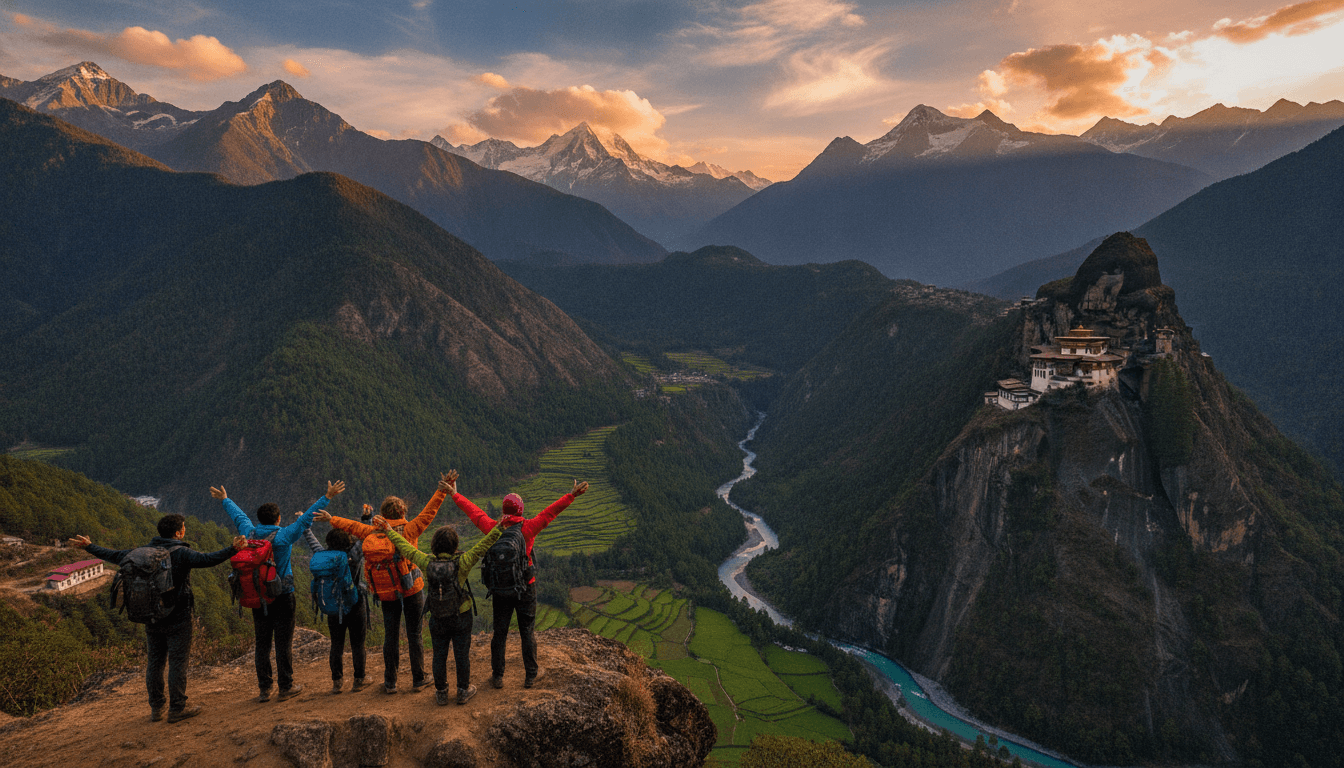
Wonders of Bhutan — Self-Launched
10 days · Bhutan
G Adventures charges £3,500
No-markup version: ~£1,820 per person
Estimate only, not a guaranteed price. Always verify costs independently before booking.
A 10-day self-launched loop through the Dragon Kingdom — Paro, Punakha, Phobjikha Valley, Thimphu, the remote Haa Valley and the Tiger's Nest — done independently. Bhutan requires every visitor to pay the Sustainable Development Fee (US$100/day, roughly £79) and to travel with a licensed guide for most of the trip, but you can cut the operator markup by booking directly with a local Bhutanese ground agent or a licensed freelance guide, staying in family-run guesthouses and small hotels, eating where locals eat, and using shared/driver-hired transport rather than a private vehicle included in a packaged price. Expect 2–3 hours of driving on most days on winding mountain roads, plenty of walking, and cool nights at altitude. All costs are approximate and exclude international flights to Paro (via Delhi, Kathmandu, Bangkok or Singapore).
Day-by-day
Arrive Paro & Rimpung Dzong orientation
Paro
Land at Paro International (one of the world's most dramatic approaches) and meet your pre-arranged local guide/driver. Bhutanese regulations mean you'll have a licensed guide with you, but you can hire one freelance (~£30–35/day, often shared between 2–4 travellers) and use a guesthouse instead of a hotel. Afternoon: visit Rimpung Dzong, the fortress-monastery above the river that doubles as a monk school, then walk the single-street old town past the archery ground and handicraft shops. Welcome dinner of ema datshi (chilli and cheese) and red rice — most guesthouses include breakfast and dinner in the room rate.
🚌Pre-arranged pickup from Paro airport (~£8–10); everything else on foot
🛏Family-run guesthouse in Paro old town (twin room, breakfast & dinner included)
- →Airport pickup (pre-booked with guesthouse or guide)
- →Rimpung Dzong visit
- →Paro old town orientation walk
Dochula Pass to Punakha
Punakha
Drive east over the Dochula Pass (3,100m) — on a clear day the whole eastern Himalaya, including Jomolhari, is visible behind the 108 chortens and prayer flags. Stop at the Druk Wangyal Lhakhang and the hilltop café for tea. Descend into the subtropical Punakha valley, a completely different climate (warm, banana palms, rice fields). Settle into a guesthouse in Punakha town or Khuruthang. Afternoon free for the Punakha suspension bridge over the Pho Chhu.
🚌Private or shared 4WD with guide, Paro–Punakha ~3 hrs (~£45 for the day shared between travellers)
🛏Guesthouse in Punakha / Khuruthang (breakfast & dinner included)
- →Dochula Pass & 108 chortens
- →Druk Wangyal Lhakhang
- →Punakha suspension bridge walk
Punakha Dzong, Chimi Lhakhang & Khamsum Yueley Chorten
Punakha
Early start for Punakha Dzong — arguably Bhutan's most beautiful fortress, at the confluence of the Pho and Mo Chhu rivers — before the tour buses arrive. Then walk 30 minutes through paddy fields and a village to Chimi Lhakhang, the temple of the 'Divine Madman' known for fertility blessings, passing the phallus-painted houses of Lobesa village. Lunch at a local farmhouse. Afternoon hike uphill ~45 mins to Khamsum Yueley Namgyal Chorten for valley views, or continue to Wangdue Phodrang's new town to see the rebuilt dzong.
🚌Guide's vehicle for short hops; ~3 hrs walking
🛏Guesthouse in Punakha / Khuruthang (breakfast & dinner included)
- →Punakha Dzong (timed for early morning)
- →Chimi Lhakhang hike
- →Farmhouse lunch
- →Khamsum Yueley Namgyal Chorten hike
Over Pelela-style passes to Phobjikha Valley
Gangtey / Phobjikha
Drive west and up through the Black Mountains to Gangtey (Phobjikha Valley), stopping in the village of Khewa and at roadside viewpoints. Phobjikha is a wide glacial bowl ringed by pine forest and home to the black-necked cranes that migrate from Tibet each winter. Check into a farmhouse or valley guesthouse with a wood stove — electricity and wifi can be patchy here, which is part of the charm. Sunset walk along the valley floor.
🚌Private vehicle Punakha–Gangtey ~4 hrs (~£55 for the day, shared)
🛏Farmhouse stay or valley guesthouse with wood stove (breakfast & dinner included)
- →Scenic drive via Wangdue and Pelela area
- →Khewa village stop
- →Phobjikha Valley sunset walk
Gangtey Goempa, community school & Khewa Valley
Gangtey / Phobjikha
Walk up to Gangtey Goempa, the 17th-century Nyingma monastery perched above the valley and home to some of Bhutan's most sacred relics — you may catch morning puja. Continue to a community school (ask your guide to arrange a short visit; bring pencils or notebooks rather than sweets). Afternoon: cross the valley on foot to Khewa and visit an old temple, where you can make a small offering (butter lamps ~£1–2). This is prime black-necked crane territory in November–February — bring binoculars.
🚌Walking day; vehicle on standby
🛏Farmhouse stay or valley guesthouse (breakfast & dinner included)
- →Gangtey Goempa monastery
- →Community school visit
- →Phobjikha–Khewa Valley walk
- →Butter lamp offering at village temple
Capital day: Thimphu's culture circuit
Thimphu
Drive to Thimphu (~4–5 hrs with a pass crossing). Hit the free/cheap cultural sites: the National Library (sacred texts), the Memorial Chorten where locals circle with prayer beads all day, and the Institute for Zorig Chusum, where you can watch students learning the thirteen traditional arts — wood carving, thangka painting, clay sculpture. Swing past the giant Buddha Dordenma if time allows. Evening on Norzin Lam for Bhutanese food and the weekend market if it's on.
🚌Private vehicle Gangtey–Thimphu ~4.5 hrs (~£55 shared)
🛏Budget hotel or guesthouse in central Thimphu (breakfast & dinner included)
- →National Library
- →Memorial Chorten
- →Institute of Zorig Chusum
- →Buddha Dordenma (optional)
Over Chelela Pass into the Haa Valley
Haa
The best drive in Bhutan: climb to Chelela Pass (3,988m) — the highest road pass in the country — with views of Jomolhari and a ridge strung with prayer flags. En route, hike ~45 minutes to Kila Goempa, a nunnery clinging to a cliff face above Paro. Descend into the Haa Valley, one of the most remote and least-visited, and visit the three shrines of Haa town: Wangchuk Lo Dzong, Lhakhang Nagpo (Black Temple) and Lhakhang Karpo (White Temple).
🚌Private vehicle Thimphu–Chelela–Haa ~5 hrs including stops (~£60 shared)
🛏Haa valley guesthouse (breakfast & dinner included)
- →Chelela Pass
- →Kila Goempa nunnery hike
- →Wangchuk Lo Dzong
- →Lhakhang Nagpo & Karpo temples
Back to Paro via Drukgyal Dzong
Paro
Return to Paro over Chelela or via the Haa–Paro road, stopping at the ruins of Drukgyal Dzong, the fortress that repelled Tibetan invasions in the 17th century and still commands the upper Paro valley with Jomolhari behind it. Afternoon free: browse Paro's craft shops (textiles and thangka painting are the buys), do laundry, or just acclimatise with tea in the square. Early night — tomorrow is the Tiger's Nest.
🚌Private vehicle Haa–Paro ~3 hrs (~£45 shared)
🛏Guesthouse in Paro old town (breakfast & dinner included)
- →Drukgyal Dzong ruins
- →Paro craft shopping / free afternoon
Tiger's Nest (Taktsang) hike & Kyichu Lhakhang
Paro
Start by 7:30am to beat the crowds. The hike to Taktsang Monastery is ~2 hrs up (900m of gain through pine forest) — steep but on a clear path, with a café at the halfway viewpoint. The monastery clings to the cliff face where Guru Rinpoche is said to have flown in on a tigress. Allow 4–5 hrs round trip. Afternoon: Kyichu Lhakhang, one of Bhutan's two oldest temples (7th century), then the Paro archery grounds where locals shoot at targets 145m away — best with a beer and a plate of momos. Farewell dinner.
🚌Short transfers by guide's vehicle; hiking otherwise
🛏Guesthouse in Paro old town (breakfast & dinner included)
- →Tiger's Nest (Taktsang) hike
- →Kyichu Lhakhang
- →Paro archery grounds
Depart Paro
Paro
Transfer to Paro International for your onward flight — most departures go via Delhi, Kathmandu, Kolkata, Bangkok or Singapore. If you're flying out of India and re-entering later, double-check your Indian visa type (tourist visas can carry restrictions on re-entry within two months). Change any leftover ngultrum before security — it's worthless outside Bhutan, though Indian rupees are accepted locally.
🚌Guesthouse/guide transfer to Paro airport (~£8)
🛏None (departure day)
- →Airport transfer
Self-launched vs. G Adventures
| This itinerary (self-launched) | G Adventures | |
|---|---|---|
| Price per person | ~£1,820 | £3,500 |
| Duration | 10 days | 10 days |
| Who books it | You and your group, direct | Tour operator, guided group |
| Savings | £1,680 per person (48%) | |
Estimate only, not a guaranteed price. Always verify costs independently before booking.
Want to see more G Adventures-style trips? Check them out here.~£1,820
estimated per person
You never pay Travel Crew for this — you pay hostels, transport, and activity providers directly, the same as if you'd booked it all yourself.
This publishes your dates so other travellers can find and join you — no tour operator needed.
Customise with Tour BusterCreated by

Travel Crew
0 trips
Frequently asked questions
How much does Wonders of Bhutan — Self-Launched cost?+
Doing it yourself with this self-launched itinerary costs an estimated £1,820 per person for 10 days in Bhutan. This is an AI-generated estimate based on typical budget-traveller prices — actual costs will vary by season and how you book.
Is this cheaper than booking with G Adventures?+
Yes — G Adventures charges around £3,500 per person for a similar tour. Doing the same route independently, using the same standard of accommodation and activities, costs an estimated £1,820 — a saving of roughly £1,680 (48%) per person.
How long is the Bhutan trip?+
This itinerary runs 10 days, covering 10 day-by-day stops through Bhutan.
How do I join this trip?+
You can join an existing open departure using this itinerary if one is scheduled, or launch your own departure with your own dates and invite other travellers to join you — no tour operator required.
Isn't it easier to just use a tour operator?+
Well, yes, a tour operator will book all the individual parts of your travel for you and provide a guide. That's obvious, but doing this has the potential to save the group thousands, which can in turn improve your itinerary substantially or save you huge amounts of money. Also, when you launch a departure, Travel Crew has tools in place to help you book the individual sections of the trip or make it easier for you to do this as a group. Really, you do not need a middle man. If you are more comfortable paying more and using a middle man, then you should certainly do this.
Is it safer to book through a tour operator?+
Arguably, there isn't much difference. A self-launched trip runs on the same principle as a group travel crew: collective responsibility, everyone looking out for each other, the same way it would if a group of friends organised the trip themselves — because that's exactly what's happening. You should always take out travel insurance before you go, self-launched or not; that doesn't change either way. Every open departure is published publicly with real dates and a real trip organiser, so it's never an anonymous arrangement, and our support team is reachable any time you need help, including in an emergency while you're away. Longer-term, we're building direct relationships with ground DMCs in popular destinations, offered as an optional paid add-on for extra on-the-ground support. Ultimately, though, the group is responsible for its own conduct and safety on a self-launched trip, same as on any trip you plan yourself.
What kind of trip is this?+
This is a culture, hiking, adventure trip through Bhutan, self-launched rather than run by a tour operator — you organise it with a group you find or bring yourself.
Would you like to name the operator, name the trip, or have any suggestions about how to improve this itinerary?
Drop your comment below — if you've done a similar route, tell us what worked, what you'd add, or what you'd skip.
No comments yet — be the first to share your take.
Sign in to leave a comment.