
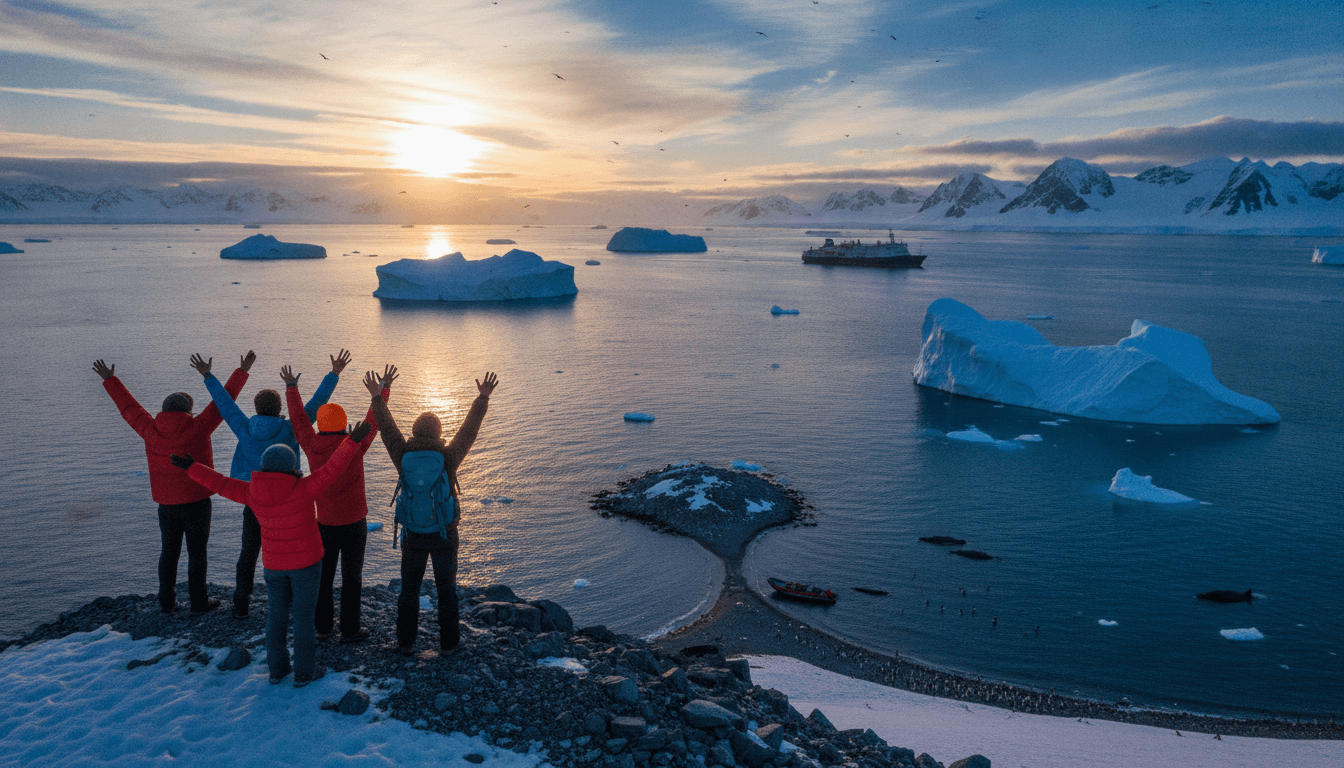
Quest for the Antarctic Circle: Self-Launched Expedition
14 days · Antarctica & Ushuaia, Argentina
G Adventures charges £7,720
No-markup version: ~£6,200 per person
Estimate only, not a guaranteed price. Always verify costs independently before booking.
Antarctica is one of the few destinations on Earth where going "fully independent" isn't possible — you must travel aboard a licensed expedition vessel to reach the continent. However, there is significant money to be saved by booking a comparable expedition cruise directly with an operator, hunting last-minute "standby" deals in Ushuaia, skipping the group-tour premium, and arranging your own Ushuaia accommodation and transfers. This self-launched itinerary mirrors the G Adventures route — Drake Passage crossing, South Shetland Islands, Antarctic Peninsula, and an attempt on the Antarctic Circle — using budget-conscious booking strategies. All cost estimates are approximate and per person.
Day-by-day
Arrive in Ushuaia — The End of the World
Ushuaia, Argentina
Fly into Malvinas Argentinas International Airport (USH). Book your own transfer into town via a local remis taxi (~£8) rather than a paid group transfer. Check into a hostel or guesthouse in the centre. Ushuaia is a compact, walkable city — spend the afternoon exploring the waterfront, Magellan Strait views, and the colourful main street (San Martín). Grab a craft beer and king crab (centolla) empanadas at a local parilla.
🚌Fly into Ushuaia (USH). Local remis taxi from airport to centre ~£8.
🛏Freestyle Ushuaia Hostel or Los Cormoranes Hostel — expect dorm beds or budget private rooms. Approx £20–30/night.
- →Walk the Ushuaia waterfront and Paseo del Centenario promenade
- →Visit the harbour and scout the expedition cruise ships moored at the port
- →Browse the main street (San Martín) for last-minute gear and supplies
- →Try local king crab (centolla) at a budget parilla
Free Morning in Ushuaia / Embark Your Expedition Ship
Ushuaia, Argentina
Use the morning for any last-minute shopping — warm layers, dry bags, seasickness tablets (essential for the Drake!). A good option is the Ushuaia Duty Free zone on San Martín. In the afternoon, board your independently booked expedition vessel at the Ushuaia cruise pier. Tip: the single biggest saving strategy for Antarctic cruises is booking a 'last-minute standby' deal directly in Ushuaia — operators such as Antarpply, Antarctica21, or Quark Expeditions regularly offer unsold berths at 40–60% off in the days before departure. Budget operators to compare include Poseidon Expeditions, Aurora Expeditions, and Oceanwide Expeditions — book direct on their websites. Sail out through the scenic Beagle Channel in the evening.
🚌Walk or take a short taxi to the Ushuaia cruise pier (~£3). Sail via Beagle Channel.
🛏Aboard your expedition vessel (shared cabin — quad, triple, or twin). Cost included in cruise booking.
- →Last-minute shopping on San Martín street and at the Duty Free zone
- →Embark your independently booked expedition ship at the Ushuaia cruise pier
- →Evening sail through the Beagle Channel — watch for dolphins and Andean condors
- →Attend the ship's mandatory safety and zodiac briefing
Drake Passage — Day One at Sea
Drake Passage
The famous Drake Passage crossing (~1,000 km / 600 mi) begins. Conditions range from mirror-calm ('Drake Lake') to notoriously rough ('Drake Shake') — take your seasickness tablets the night before. Spend the day on deck spotting wandering albatrosses, petrels, and cape pigeons riding the ship's thermals. Attend naturalist lectures run by the ship's onboard expedition team — these are included on all reputable Antarctic expedition vessels. Meals are included on board.
🚌Expedition vessel crossing Drake Passage.
🛏Aboard expedition vessel.
- →Seabird spotting from the observation deck — albatross, petrels, and storm petrels
- →Attend naturalist and glaciology lectures from the ship's expedition team
- →Learn to identify Antarctic wildlife using the ship's reference library
- →Rest and acclimatise — seasickness is common on Day 1 of the Drake
Drake Passage — Day Two / Approach South Shetlands
Drake Passage / Approaching South Shetland Islands
A second day at sea as you approach the Antarctic Convergence — a biological boundary where cold polar water meets warmer sub-Antarctic water, dramatically increasing wildlife activity. Watch for your first icebergs. More expert lectures from the ship's team cover Antarctic history (Shackleton, Scott, Amundsen), ecology, and glaciology. The mood on deck becomes electric as the first ice appears.
🚌Expedition vessel — final approach to South Shetland Islands.
🛏Aboard expedition vessel.
- →Spot your first Antarctic icebergs from the observation deck
- →Attend lectures on Antarctic exploration history and polar ecology
- →Photography workshop — most expedition ships offer informal sessions
- →Watch for humpback and minke whales as you cross the Antarctic Convergence
South Shetland Islands — First Landings
South Shetland Islands, Antarctica
Your first zodiac landings on Antarctic soil. The South Shetland Islands are home to enormous penguin rookeries — chinstrap and gentoo colonies number in the hundreds of thousands. Deception Island (a flooded volcanic caldera) is a common first stop, as is Half Moon Island. Wet beach landings are standard — waterproof boots are provided by the ship. Two landings per day are typical, weather permitting. All zodiac excursions are included in your cruise fare on reputable operators.
🚌Zodiac (inflatable rubber boat) to shore landings — included in cruise.
🛏Aboard expedition vessel.
- →Zodiac landing at Deception Island or Half Moon Island
- →Walk among chinstrap and gentoo penguin rookeries
- →Spot Weddell and leopard seals hauled out on the shore
- →Second afternoon zodiac landing and wildlife excursion
South Shetland Islands to Antarctic Peninsula
South Shetland Islands / Antarctic Peninsula
Continue south into the Antarctic Peninsula proper. The scenery becomes increasingly dramatic — glaciers calving directly into the sea, towering icebergs, and snow-capped peaks. Likely landing sites include Cuverville Island (one of the largest gentoo rookeries on the peninsula) or Paradise Harbour. Watch for orca (killer whales) hunting in the channels. The Peninsula's channels, including the Neumayer Channel and Lemaire Channel ('Kodak Gap'), offer some of the most photogenic scenery on Earth.
🚌Expedition vessel navigating Antarctic Peninsula channels; zodiac excursions.
🛏Aboard expedition vessel.
- →Zodiac landing at Cuverville Island — massive gentoo penguin colony
- →Cruise the Neumayer Channel and Lemaire Channel by zodiac
- →Spot humpback and minke whales feeding in the channels
- →Afternoon landing at Paradise Harbour or Neko Harbour (continental Antarctica)
Pushing South — Toward the Antarctic Circle
Western Antarctic Peninsula
The ship pushes further south along the western coast of the Antarctic Peninsula, weaving between colossal tabular icebergs and past remote penguin colonies. The landscape becomes increasingly raw and otherworldly. The expedition team monitor ice and weather conditions closely — reaching the Antarctic Circle (66°33'S) depends on conditions but is the goal. Lectures continue on board during navigation time. Keep your camera ready at all times — icebergs of extraordinary scale and form appear regularly.
🚌Expedition vessel heading south toward the Antarctic Circle.
🛏Aboard expedition vessel.
- →Zodiac cruise among colossal icebergs in the Grandidier Channel
- →Attend briefings on Antarctic Circle crossing preparations
- →Wildlife spotting from the observation deck — Adélie penguins on ice floes
- →Photography of the ever-changing iceberg and glacier landscapes
Antarctic Circle Crossing
Antarctic Circle (66°33'S)
The highlight of the voyage — crossing the Antarctic Polar Circle at 66°33' South latitude. Very few travellers in history have reached this point, and crossing it by ship is a genuine achievement. Most expedition ships mark the occasion with a celebratory ceremony on deck (often involving a tot of spirits). Beyond the Circle, the scenery is even more remote and pristine — glassy waters, unbroken ice shelves, and extraordinary silence. Zodiac landings may be attempted in iceberg-strewn bays if conditions allow.
🚌Expedition vessel at the Antarctic Circle.
🛏Aboard expedition vessel.
- →Antarctic Circle crossing ceremony on the observation deck
- →Zodiac excursion among ice floes south of 66°33'S
- →Wildlife spotting — snow petrels and Antarctic petrels are common this far south
- →Photograph the midnight sun (in austral summer, it barely sets this far south)
Heading North — Antarctic Peninsula Revisited
Antarctic Peninsula
Turn north and continue exploring the Peninsula on the return journey. Each day brings different wildlife sightings and conditions — repeat landings at new sites along the Peninsula's western coast. Popular spots include Port Lockroy (a restored British Antarctic Survey base and post office — you can send a postcard from Antarctica!), Petermann Island, and the Argentine Islands. The ship's naturalists continue lectures and can identify specific individual whale flukes using photo-ID catalogues.
🚌Expedition vessel northbound along the Antarctic Peninsula.
🛏Aboard expedition vessel.
- →Zodiac landing at Port Lockroy — visit the museum and post a postcard from Antarctica
- →Gentoo penguin colony walk at Petermann Island
- →Zodiac cruise through the Argentine Islands
- →Whale watching — humpback whales are frequently seen feeding near the surface
Antarctic Peninsula — Final Southern Landings
Antarctic Peninsula
More zodiac landings along the Peninsula as the ship continues north. The final southern days often yield the best wildlife encounters as you've learned where to look and what to expect. Experienced guides will help you find leopard seals resting on ice floes and point out crabeater seals — the world's most numerous large mammal. Evening recap sessions with the expedition team allow you to identify and record every species spotted so far.
🚌Expedition vessel and zodiac excursions.
🛏Aboard expedition vessel.
- →Zodiac landing and penguin colony walk — final southern excursion
- →Spot leopard seals and crabeater seals on ice floes
- →Evening species recap session with expedition naturalists
- →Optional: if you pre-booked camping or kayaking add-ons, final opportunities here
South Shetland Islands — Farewell to Antarctica
South Shetland Islands / Drake Passage entrance
Final potential landing in the South Shetland Islands before the Drake Passage crossing begins again. King George Island hosts multiple international research stations (Chilean, Argentinian, Brazilian, and others) — some expedition ships stop here. Elephant Island — where Shackleton's men survived for months in 1916 — may be visible in the distance. As the last icebergs disappear astern, the full emotional weight of what you've just experienced tends to hit. Stock up on drinks from the ship's bar — last chance for Antarctic toasts.
🚌Expedition vessel — entering the Drake Passage heading north.
🛏Aboard expedition vessel.
- →Final zodiac landing in the South Shetlands (King George Island or similar)
- →Pass by Elephant Island — site of Shackleton's legendary survival story
- →Evening farewell dinner and expedition recap presentation
- →Begin the Drake Passage northward crossing
Drake Passage Northbound — Day One
Drake Passage
Two full days crossing the Drake Passage back to Ushuaia. Use the time to go through your photos, attend the final expedition lectures, and reflect on the journey. Seabird spotting remains excellent — the albatrosses that have followed the ship since day one will still be riding the thermals. Naturalists often host informal photo-sharing sessions in the ship's lounge. Start thinking about how to describe what you've just seen to people who've never been.
🚌Expedition vessel crossing Drake Passage northbound.
🛏Aboard expedition vessel.
- →Final seabird watching — wandering and royal albatrosses
- →Photo review and editing session
- →Expedition team's wrap-up lectures on Antarctic conservation and climate change
- →Swap contact details with fellow travellers — you've shared something extraordinary
Drake Passage — Final Day at Sea / Approach Ushuaia
Drake Passage / Beagle Channel
The final day at sea before re-entering the Beagle Channel and returning to Ushuaia. Keep watch from the observation deck — Chilean and Argentine Patagonia's peaks rise dramatically on both sides of the Channel as you approach. The ship's expedition team will present certificates to all guests who crossed the Antarctic Circle. Pack your bags, sort your kit, and leave reviews for the expedition staff who made it all possible. Disembarkation is typically the following morning.
🚌Expedition vessel via Beagle Channel into Ushuaia port.
🛏Aboard expedition vessel.
- →Antarctic Circle crossing certificate presentation ceremony
- →Final observation deck watch as you enter the Beagle Channel
- →Pack and prepare for disembarkation
- →Evening farewell with expedition crew
Disembark Ushuaia — Journey Home
Ushuaia, Argentina
Disembark after breakfast (typically by 08:00–09:00). Arrange your own onward transfer — a local remis taxi to the airport costs around £8. If your flight home is in the evening, drop your bags at a left-luggage spot and spend the afternoon at the Museo del Fin del Mundo (End of the World Museum, ~£5 entry) or take a walk in Tierra del Fuego National Park (bus from town, ~£3 return). Celebrate with a final Patagonian meal before heading to Ushuaia Airport (USH) for your international connection via Buenos Aires (EZE).
🚌Local remis taxi from port to airport (~£8). Fly Ushuaia (USH) → Buenos Aires (AEP/EZE) → home.
🛏None needed (day disembarkation) — or book one extra night at a Ushuaia hostel (~£25–30) if your flight is next day.
- →Disembark after breakfast and arrange your own taxi transfer (~£8)
- →Store luggage and visit the Museo del Fin del Mundo (~£5 entry)
- →Optional: Tierra del Fuego National Park walk (bus ~£3 return)
- →Final Ushuaia meal before departing to USH airport
Self-launched vs. G Adventures
| This itinerary (self-launched) | G Adventures | |
|---|---|---|
| Price per person | ~£6,200 | £7,720 |
| Duration | 14 days | 14 days |
| Who books it | You and your group, direct | Tour operator, guided group |
| Savings | £1,520 per person (20%) | |
Estimate only, not a guaranteed price. Always verify costs independently before booking.
Want to see more G Adventures-style trips? Check them out here.~£6,200
estimated per person
You never pay Travel Crew for this — you pay hostels, transport, and activity providers directly, the same as if you'd booked it all yourself.
This publishes your dates so other travellers can find and join you — no tour operator needed.
Customise with Tour BusterCreated by

Travel Crew
0 trips
Frequently asked questions
How much does Quest for the Antarctic Circle: Self-Launched Expedition cost?+
Doing it yourself with this self-launched itinerary costs an estimated £6,200 per person for 14 days in Antarctica & Ushuaia, Argentina. This is an AI-generated estimate based on typical budget-traveller prices — actual costs will vary by season and how you book.
Is this cheaper than booking with G Adventures?+
Yes — G Adventures charges around £7,720 per person for a similar tour. Doing the same route independently, using the same standard of accommodation and activities, costs an estimated £6,200 — a saving of roughly £1,520 (20%) per person.
How long is the Antarctica & Ushuaia, Argentina trip?+
This itinerary runs 14 days, covering 14 day-by-day stops through Antarctica & Ushuaia, Argentina.
How do I join this trip?+
You can join an existing open departure using this itinerary if one is scheduled, or launch your own departure with your own dates and invite other travellers to join you — no tour operator required.
Isn't it easier to just use a tour operator?+
Well, yes, a tour operator will book all the individual parts of your travel for you and provide a guide. That's obvious, but doing this has the potential to save the group thousands, which can in turn improve your itinerary substantially or save you huge amounts of money. Also, when you launch a departure, Travel Crew has tools in place to help you book the individual sections of the trip or make it easier for you to do this as a group. Really, you do not need a middle man. If you are more comfortable paying more and using a middle man, then you should certainly do this.
Is it safer to book through a tour operator?+
Arguably, there isn't much difference. A self-launched trip runs on the same principle as a group travel crew: collective responsibility, everyone looking out for each other, the same way it would if a group of friends organised the trip themselves — because that's exactly what's happening. You should always take out travel insurance before you go, self-launched or not; that doesn't change either way. Every open departure is published publicly with real dates and a real trip organiser, so it's never an anonymous arrangement, and our support team is reachable any time you need help, including in an emergency while you're away. Longer-term, we're building direct relationships with ground DMCs in popular destinations, offered as an optional paid add-on for extra on-the-ground support. Ultimately, though, the group is responsible for its own conduct and safety on a self-launched trip, same as on any trip you plan yourself.
What kind of trip is this?+
This is a adventure, wildlife, slow-travel trip through Antarctica & Ushuaia, Argentina, self-launched rather than run by a tour operator — you organise it with a group you find or bring yourself.
Would you like to name the operator, name the trip, or have any suggestions about how to improve this itinerary?
Drop your comment below — if you've done a similar route, tell us what worked, what you'd add, or what you'd skip.
No comments yet — be the first to share your take.
Sign in to leave a comment.