
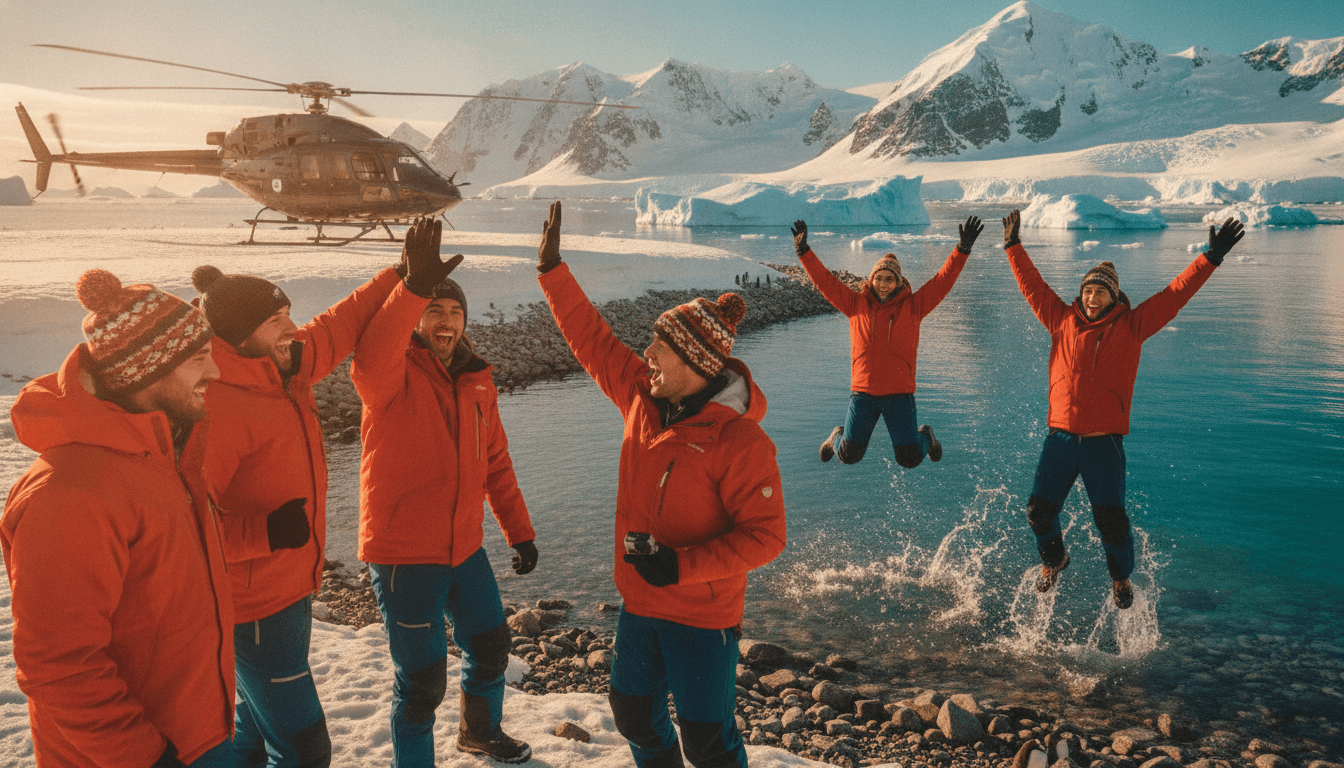
Antarctica by Helicopter: Self-Launched Polar Expedition
12 days · Antarctic Peninsula
Exodus charges £13,150
No-markup version: ~£8,500 per person
Estimate only, not a guaranteed price. Always verify costs independently before booking.
Antarctica is one of the few destinations where a fully independent trip is genuinely difficult — there are no budget hostels on the ice. However, you can dramatically cut costs by self-booking an expedition cruise directly with smaller operators, skipping the premium Exodus markup, arranging your own Buenos Aires accommodation, booking your own Ushuaia-to-Buenos Aires flights, and choosing a shared cabin berth rather than a suite. This self-launched version follows the exact same route — Drake Passage crossing, Weddell Sea, Antarctic Sound, Zodiac excursions, and helicopter flightseeing — but sources the cruise independently via last-minute Antarctica expedition brokers (e.g. Pole to Pole, Chimu Adventures, or direct with Quark or Hurtigruten), saving thousands. All costs are approximate estimates in GBP.
Day-by-day
Arrive in Buenos Aires, Argentina
Buenos Aires, Argentina
Fly into Ministro Pistarini International Airport (EZE) independently — budget airlines like Aerolíneas Argentinas and LATAM often offer competitive fares from European hubs via connections. Take the Tienda León bus shuttle from EZE to central Buenos Aires (~£7). Check into a well-rated hostel or budget hotel in Palermo or San Telmo. Spend the afternoon exploring the colourful La Boca neighbourhood, grab a classic Argentine steak dinner for ~£10-15 at a local parrilla, and prepare your kit for the expedition ahead.
🚌Tienda León airport shuttle from EZE to Buenos Aires centre (~£7)
🛏Hostel Estoril or similar budget hotel in Buenos Aires (~£25-35/night)
- →Arrive at EZE and take the Tienda León shuttle to central BA (~£7)
- →Check into budget accommodation in Palermo or San Telmo
- →Explore La Boca and San Telmo neighbourhoods independently
- →Classic Argentine steak dinner at a local parrilla (~£10-15)
- →Final gear check and packing for the Antarctic expedition
Fly to Ushuaia and Embark on Expedition Vessel
Ushuaia, Argentina
Book your own domestic flight from Buenos Aires (AEP/Aeroparque) to Ushuaia (USH) independently with Aerolíneas Argentinas — booked in advance this costs ~£80-120 return. This replaces the operator's private charter and is the single biggest independent saving on the logistics leg. Upon arrival in Ushuaia, explore the town's harbour and waterfront on foot before your afternoon embarkation on your self-booked expedition vessel. Drinks, welcome briefings, and safety drills take place as the ship departs down the Beagle Channel toward Antarctica.
🚌Aerolíneas Argentinas domestic flight Buenos Aires → Ushuaia (~£90 one-way); taxi or remis to port (~£8)
🛏Shared cabin/triple berth on expedition vessel (included in cruise cost)
- →Fly Aerolíneas Argentinas from Buenos Aires Aeroparque (AEP) to Ushuaia (USH) (~£90 one-way if booked early)
- →Explore Ushuaia's waterfront, Museo del Fin del Mundo, and Martial Glacier viewpoint
- →Embark on self-booked Antarctic expedition vessel
- →Mandatory safety briefing and Zodiac training on board
- →Depart along the historic Beagle Channel — watch for Magellanic penguins and sea lions
Crossing the Drake Passage
Drake Passage
The legendary Drake Passage — 800 km of open Southern Ocean between Cape Horn and the Antarctic Peninsula. Conditions can range from the 'Drake Lake' (calm) to the 'Drake Shake' (rough). Spend the day on deck spotting albatrosses, petrels, skuas, and if lucky, dolphins and whales. Most expedition vessels include naturalist presentations on Antarctic wildlife, glaciology, and history — attend all of these to make the most of the crossing. Pack sea sickness medication (buy in advance in Ushuaia pharmacies, ~£5).
🚌At sea — expedition vessel crossing the Drake Passage
🛏Shared cabin on expedition vessel (included in cruise cost)
- →Wildlife spotting from deck — albatrosses, giant petrels, Cape petrels, skuas
- →Watch for dolphins and whales in the open Southern Ocean
- →Attend onboard naturalist lectures on Antarctic history and wildlife
- →Drake Passage navigation briefing with expedition team
- →Photography workshop sessions (typically offered on board)
At Sea: Antarctic Convergence and Expert Lectures
Southern Ocean / Antarctic Convergence Zone
Today the ship crosses the Antarctic Convergence — the biological boundary where warmer sub-Antarctic and cold Antarctic waters meet. Water temperature drops noticeably and wildlife activity increases dramatically. Join expert-led lectures on glaciology, polar photography, and the history of Antarctic exploration. Most independent expedition vessels offer similar educational programming to premium operators — this is a key feature to check when booking your cruise. Spend time on the bridge chatting with the ship's captain and officers if permitted.
🚌At sea — continuing south toward the Antarctic Peninsula
🛏Shared cabin on expedition vessel (included in cruise cost)
- →Cross the Antarctic Convergence — watch for dramatic change in wildlife
- →Attend expert lectures: glaciology, polar photography, Antarctic history
- →Spot first icebergs on the horizon
- →Visit the bridge (if permitted) for navigation insight
- →Socialise with fellow expedition passengers — a naturally forming travel crew
Antarctic Sound: Brown Bluff and Adélie Penguin Colonies
Antarctic Sound, Antarctic Peninsula
Enter the Antarctic Sound — known as 'Iceberg Alley' for its spectacular concentration of tabular icebergs calved from the Larsen Ice Shelf. The first landing goal is Brown Bluff, on the most northerly tip of the Antarctic continent — a 678-metre volcanic cliff face rising dramatically from the sea. Zodiac cruise to shore to visit one of the largest Adélie penguin colonies on the Peninsula. Gentoo penguins and Weddell seals are also common here. If helicopter operations are available on your vessel (book a vessel with helicopter capacity — Quark's Ultramarine or similar), flightseeing may take place today.
🚌Zodiac inflatable boats for shore landings (included in cruise)
🛏Shared cabin on expedition vessel (included in cruise cost)
- →Zodiac cruise through Antarctic Sound — 'Iceberg Alley'
- →Landing at Brown Bluff: 678-metre volcanic cliffs and Adélie penguin colony
- →Wildlife viewing: Adélie and Gentoo penguins, Weddell seals
- →Photography of tabular icebergs from Zodiac
- →Possible helicopter flightseeing if vessel has helicopter capability (check at booking)
Erebus and Terror Gulf: James Ross Island Group
Erebus and Terror Gulf, Antarctic Peninsula
Named after HMS Erebus and HMS Terror — the ships of James Clark Ross's 1840s Antarctic expedition — this remote gulf sits on the southeast side of the Antarctic Peninsula. The James Ross Island group was first explored by the Swedish Antarctic Expedition of 1901-04 and contains some of the most geologically significant terrain on the Peninsula. Land and hike to a summit for views over the Weddell Sea. Look for ventifacts (ancient wind-polished rocks), fossil finds, and the remarkable KT Boundary — marking the transition from the Cretaceous to Tertiary Period.
🚌Zodiac shore landings; helicopter if vessel-equipped and weather permits
🛏Shared cabin on expedition vessel (included in cruise cost)
- →Zodiac landing on James Ross Island group
- →Summit hike with views over the northern Weddell Sea
- →Search for ventifacts and fossil finds — significant geological features
- →View the KT Boundary geological layer (Cretaceous-Tertiary transition)
- →Possible helicopter excursion weather permitting
Weddell Sea: Paulet Island and Devil Island
Weddell Sea, Antarctic Peninsula
Paulet Island is home to one of the largest Adélie penguin rookeries in Antarctica — roughly 100,000 breeding pairs. It also hosts the stone hut built by survivors of the Swedish Antarctic Expedition of 1901-04, and the grave of crew member Ole Wennersgaard. This is one of the most historically and wildlife-rich landings on any Antarctic itinerary. Alternatively, Zodiac cruise to Devil Island and hike to viewpoints overlooking the twin volcanic cones rising from Vega Island's bay. Icebergs grounded in shallow waters create surreal, otherworldly scenes.
🚌Zodiac inflatable boats for shore landings and cruising
🛏Shared cabin on expedition vessel (included in cruise cost)
- →Landing at Paulet Island: ~100,000 Adélie penguin pairs
- →Visit the historic Swedish Antarctic Expedition hut (1901-04)
- →Pay respects at Ole Wennersgaard's grave site
- →Zodiac cruise to Devil Island — twin volcanic cones and grounded icebergs
- →Wildlife photography of penguins, seals, and ice formations
Helicopter Flightseeing and Remote Weddell Sea Exploration
Weddell Sea / Joinville Island
Today the focus shifts to helicopter operations if conditions allow. The dramatic headland on the north-eastern tip of Joinville Island is a key target — a prominent rocky outcrop rising from the icy landscape that has guided explorers for over a century. From the air, views extend across the Weddell Sea, the Antarctic Sound, and the vast glacial interior of the Peninsula. When not flying, Zodiac cruises among sculpted icebergs deliver intimate wildlife encounters — leopard seals, crabeater seals, and minke whales are frequently spotted in these waters.
🚌Helicopter flightseeing and Zodiac excursions (included in cruise)
🛏Shared cabin on expedition vessel (included in cruise cost)
- →Helicopter flightseeing over Joinville Island headland (weather permitting)
- →Views of Antarctic Sound, the Weddell Sea, and glacial interior from the air
- →Zodiac cruise among sculpted Weddell Sea icebergs
- →Wildlife spotting: leopard seals, crabeater seals, minke whales
- →Onboard expert debrief and species identification session
South Shetland Islands: Livingston or Deception Island
South Shetland Islands
As the expedition begins its return arc, the South Shetland Islands offer spectacular final landings. Livingston Island's Tangra Mountains — 32 km long and rising to 1,700 metres at Mount Friesland — are among the most dramatic peaks in the Southern Ocean and a prime helicopter flightseeing target. Alternatively, Deception Island's flooded volcanic caldera offers a completely unique experience: waddling penguins, basking seals, rusting whaling-era remnants, geothermal steam vents, and optional walks to panoramic ridgeline vistas. The contrast of black volcanic sand and white snow is visually extraordinary.
🚌Helicopter and/or Zodiac shore landings (included in cruise)
🛏Shared cabin on expedition vessel (included in cruise cost)
- →Helicopter flightseeing over Livingston Island's Tangra Mountains (~1,700m peaks)
- →OR: Landing at Deception Island's volcanic caldera
- →Walk among Chinstrap penguins and fur seals at Deception Island
- →Explore ruins of historic whaling station on Deception Island beach
- →Optional ridge walk for panoramic views over the flooded caldera
Northbound Across the Drake Passage
Drake Passage
The ship turns north for the return crossing of the Drake Passage. Take time to decompress, journal, and process what you've experienced. The ship's spa, sauna, or bar are good places to relax and swap stories with fellow passengers. Naturalists may host final wrap-up presentations and species identification reviews. This is also a good time to sort and back up your photographs, and plan your Buenos Aires extension if you have one.
🚌At sea — northbound Drake Passage crossing
🛏Shared cabin on expedition vessel (included in cruise cost)
- →Relax on deck watching for seabirds on the return crossing
- →Attend final naturalist wrap-up lectures and species reviews
- →Sort and back up expedition photography
- →Use ship's spa or sauna to recover
- →Plan your Buenos Aires extension itinerary
Final Day at Sea: Drake Passage
Drake Passage / Approaching Cape Horn
The final sea day as the ship approaches Cape Horn and the entrance to the Beagle Channel. Join remaining onboard presentations and Q&A sessions with the expedition team. Cape Horn — the southernmost tip of South America and one of the world's most famous maritime waypoints — may be visible on the horizon in good conditions. Pack, label your luggage ready for disembarkation, and exchange contacts with the travel crew you've formed over the past 10 days.
🚌At sea — approaching the Beagle Channel
🛏Shared cabin on expedition vessel (included in cruise cost)
- →Final onboard lectures and open Q&A with expedition naturalists
- →Possible views of Cape Horn on the horizon
- →Pack and prepare for disembarkation in Ushuaia
- →Exchange contacts and social media with fellow travellers
- →Farewell dinner with the expedition team on board
Disembark in Ushuaia and Fly to Buenos Aires
Ushuaia → Buenos Aires, Argentina
Disembark in Ushuaia after breakfast. Unlike the operator-included package tour, you'll have booked your return Ushuaia–Buenos Aires flight independently with Aerolíneas Argentinas (~£90). Use spare time before your flight to visit Tierra del Fuego National Park independently — a shared taxi or local bus to the park entrance costs ~£5-8 return, and entrance is ~£12. The park offers short trails through lenga beech forest to Lapataia Bay — the southern terminus of Ruta Nacional 3, the longest road in Argentina. Fly back to Buenos Aires and onward home.
🚌Local taxi or bus to Tierra del Fuego National Park (~£8); Aerolíneas Argentinas USH → AEP (~£90)
🛏None (travel day) or one additional night in Buenos Aires if needed (~£30)
- →Disembark Ultramarine/expedition vessel after breakfast
- →Independent visit to Tierra del Fuego National Park (~£12 entry + £8 transport)
- →Walk the Lapataia Bay trail — southern terminus of Route 3
- →Fly Aerolíneas Argentinas Ushuaia → Buenos Aires (~£90)
- →Depart Buenos Aires for home or extend independently
Self-launched vs. Exodus
| This itinerary (self-launched) | Exodus | |
|---|---|---|
| Price per person | ~£8,500 | £13,150 |
| Duration | 12 days | 12 days |
| Who books it | You and your group, direct | Tour operator, guided group |
| Savings | £4,650 per person (35%) | |
Estimate only, not a guaranteed price. Always verify costs independently before booking.
Want to see more Exodus-style trips? Check them out here.~£8,500
estimated per person
You never pay Travel Crew for this — you pay hostels, transport, and activity providers directly, the same as if you'd booked it all yourself.
This publishes your dates so other travellers can find and join you — no tour operator needed.
Customise with Tour BusterCreated by

Travel Crew
0 trips
Frequently asked questions
How much does Antarctica by Helicopter: Self-Launched Polar Expedition cost?+
Doing it yourself with this self-launched itinerary costs an estimated £8,500 per person for 12 days in Antarctic Peninsula. This is an AI-generated estimate based on typical budget-traveller prices — actual costs will vary by season and how you book.
Is this cheaper than booking with Exodus?+
Yes — Exodus charges around £13,150 per person for a similar tour. Doing the same route independently, using the same standard of accommodation and activities, costs an estimated £8,500 — a saving of roughly £4,650 (35%) per person.
How long is the Antarctic Peninsula trip?+
This itinerary runs 12 days, covering 12 day-by-day stops through Antarctic Peninsula.
How do I join this trip?+
You can join an existing open departure using this itinerary if one is scheduled, or launch your own departure with your own dates and invite other travellers to join you — no tour operator required.
Isn't it easier to just use a tour operator?+
Well, yes, a tour operator will book all the individual parts of your travel for you and provide a guide. That's obvious, but doing this has the potential to save the group thousands, which can in turn improve your itinerary substantially or save you huge amounts of money. Also, when you launch a departure, Travel Crew has tools in place to help you book the individual sections of the trip or make it easier for you to do this as a group. Really, you do not need a middle man. If you are more comfortable paying more and using a middle man, then you should certainly do this.
Is it safer to book through a tour operator?+
Arguably, there isn't much difference. A self-launched trip runs on the same principle as a group travel crew: collective responsibility, everyone looking out for each other, the same way it would if a group of friends organised the trip themselves — because that's exactly what's happening. You should always take out travel insurance before you go, self-launched or not; that doesn't change either way. Every open departure is published publicly with real dates and a real trip organiser, so it's never an anonymous arrangement, and our support team is reachable any time you need help, including in an emergency while you're away. Longer-term, we're building direct relationships with ground DMCs in popular destinations, offered as an optional paid add-on for extra on-the-ground support. Ultimately, though, the group is responsible for its own conduct and safety on a self-launched trip, same as on any trip you plan yourself.
What kind of trip is this?+
This is a adventure, wildlife, slow-travel trip through Antarctic Peninsula, self-launched rather than run by a tour operator — you organise it with a group you find or bring yourself.
Would you like to name the operator, name the trip, or have any suggestions about how to improve this itinerary?
Drop your comment below — if you've done a similar route, tell us what worked, what you'd add, or what you'd skip.
No comments yet — be the first to share your take.
Sign in to leave a comment.