
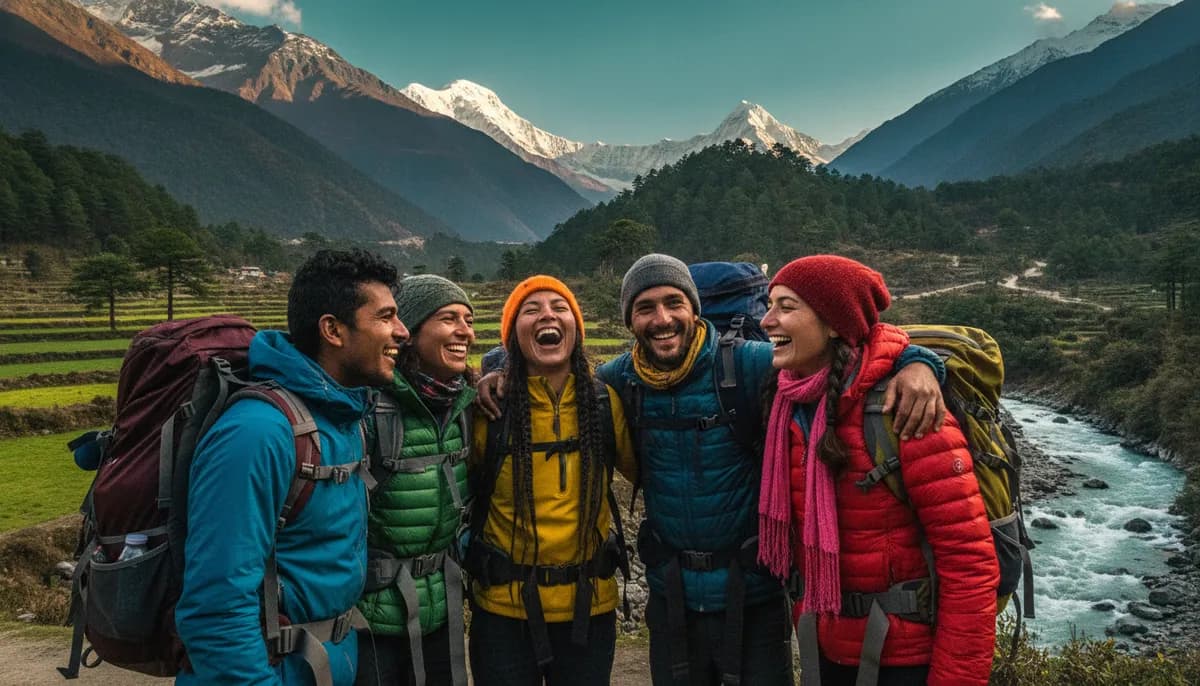
Self-Launched Annapurna Circuit Trek (17 Days)
17 days · Annapurna Circuit, Nepal
Much Better Adventures charges £1,450
No-markup version: ~£1,150 per person
Estimate only, not a guaranteed price. Always verify costs independently before booking.
A self-launched version of the classic 17-day Annapurna Circuit trek: Kathmandu to Tal, up the Marshyangdi valley, a Tilicho Lake detour, over Thorong La (5,416m) and down to Jomsom, then Pokhara and back to Kathmandu. Instead of a guided group, you travel independently using public buses, shared jeeps and local flights, sleep in teahouses and hire a porter or guide locally only if you want one. Permits (ACAP + TIMS) are easy to arrange yourself in Kathmandu. Costs are approximate and exclude international flights. Note: itinerary assumes the standard route; check current trail/road conditions (Prithvi Highway repairs, landslide risk) before setting off.
Day-by-day
Kathmandu arrivals and permit prep
Kathmandu
Fly into Tribhuvan International Airport and take a prepaid taxi or local ride-share to Thamel (~£4-6). Check into a budget guesthouse or hostel in Thamel. In the afternoon, sort your trekking permits: get the ACAP permit at the Nepal Tourism Board office (Bhrikutimandu) and the TIMS card there too — bring 2 passport photos and copies of your passport, roughly £30-35 total. Rent or buy any gear you're missing in Thamel's gear shops (down jacket ~£2/day, sleeping bag ~£2/day). Have an early dinner — dal bhat or momos for £3-5.
🚌Prepaid taxi from airport (~£4-6)
🛏Budget guesthouse in Thamel (dorm or twin, £10-15)
- →Collect ACAP and TIMS permits at Nepal Tourism Board
- →Gear rental in Thamel
- →Explore Thamel streets and Asan market
Long bus to Besisahar
Besisahar
Take an early tourist bus from Kathmandu's Gongabu (Machhapokhari) bus park to Besisahar, roughly 7-9 hours, ~£6-9. If the Prithvi Highway is still under repair near Krishna Bhir, expect an alternative route adding 2-3 hours. Stay in a simple guesthouse in Besisahar (~£8-12) and eat a cheap local dinner. Buy any last snacks here.
🚌Tourist bus Kathmandu to Besisahar (~£6-9)
🛏Guesthouse in Besisahar (£8-12)
- →Scenic bus journey through river valleys
- →Overnight in Besisahar
Shared jeep to Dharapani, hike to Bagarchhap
Bagarchhap
Take a shared jeep from Besisahar to Dharapani (~4-5 hours, ~£8-12) — this saves a long road walk. Permit check at Dharapani. Then hike ~2 hours (4 miles) on the jeep track and forest trail along the Marshyangdi River to Bagarchhap (2,160m). Check into your first teahouse. ~£8-10 for a room including dinner usually, and budget £4-6 for food. Shower and charging cost an extra £1-3 each.
🚌Shared jeep Besisahar-Dharapani (~£8-12)
🛏Teahouse in Bagarchhap (twin, £6-9)
- →Shared jeep ride to Dharapani
- →Afternoon hike to Bagarchhap
- →First teahouse night
Bagarchhap to Chame
Chame
Hike ~6 hours (9 miles) up past a small waterfall, through rhododendron and oak forest to Timang village for lunch with views of Manaslu Peak, then gently on through Thanchok and Koto to Chame (2,670m). Walk independently, following the well-marked trail — or hire a local guide in Besisahar/Kathmandu (~£15-25/day) if you'd rather have company and route help. Teahouse night in Chame.
🚌On foot
🛏Teahouse in Chame (£6-9)
- →Trek Bagarchhap to Chame
- →Manaslu views from Timang
Chame to Upper Pisang
Upper Pisang
Climb above 3,000m today. Cross the Marshyangdi River, pass a chorten, and follow the undulating forest trail to Bhratang, then up to Dhikur Pokhari for lunch with Swargadwari rock formation on your right. The valley widens and vegetation thins as you reach Upper Pisang (3,300m). ~6 hours, 9 miles. Stay in a teahouse; keep warm layers handy.
🚌On foot
🛏Teahouse in Upper Pisang (£6-9)
- →Trek Chame to Upper Pisang
- →Bhratang waterfall viewpoint
Upper Pisang to Manang via Ghyaru
Manang
The long day: ~8-9 hours, 14 miles. Take the high route through Ghyaru (there's a remote Tibetan monastery near the start of the climb) then roll through arid landscapes to Ngawal for lunch, and continue to Manang (3,540m). This is the biggest village on the circuit — expect more teahouse choice and slightly higher prices. Total ~£9-12 for room and food.
🚌On foot
🛏Teahouse in Manang (£7-10)
- →High route via Ghyaru and Ngawal
- →Monastery visit
- →Arrive in Manang
Acclimatisation day in Manang
Manang
A essential rest day. Wander the old alleys, drink smoky chai, and do an optional short walk to Gangapurna Lake or visit the Himalayan Rescue Association post for their free altitude talk (usually 3pm daily — genuinely worth it). If you want expert backup, you can pay for a HRA consultation (~£10-20) if feeling unwell. Costs today are just food and a teahouse (~£12-15).
🚌On foot
🛏Teahouse in Manang (£7-10)
- →Gangapurna Lake walk
- →Himalayan Rescue Association altitude talk
- →Explore Manang old town
Manang to Sri Kharka
Sri Kharka
~5 hours, 5 miles, via barley and buckwheat fields, a suspension bridge over the Thorang Khola, and juniper forest to Khangsar, then up to Sri Kharka (3,880m). The low oxygen makes the climb feel harder — go slowly. Teahouse night, hot meal, early bed.
🚌On foot
🛏Teahouse in Sri Kharka (£7-10)
- →Trek via Khangsar to Sri Kharka
Tilicho Base Camp
Tilicho Base Camp
~3-4 hours, 4 miles to Tilicho Base Camp (4,150m) along a stretch with a landslide scar and exposed rocky slope — check conditions locally with teahouse owners and other trekkers before committing; in winter (Jan-Mar) it may be closed. If conditions look doubtful, many independent trekkers skip the Tilicho detour and go straight to Yak Kharka. Teahouse at Base Camp.
🚌On foot
🛏Teahouse at Tilicho Base Camp (£8-11)
- →Hike to Tilicho Base Camp
- →High-altitude stargazing
Tilicho Lake and back to Sri Kharka
Sri Kharka
Start before dawn with a headlamp, ~9-10 hours and 11 miles round trip: up to Tilicho Lake (4,920m), one of the highest lakes in the world, back to Base Camp for breakfast, then descend to Sri Kharka. Take it slowly on the descent — knees and altitude both bite. Teahouse in Sri Kharka.
🚌On foot
🛏Teahouse in Sri Kharka (£7-10)
- →Sunrise hike to Tilicho Lake
- →Descend to Sri Kharka
Sri Kharka to Yak Kharka
Yak Kharka
~5 hours, 7 miles: climb past Old Khangsar ruins, up through pastures (look for yaks), then drop to the Thorang Khola and rejoin the main circuit to Yak Kharka (4,050m). Teahouse night — prices creep up with altitude, budget £10-14 for room plus dinner and breakfast.
🚌On foot
🛏Teahouse in Yak Kharka (£8-11)
- →Trek to Yak Kharka
- →Old Khangsar ruins
Approach to Thorong Phedi
Thorong Phedi
~4-5 hours, 4 miles past Ledar village and across the Thorang Khola to Thorong Phedi (4,450m). Go slow — the altitude is the challenge, not the distance. Get an early night; confirm the weather forecast with your teahouse owner and other trekkers (they're the best source of trail news on the pass).
🚌On foot
🛏Teahouse at Thorong Phedi (£9-12)
- →Trek to Thorong Phedi Base Camp
Thorong La (5,416m) to Muktinath
Muktinath
The big one: leave around 4am, climb past High Camp to Thorong La (5,416m) — the highest navigable pass in the world — then descend 1,600m to Muktinath (3,760m). ~10-12 hours, 11 miles. Watch for signs of altitude sickness and turn back if needed. In Muktinath visit the Vishnu temple; there are also hot springs at nearby Chumig Gyatsa if you need them. Note: from Phedi or High Camp you can also hire a jeep to Muktinath if the pass is closed or you're not feeling it — this is a legitimate Plan B that independent trekkers use all the time.
🚌On foot (optional shared jeep backup against payment)
🛏Teahouse/guesthouse in Muktinath (£9-12)
- →Cross Thorong La pass at sunrise-ish
- →Muktinath Vishnu temple
- →Optional hot springs
Descend to Jomsom via Kagbeni
Jomsom
~6 hours, 11 miles downhill to Kagbeni along the Kali Gandaki, the world's deepest gorge, then flat to Jomsom (2,720m). Big views of Annapurna and Dhaulagiri. Teahouse or guesthouse in Jomsom — this is the last mountain night. There are also shared jeeps from Muktinath to Jomsom if you want to save your legs (~£5-8).
🚌On foot
🛏Teahouse/guesthouse in Jomsom (£8-12)
- →Trek Kali Gandaki gorge to Kagbeni and Jomsom
- →Annapurna and Dhaulagiri views
Flight (or jeep) to Pokhara
Pokhara
Book a morning Jomsom-Pokhara flight directly with Tara Air or Yeti Airlines (roughly £60-80, buy a few days ahead) — in winter (mid-Nov to mid-Feb) flights often don't run, in which case take a shared jeep/bus via Beni (~7-8 hours, ~£10-15). Check into a lakeside guesthouse in Pokhara (£10-18) and take a walk along Phewa Lake. Celebration dinner for £5-8.
🚌Domestic flight Jomsom-Pokhara (~£60-80) or jeep/bus (~£10-15)
🛏Lakeside guesthouse in Pokhara (£10-18)
- →Jomsom-Pokhara flight or scenic jeep road
- →Lakeside stroll in Pokhara
Pokhara to Kathmandu
Kathmandu
Take a tourist bus from Pokhara to Kathmandu (~7-8 hours, ~£10-15) or, to skip the drive, a domestic flight (~£60-90 if booked ahead). Check back into a Thamel guesthouse (~£10-15) and spend the evening exploring. Optional extras if you have energy: a sunset visit to Swayambhunath (Monkey Temple) entrance ~£2.
🚌Tourist bus Pokhara-Kathmandu (~£10-15) or flight (~£60-90)
🛏Budget guesthouse in Thamel (£10-15)
- →Bus or flight back to Kathmandu
- →Optional Swayambhunath visit
Kathmandu culture and departure
Kathmandu
Sleep in, then use your free half-day for Boudhanath stupa (~£2 entrance) or Pashupatinath (~£6) — both walkable or a cheap taxi from Thamel. A self-booked half-day heritage tour via GetYourGuide costs ~£20-30 if you want a guide. Then head to the airport (taxi ~£4-6) for your flight out. Budget ~£25 for food and entries today.
🚌Taxi to airport (~£4-6)
🛏Departure day
- →Boudhanath stupa
- →Pashupatinath temple
- →Thamel shopping
Self-launched vs. Much Better Adventures
| This itinerary (self-launched) | Much Better Adventures | |
|---|---|---|
| Price per person | ~£1,150 | £1,450 |
| Duration | 17 days | 17 days |
| Who books it | You and your group, direct | Tour operator, guided group |
| Savings | £300 per person (21%) | |
Estimate only, not a guaranteed price. Always verify costs independently before booking.
Want to see more Much Better Adventures-style trips? Check them out here.~£1,150
estimated per person
You never pay Travel Crew for this — you pay hostels, transport, and activity providers directly, the same as if you'd booked it all yourself.
This publishes your dates so other travellers can find and join you — no tour operator needed.
Customise with Tour BusterCreated by

Travel Crew
0 trips
Frequently asked questions
How much does Self-Launched Annapurna Circuit Trek (17 Days) cost?+
Doing it yourself with this self-launched itinerary costs an estimated £1,150 per person for 17 days in Annapurna Circuit, Nepal. This is an AI-generated estimate based on typical budget-traveller prices — actual costs will vary by season and how you book.
Is this cheaper than booking with Much Better Adventures?+
Yes — Much Better Adventures charges around £1,450 per person for a similar tour. Doing the same route independently, using the same standard of accommodation and activities, costs an estimated £1,150 — a saving of roughly £300 (21%) per person.
How long is the Annapurna Circuit, Nepal trip?+
This itinerary runs 17 days, covering 17 day-by-day stops through Annapurna Circuit, Nepal.
How do I join this trip?+
You can join an existing open departure using this itinerary if one is scheduled, or launch your own departure with your own dates and invite other travellers to join you — no tour operator required.
Isn't it easier to just use a tour operator?+
Well, yes, a tour operator will book all the individual parts of your travel for you and provide a guide. That's obvious, but doing this has the potential to save the group thousands, which can in turn improve your itinerary substantially or save you huge amounts of money. Also, when you launch a departure, Travel Crew has tools in place to help you book the individual sections of the trip or make it easier for you to do this as a group. Really, you do not need a middle man. If you are more comfortable paying more and using a middle man, then you should certainly do this.
Is it safer to book through a tour operator?+
Arguably, there isn't much difference. A self-launched trip runs on the same principle as a group travel crew: collective responsibility, everyone looking out for each other, the same way it would if a group of friends organised the trip themselves — because that's exactly what's happening. You should always take out travel insurance before you go, self-launched or not; that doesn't change either way. Every open departure is published publicly with real dates and a real trip organiser, so it's never an anonymous arrangement, and our support team is reachable any time you need help, including in an emergency while you're away. Longer-term, we're building direct relationships with ground DMCs in popular destinations, offered as an optional paid add-on for extra on-the-ground support. Ultimately, though, the group is responsible for its own conduct and safety on a self-launched trip, same as on any trip you plan yourself.
What kind of trip is this?+
This is a adventure, hiking, budget trip through Annapurna Circuit, Nepal, self-launched rather than run by a tour operator — you organise it with a group you find or bring yourself.
Would you like to name the operator, name the trip, or have any suggestions about how to improve this itinerary?
Drop your comment below — if you've done a similar route, tell us what worked, what you'd add, or what you'd skip.
No comments yet — be the first to share your take.
Sign in to leave a comment.